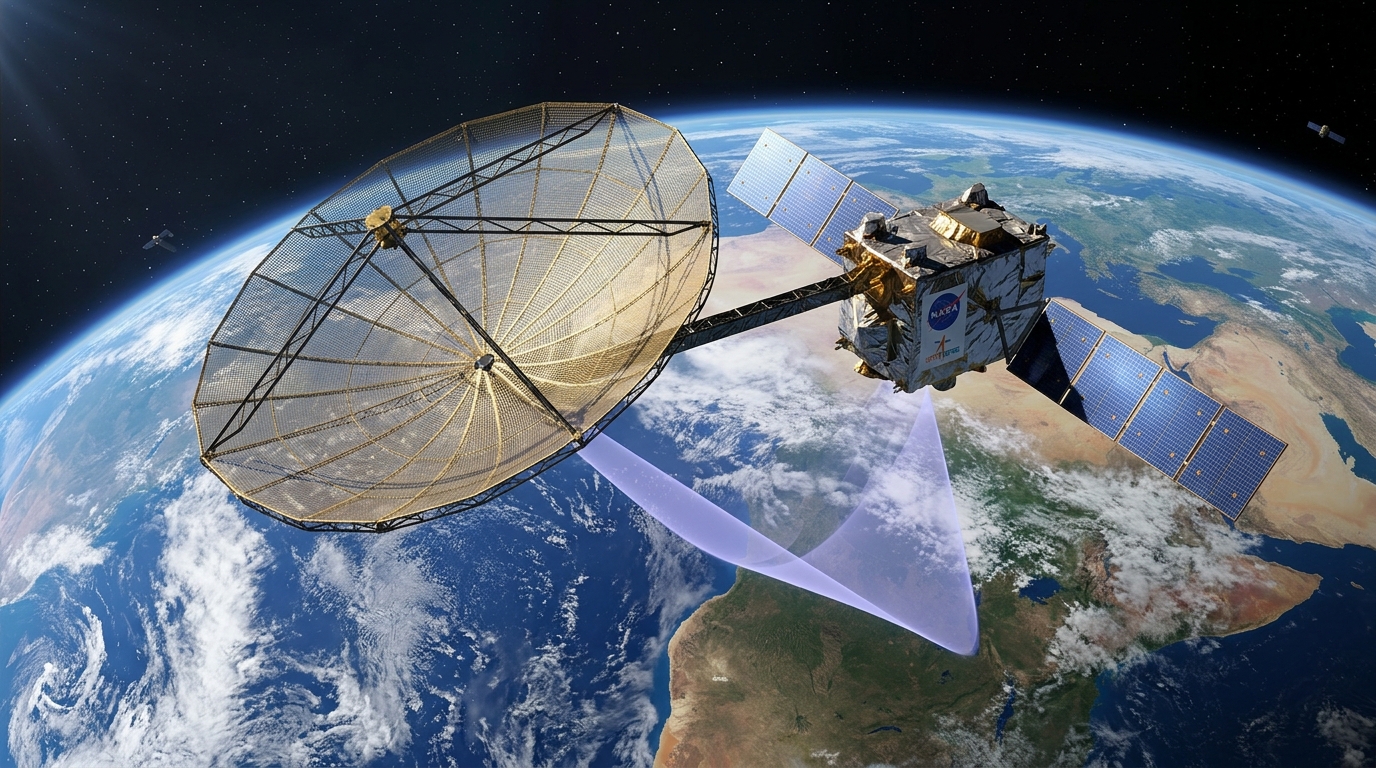
1. India Achieves Quantum Key Distribution Milestone Over Terrestrial Free-Space
The Department of Science and Technology (DST) has successfully demonstrated an unhackable Quantum Key Distribution (QKD) link over a metropolitan terrestrial free-space distance. This technological advancement utilizes the principles of quantum mechanics to secure cryptographic keys, ensuring absolute forward secrecy against unauthorized interception or quantum computing attacks. This milestone aligns closely with the objectives of the National Quantum Mission (NQM), positioning India among the elite global group of nations capable of indigenous secure quantum networks. The implementation has immense implications for safeguarding critical national infrastructure, military communications, and financial transaction networks from sophisticated cyber threats.
🎯 Key Exam Prelims Pointers:
- Nodal Ministry: Department of Science and Technology (DST), Ministry of Science and Technology.
- Core Policy Framework: National Quantum Mission (NQM) approved with a multi-year financial outlay.
- Core Mechanism: Relies on Heisenberg's Uncertainty Principle and photon polarization states to detect eavesdropping.
2. Reserve Bank of India Expands Programmable CBDC Pilot for Direct Welfare Transfers
The Reserve Bank of India (RBI) has widened the scope of the Central Bank Digital Currency (CBDC) Retail pilot by introducing programmable payment features for targeted welfare schemes. By utilizing smart contract architecture, the digital rupee can now be restricted for specific use-cases such as fertilizer subsidies, educational grants, or healthcare expenditures, ensuring cent-percent leak-proof execution. This mechanism prevents diversion and misuse of public funds while bypassing traditional intermediaries. The initiative underscores India's evolving fintech landscape, blending the sovereign backing of fiat currency with programmatic automation to enhance fiscal efficiency and financial inclusion.
🎯 Key Exam Prelims Pointers:
- Governing Statute: Reserve Bank of India Act, 1934.
- Technology Backend: Distributed Ledger Technology (DLT) coupled with conditional cryptographic smart contracts.
- Primary Objective: Target-specific fund utilization and elimination of leakages in social sector schemes.
3. Ministry of Environment Notifies Guidelines for Ecologically Sensitive Zones in Western Ghats
The Ministry of Environment, Forest and Climate Change (MoEFCC) has issued a revised comprehensive notification demarcating Ecologically Sensitive Areas (ESA) across the Western Ghats states. The framework prohibits high-impact industrial activities, large-scale mining, thermal power plants, and red-category polluting industries while balancing livelihood requirements of local hill communities. Based on the landmark Gadgil and Kasturirangan committee reports, the policy aims to protect the fragile biodiversity hotspot from anthropogenic pressures, mitigate extreme weather vulnerabilities, and preserve catchment areas of major peninsular river systems.
🎯 Key Exam Prelims Pointers:
- Nodal Ministry: Ministry of Environment, Forest and Climate Change (MoEFCC).
- Constitutional Mandate: Article 48A (Protection and improvement of environment and safeguarding of forests and wildlife).
- Statutory backing: Environment (Protection) Act, 1986.
4. India Successfully Tests Advanced Hypersonic Technology Demonstrator Vehicle
India's Defence Research and Development Organisation (DRDO) has successfully flight-tested the Advanced Hypersonic Technology Demonstrator Vehicle (HSTDV) powered by an air-breathing scramjet engine. Traveling at velocities exceeding Mach 5, the system demonstrated sustained hypersonic cruise flight, aerodynamic thermal management, and autonomous guidance systems under extreme atmospheric friction. This breakthrough significantly enhances India's strategic deterrent capabilities, placing it among a select group of nations possessing indigenous high-speed scramjet propulsion technology for advanced conventional and strategic defense applications.
🎯 Key Exam Prelims Pointers:
- Developing Agency: Defence Research and Development Organisation (DRDO).
- Key Propulsion System: Supersonic Combustion Ramjet (Scramjet) engine technology.
- Operational Threshold: Speeds greater than Mach 5 (five times the speed of sound).
📝 Daily Current Affairs MCQ Challenge
With reference to Quantum Key Distribution (QKD), which recently made news, consider the following statements: 1. It relies on the laws of quantum mechanics to ensure secure communication. 2. Any attempt by an eavesdropper to intercept the key necessarily disturbs the quantum states, alerting the communicating parties. Which of the statements given above is/are correct?
A) 1 only
B) 2 only
C) Both 1 and 2
D) Neither 1 nor 2
Click to View Answer & Explanation
Correct Answer: C) Both 1 and 2
Explanation: Both statements are correct. Quantum Key Distribution (QKD) uses quantum mechanics principles (such as photon polarization and Heisenberg's Uncertainty Principle) to generate shared, random secret keys known only to communicating parties. If a third party attempts to eavesdrop or measure the photons, the quantum state collapses or gets altered, which introduces detectable anomalies, thereby securing the system against undetected breaches.


Comments & Reviews
Tap stars to rate this page: