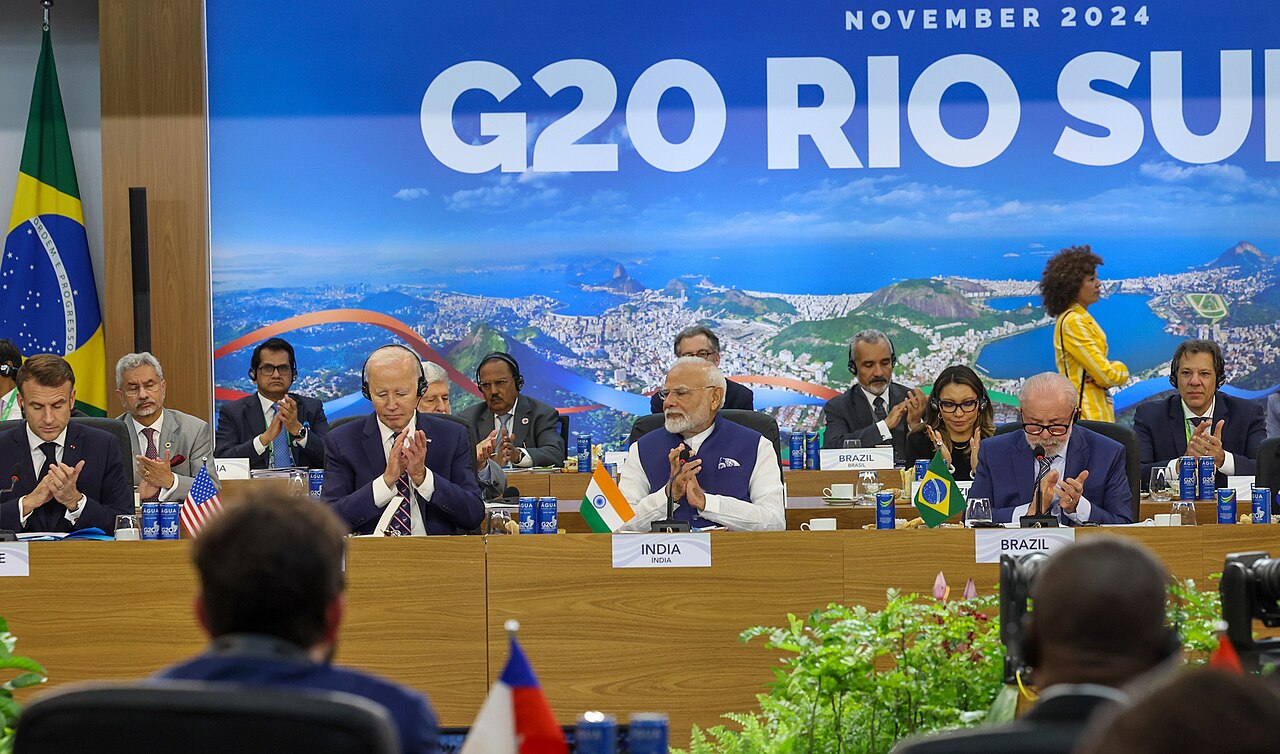
1. Formal Launch of the Global Alliance Against Hunger and Poverty at G20 Rio Summit
At the 19th G20 Leaders' Summit in Rio de Janeiro, Brazil, the Global Alliance Against Hunger and Poverty was formally launched under the Brazilian G20 presidency, with India joining as a founding member. The multilateral initiative aims to mobilize coordinated financial resources and scale proven policy instruments—including targeted school feeding programs, cash transfers, and climate-resilient agriculture—to accelerate progress toward UN Sustainable Development Goals 1 (No Poverty) and 2 (Zero Hunger). India highlighted its domestic welfare architecture, particularly the Pradhan Mantri Garib Kalyan Anna Yojana (PMGKAY) and the Aadhaar-enabled Direct Benefit Transfer (DBT) system, as scalable global models for food security and social safety delivery.
🎯 Key Exam & Knowledge Points:
- Founding Mandate: Championed by the Brazilian G20 presidency to eradicate hunger by 2030 in alignment with SDGs 1 and 2.
- Operational Framework: Structured around policy 'baskets' supported by multilateral development banks (MDBs), international donors, and technical knowledge exchange.
- India's Contribution: Showcasing Digital Public Infrastructure (DPI)-backed welfare distribution and the world's largest food security safety net.
2. ISRO and ESA Complete Final Readiness for Proba-3 High-Precision Formation Flying Mission
The Indian Space Research Organisation (ISRO) and the European Space Agency (ESA) reached the final pre-launch stage for the joint Proba-3 mission, scheduled for lift-off aboard the PSLV-XL rocket from the Satish Dhawan Space Centre (SDSC-SHAR), Sriharikota. Proba-3 comprises two separate spacecraft—an 'Occulter' satellite and a 'Coronagraph' satellite—that will fly in millimetre-precision formation 144 metres apart. By precisely blocking the dazzling solar disk, the Occulter enables continuous, high-resolution scientific observations of the Sun's faint outer atmosphere (the solar corona), illuminating coronal mass ejections (CMEs) and solar wind dynamics that drive space weather.
🎯 Key Exam & Knowledge Points:
- Launch Vehicle: Polar Satellite Launch Vehicle in its 'XL' extended booster configuration (PSLV-XL).
- Key Scientific Objective: Studying the solar corona down to 1.08 solar radii, bridging the observational gap between space coronagraphs and ground-based total solar eclipses.
- Technological Breakthrough: World's first precision formation flying mission controlled via laser metrology and relative GPS positioning.
3. Observance of World Toilet Day 2026: Accelerating Swachh Bharat Mission (Grameen) Phase-II
Marking World Toilet Day on 19 November—established by the United Nations to focus on sanitation equity under SDG 6 (Clean Water and Sanitation)—the Department of Drinking Water and Sanitation (Ministry of Jal Shakti) released progress indicators for the Swachh Bharat Mission (Grameen) Phase-II. The mission has transitioned from basic Open Defecation Free (ODF) status to comprehensive ODF Plus Model villages, prioritizing Solid and Liquid Waste Management (SLWM), faecal sludge management (FSM), and greywater recycling. India’s rural sanitation drive continues to serve as an international benchmark for preventive public health and community dignity.
🎯 Key Exam & Knowledge Points:
- Global Observance: Designated on 19 November annually under UN General Assembly Resolution 67/291 since 2013.
- Sustainable Development Goal: Direct target of SDG 6.2 (achieving access to adequate and equitable sanitation and hygiene for all).
- Policy Evolution: SBM-G Phase-II focuses on ODF sustainability and visual cleanliness through decentralized waste treatment.
4. COP29 Climate Summit in Baku: Developing Nations Push for Robust 'NCQG' Finance Delivery
Negotiations at the 29th UN Climate Change Conference (COP29) in Baku, Azerbaijan, reached a crucial juncture regarding the adoption of the New Collective Quantified Goal (NCQG) on climate finance. Replacing the outdated \$100 billion annual target established in 2009, developing economies, including the Like-Minded Developing Countries (LMDC) and the G77+China coalition, called for at least \$1 trillion annually in public, grant-equivalent, and non-debt-creating finance. India reaffirmed the foundational principle of Common But Differentiated Responsibilities and Respective Capabilities (CBDR-RC), urging developed nations to fulfill historical climate obligations without shifting fiscal burdens onto the Global South.
🎯 Key Exam & Knowledge Points:
- Legal Foundation: Mandated under Article 9 of the Paris Agreement (2015) to set a new post-2025 financial commitment.
- Core Diplomatic Principle: CBDR-RC and Equity enshrined in the United Nations Framework Convention on Climate Change (UNFCCC).
- Key Demand: Prioritizing concessional grant funding for adaptation and loss & damage over debt-inducing commercial loans.
5. Rani Lakshmibai Birth Anniversary: Commemorating Valour and Expanding Women in Frontline Defence
On 19 November, India commemorates the birth anniversary of Rani Lakshmibai of Jhansi (born 19 November 1828 in Varanasi as Manikarnika Tambe), a legendary heroine of the Indian Rebellion of 1857. The day was marked by the Ministry of Defence with policy milestones expanding permanent commission and combat deployment for women officers across the Indian Army, Navy, and Air Force. Historical tributes highlighted her legendary resistance against the British East India Company's annexations under Lord Dalhousie's Doctrine of Lapse, cementing her legacy as an enduring symbol of national sovereignty and anti-colonial resistance.
🎯 Key Exam & Knowledge Points:
- Historical Trigger: Jhansi was annexed in 1854 under the Doctrine of Lapse after the death of Maharaja Gangadhar Rao.
- Decisive Battle: Rani Lakshmibai fought alongside Tatya Tope and achieved martyrdom near Kotah-ki-Serai (Gwalior) on 18 June 1858 against British forces led by Sir Hugh Rose.
- Famous Tribute: British commander Sir Hugh Rose described her as "the only man among the rebels."
6. RBI Reviews Scale-Based Regulation (SBR) Metrics for Non-Banking Financial Companies (NBFCs)
The Reserve Bank of India (RBI) released its updated supervisory review assessing the impact of the Scale-Based Regulation (SBR) framework on Non-Banking Financial Companies (NBFCs). The SBR architecture classifies NBFCs into four tiers based on size, interconnectedness, and systemic significance: Base Layer, Middle Layer, Upper Layer, and Top Layer. The review highlighted enhanced capital adequacy ratios (CRAR), tighter exposure norms, and mandatory Chief Risk Officer (CRO) appointments, which have significantly bolstered balance-sheet resilience against systemic liquidity shocks while sustaining credit flow to MSMEs and retail borrowers.
🎯 Key Exam & Knowledge Points:
- Regulatory Architecture: Implemented following systemic fallout from major shadow-banking stresses to align regulations with commercial banks.
- Four-Tier Structure: Base Layer (asset size < ₹1,000 crore), Middle Layer, Upper Layer (top systemic NBFCs subjected to bank-like prudential norms), and Top Layer (reserve tier).
- Prudential Focus: Harmonized Non-Performing Asset (NPA) classification and Common Equity Tier 1 (CET-1) capital mandates for Upper Layer entities.
📝 Daily Current Affairs Practice Quiz (6 Questions)
Q1. With reference to the 'Global Alliance Against Hunger and Poverty' launched at the G20 Rio Summit, consider the following statements: 1. The alliance was formally launched as a flagship initiative under the Brazilian G20 presidency. 2. Its primary multilateral mandate is tied directly to the achievement of UN Sustainable Development Goals (SDG) 1 and 2. 3. Participation in the alliance is strictly restricted to G20 member countries and bars non-G20 nations. Which of the statements given above are correct?
A) 1 and 2 only
B) 1 and 3 only
C) 2 and 3 only
D) 1, 2 and 3
Show Answer & Explanation
Correct Answer: A) 1 and 2 only
Explanation: Statements 1 and 2 are correct. Statement 3 is incorrect because the Global Alliance is open to all countries, international organizations, financial institutions, and philanthropic foundations worldwide, not just G20 members.
Q2. In the joint ISRO-ESA Proba-3 mission, what is the primary scientific purpose of flying two separate satellites in precision formation 144 metres apart?
A) To create an artificial solar eclipse in space to observe the Sun's faint outer corona
B) To measure lunar gravitational anomalies with twin laser interferometers
C) To detect low-frequency gravitational waves from colliding neutron stars
D) To map terrestrial ocean salinity and polar ice sheet thickness
Show Answer & Explanation
Correct Answer: A) To create an artificial solar eclipse in space to observe the Sun's faint outer corona
Explanation: The Occulter satellite precisely casts a shadow on the Coronagraph satellite 144 metres behind it, blocking out the solar disk to allow continuous imaging of the inner solar corona.
Q3. World Toilet Day is observed annually on 19 November across the globe to promote which specific United Nations Sustainable Development Goal (SDG)?
A) SDG 3 (Good Health and Well-being)
B) SDG 6 (Clean Water and Sanitation)
C) SDG 11 (Sustainable Cities and Communities)
D) SDG 13 (Climate Action)
Show Answer & Explanation
Correct Answer: B) SDG 6 (Clean Water and Sanitation)
Explanation: UN World Toilet Day (19 November) specifically supports SDG target 6.2, which calls for universal access to adequate sanitation and hygiene and ending open defecation.
Q4. The 'New Collective Quantified Goal' (NCQG) frequently discussed in UNFCCC COP negotiations is primarily concerned with:
A) Setting a new post-2025 global climate finance mobilization target from developed to developing countries
B) Establishing global limits on industrial production of hydrofluorocarbons (HFCs)
C) Defining uniform national biodiversity conservation quotas for terrestrial reserves
D) Standardizing international carbon credit trading registries under Article 6
Show Answer & Explanation
Correct Answer: A) Setting a new post-2025 global climate finance mobilization target from developed to developing countries
Explanation: Mandated under the 2015 Paris Agreement, the NCQG sets a new global climate finance target to succeed the previous \$100 billion per year baseline post-2025.
Q5. Under which British colonial policy was the princely state of Jhansi annexed by the East India Company in 1854, triggering Rani Lakshmibai's leadership in the 1857 Rebellion?
A) Subsidiary Alliance System
B) Policy of Ring Fence
C) Doctrine of Lapse
D) Permanent Settlement System
Show Answer & Explanation
Correct Answer: C) Doctrine of Lapse
Explanation: Governor-General Lord Dalhousie annexed Jhansi in 1854 under the Doctrine of Lapse after refusing to recognize the adopted heir, Damodar Rao, following Maharaja Gangadhar Rao's demise.
Q6. Under the Reserve Bank of India's Scale-Based Regulation (SBR) framework for NBFCs, which layer encompasses non-banking financial entities with asset size below ₹1,000 crore?
A) Base Layer
B) Middle Layer
C) Upper Layer
D) Top Layer
Show Answer & Explanation
Correct Answer: A) Base Layer
Explanation: In the RBI SBR framework, the Base Layer comprises non-deposit taking NBFCs below the asset size of ₹1,000 crore, peer-to-peer (P2P) lending platforms, and account aggregators.


Comments & Reviews
Tap stars to rate this page: