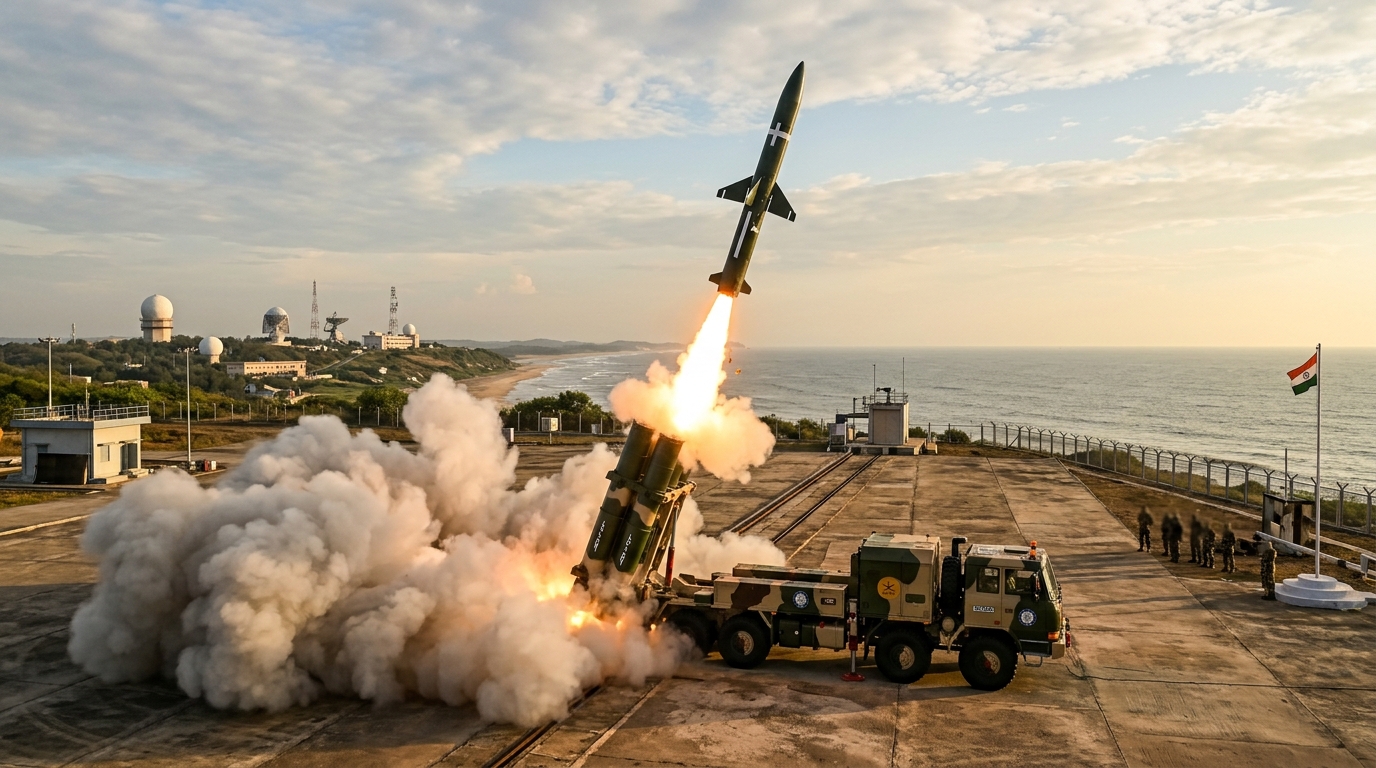
1. DRDO Successfully Flight-Tests Indigenous Long-Range Land Attack Cruise Missile (LRLACM)
The Defence Research and Development Organisation (DRDO) has achieved a major milestone in standoff precision-strike deterrence by successfully conducting the maiden flight-test of the Long-Range Land Attack Cruise Missile (LRLACM) from a mobile articulated launcher at the Integrated Test Range (ITR), Chandipur, off the coast of Odisha. Engineered by the Aeronautical Development Establishment (ADE), Bengaluru, alongside multi-laboratory DRDO centers and private defense partners, the missile demonstrated exceptional low-altitude sea-skimming and terrain-hugging maneuvers to evade enemy air defense radars.
Propelled by an indigenous small turbofan engine and guided by advanced satellite-aided navigation combining GPS and India's sovereign NavIC constellation, the missile achieved pinpoint terminal accuracy utilizing an active Radio Frequency (RF) and electro-optical seeker. The LRLACM is designed for deployment across both naval warships via universal vertical launch modules and ground-based mobile strike batteries, strengthening India's conventional long-range deterrence architecture.
🎯 Key Exam Prelims Pointers:
- Developing Agency: Developed primarily by DRDO's Aeronautical Development Establishment (ADE), Bengaluru, with industry partners.
- Guidance & Navigation: Incorporates INS/GPS/NavIC with Terrain Contour Matching (TERCOM) and Digital Scene Matching Area Correlation (DSMAC) for jam-resistant terminal homing.
- Launch Platform Versatility: Multi-platform capability capable of being launched from frontline naval surface combatants and mobile ground-based transporter erector launchers (TEL).
2. Ministry of Health Operationalizes National Portal for Rare Diseases (NPRD)
The Union Ministry of Health and Family Welfare (MoHFW) has operationalized the upgraded National Portal for Rare Diseases (NPRD) to streamline financial assistance and digital crowd-funding under the National Policy for Rare Diseases (NPRD), 2021. Under the revamped framework, eligible patients suffering from specified rare conditions can receive financial support of up to ₹50 lakh for curative treatment across designated Centres of Excellence (CoEs), irrespective of their socio-economic or BPL status.
Rare diseases, while individually having low prevalence, collectively afflict an estimated 70 to 96 million citizens across India, with over 80% having genetic origins. The portal integrates an online crowd-funding mechanism that empowers corporate donors under Corporate Social Responsibility (CSR), philanthropic foundations, and global donors to contribute directly toward individualized patient therapy accounts at certified CoEs.
🎯 Key Exam Prelims Pointers:
- Statutory Policy: Governed under the National Policy for Rare Diseases (NPRD), 2021; overseen by the Ministry of Health and Family Welfare.
- Financial Entitlement: Up to ₹50 lakh assistance per patient provided at notified Centres of Excellence (CoEs), removing prior income caps.
- Disease Classification: Categorized into three tiers—Group 1 (one-time curative treatment), Group 2 (long-term/lifelong manageable care), and Group 3 (high-cost lifelong therapies like Gaucher, Pompe, and MPS).
3. IWAI Operationalizes Eastern Waterways Connectivity Transport Grid
The Inland Waterways Authority of India (IWAI), under the Ministry of Ports, Shipping and Waterways, has operationalized scheduled commercial cargo movement along the Eastern Waterways Connectivity Transport Grid (EWCTG). This strategic corridor links National Waterway 1 (NW-1 on the Ganga-Bhagirathi-Hooghly system) directly to National Waterway 2 (NW-2 on the Brahmaputra) through the bilateral Indo-Bangladesh Protocol (IBP) Route.
By connecting Haldia and Kolkata ports with Pandu (Guwahati) and Dhubri in Assam via protocol waterways in Bangladesh (Narayanganj, Sirajganj, and Ashuganj), the inland transit bypasses the congested 22-km-wide Siliguri Corridor ('Chicken's Neck'). This multimodal grid slashes cargo transit distance by over 1,000 kilometers, lowers inter-state logistics costs by 35%, and curtails freight carbon footprint in alignment with the PM Gati Shakti National Master Plan.
🎯 Key Exam Prelims Pointers:
- Statutory Authority: IWAI was established under the Inland Waterways Authority of India Act, 1985; headquarters in Noida, UP.
- Key Waterway Corridors: NW-1 extends from Prayagraj to Haldia (1,620 km, Ganga); NW-2 extends from Sadiya to Dhubri (891 km, Brahmaputra).
- International Treaty Basis: Governed by the Protocol on Inland Water Transit and Trade (PIWTT) between India and Bangladesh, operational since 1972.
4. COP Negotiators Finalize Operational Modalities for Loss and Damage Fund
Negotiators at the United Nations Framework Convention on Climate Change (UNFCCC) Conference of the Parties (COP) have locked the institutional hosting and governance structure of the Loss and Damage Fund (LDF), advancing the landmark consensus initially adopted at COP27 (Sharm el-Sheikh) and COP28 (Dubai). The Fund has officially commenced operations under an independent multilateral Board, with the World Bank serving as the interim trustee and Financial Intermediary Fund (FIF) host for a four-year mandate.
The facility is designed to deliver direct, grant-based climate finance to the most vulnerable developing nations grappling with both rapid-onset climate disasters (tropical cyclones, flash floods) and slow-onset environmental degradation (sea-level rise, glacial lake outbursts, salinization, and desertification). Developing nations underscored the foundational UNFCCC principle of Common But Differentiated Responsibilities and Respective Capabilities (CBDR-RC), calling for scaled-up mandatory capital contributions from historical Annex-I emitters.
🎯 Key Exam Prelims Pointers:
- Genesis: Formally established under Article 8 of the Paris Agreement, operationalized through COP27 and COP28 decisions.
- Interim Host: World Bank functions as the Financial Intermediary Fund (FIF) trustee for an initial 4-year transition period under an independent governing Board.
- Technical Assistance Network: Supported by the Santiago Network for Loss and Damage, which channels specialized technical expertise to vulnerable countries.
5. India-Australia 2+2 Ministerial Dialogue Strengthens Indo-Pacific Maritime & Minerals Pact
India and Australia concluded the high-level 2+2 Ministerial Dialogue in New Delhi, co-chaired by their respective Ministers of External Affairs and Defence. The bilateral consultations focused on deepening maritime domain awareness (MDA) across the Indian Ocean and South Pacific, expanding interoperability between the Indian Navy and Royal Australian Navy, and accelerating joint critical mineral processing.
Both nations reviewed the operationalization of the Mutual Logistics Support Agreement (MLSA), enabling reciprocal access to defense bases, refueling facilities, and collaborative aerial surveillance deployments using P-8 maritime patrol aircraft. Crucially, the leaders signed a bilateral implementation agreement under the Critical Minerals Investment Partnership to co-develop lithium, cobalt, and rare earth processing facilities in Australia, securing sovereign clean-tech supply chains under the Quad Critical Minerals Initiative.
🎯 Key Exam Prelims Pointers:
- 2+2 Dialogue Framework: India currently holds 2+2 ministerial dialogues with five key partners: USA, Russia, Japan, Australia, and the United Kingdom.
- Key Defense Agreements: Governed by the Comprehensive Strategic Partnership (2020), MLSA, and regular joint drills including Exercise MALABAR, AUSINDEX, and Pitch Black.
- Trade Architecture: Economic ties are propelled by the Economic Cooperation and Trade Agreement (ECTA), with negotiations ongoing for the Comprehensive Economic Cooperation Agreement (CECA).
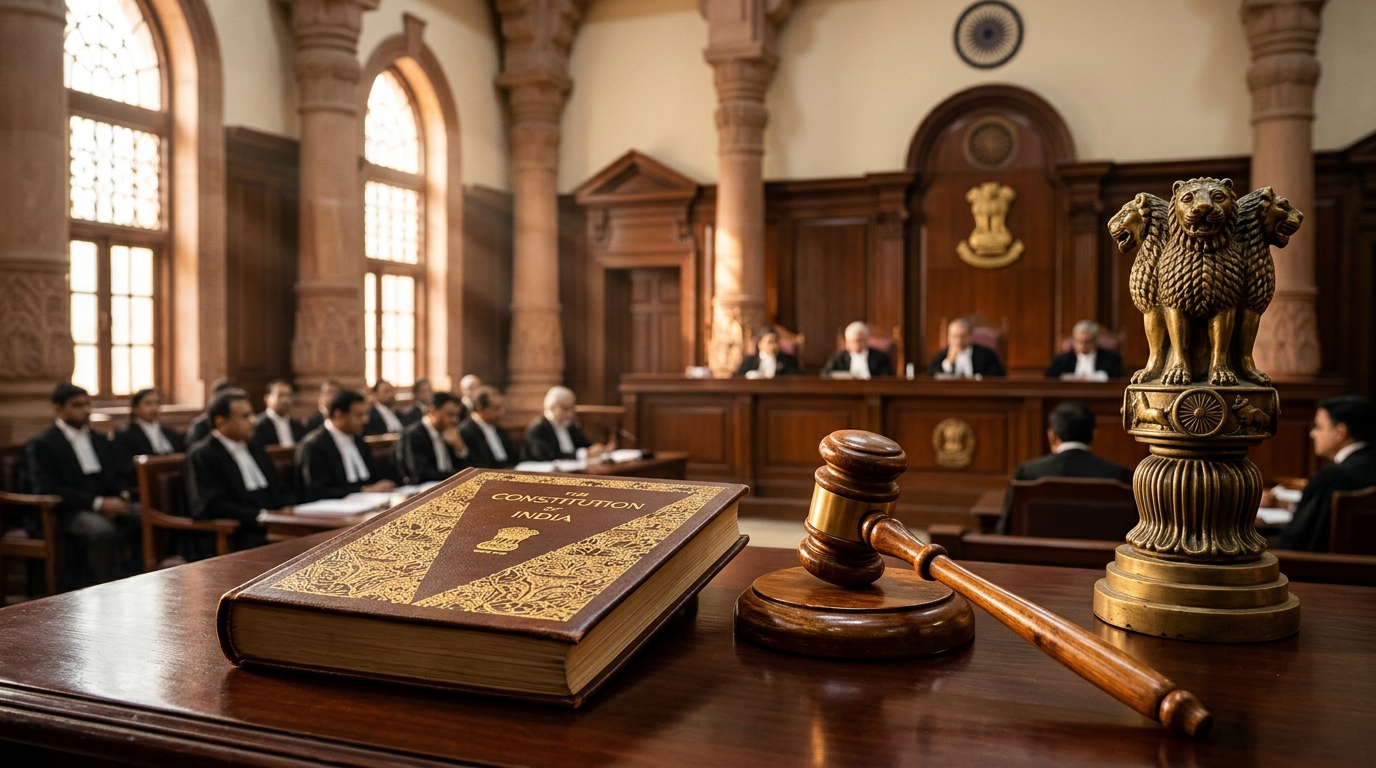
6. Supreme Court Bench Reaffirms Article 300A: Right to Property as a Human Right
A Constitution Bench of the Supreme Court of India has delivered a landmark ruling clarifying the constitutional jurisprudence surrounding the Right to Property under Article 300A of the Constitution. The apex court held that while the right to property ceased to be a Fundamental Right following the 44th Constitutional Amendment Act, 1978, it remains an essential constitutional and recognized human right under the rule of law.
The Bench ruled that the State cannot forcibly dispossess private citizens of their land or assets without strict compliance with established statutory procedures, demonstrable public purpose, and just and fair compensation. Furthermore, the Court authoritatively ruled that the State cannot invoke the legal doctrine of adverse possession against its own citizens to legitimize unauthorized occupation of private property, emphasizing that democratic governance demands high fiduciary integrity.
🎯 Key Exam Prelims Pointers:
- Constitutional Status: Originally placed under Part III (Articles 19(1)(f) and 31); relocated to Chapter IV of Part XII as Article 300A by the 44th Constitutional Amendment Act, 1978.
- Nature of Right: Article 300A provides that "No person shall be deprived of his property save by authority of law"; recognized judicially as a constitutional and human right.
- Doctrine of Adverse Possession: The Supreme Court firmly barred the State from claiming ownership of private lands through adverse possession, protecting citizens against unlawful state expropriation.
📝 Daily Current Affairs Practice Quiz (6 High-Yield Questions)
Q1. With reference to the Long-Range Land Attack Cruise Missile (LRLACM) recently tested by India, consider the following statements: 1. It is an indigenous supersonic cruise missile developed as a successor to the BrahMos missile system. 2. It is equipped with terrain contour matching (TERCOM) and NavIC-aided satellite navigation for terminal precision. 3. The missile can be launched from both naval vertical launch systems and mobile ground launchers. Which of the statements given above are correct?
A) 1 and 2 only
B) 2 and 3 only
C) 1 and 3 only
D) 1, 2 and 3
Show Answer & Explanation
Correct Answer: B) 2 and 3 only
Explanation: Statement 1 is incorrect because LRLACM is a subsonic (not supersonic) cruise missile propelled by an indigenous small turbofan engine. Statements 2 and 3 are correct: it utilizes INS, NavIC, TERCOM, and DSMAC for terminal guidance and features multi-platform launch capability across naval vessels and mobile Transporter Erector Launchers (TEL).
Q2. Under the National Policy for Rare Diseases (NPRD), 2021, what is the maximum financial assistance provided per patient for treatment at designated Centres of Excellence (CoEs)?
A) ₹15 Lakh
B) ₹20 Lakh
C) ₹50 Lakh
D) ₹1 Crore
Show Answer & Explanation
Correct Answer: C) ₹50 Lakh
Explanation: Under the revised provisions of the National Policy for Rare Diseases (NPRD), 2021, financial assistance of up to ₹50 lakh per patient is provided for curative treatment across notified Centres of Excellence (CoEs), irrespective of the patient's economic background.
Q3. The Eastern Waterways Connectivity Transport Grid (EWCTG) links which two National Waterways of India via the Indo-Bangladesh Protocol Route?
A) National Waterway 1 and National Waterway 2
B) National Waterway 1 and National Waterway 3
C) National Waterway 2 and National Waterway 4
D) National Waterway 4 and National Waterway 5
Show Answer & Explanation
Correct Answer: A) National Waterway 1 and National Waterway 2
Explanation: The Eastern Waterways Connectivity Transport Grid directly connects National Waterway 1 (Ganga-Bhagirathi-Hooghly system from Prayagraj to Haldia) with National Waterway 2 (Brahmaputra from Sadiya to Dhubri) via the Indo-Bangladesh Protocol (IBP) waterways.
Q4. With reference to the Loss and Damage Fund (LDF) operationalized under the UNFCCC, consider the following statements: 1. It was initially established through consensus reached at COP27 in Sharm el-Sheikh. 2. The International Monetary Fund (IMF) has been appointed as the permanent sovereign trustee of the fund. 3. It aims to finance both extreme weather events and slow-onset climate phenomena like sea-level rise. Which of the statements given above are correct?
A) 1 and 2 only
B) 1 and 3 only
C) 2 and 3 only
D) 1, 2 and 3
Show Answer & Explanation
Correct Answer: B) 1 and 3 only
Explanation: Statement 2 is incorrect because the World Bank (not IMF) serves as the interim host and Financial Intermediary Fund (FIF) trustee for an initial 4-year transition period under an independent governing Board. Statements 1 and 3 are correct.
Q5. With how many countries does India currently hold regular 2+2 Ministerial Dialogues involving Defence and Foreign Ministers?
A) 3
B) 4
C) 5
D) 7
Show Answer & Explanation
Correct Answer: C) 5
Explanation: India conducts 2+2 Ministerial Dialogues (Foreign and Defence Ministers meeting jointly) with five strategic partner nations: the United States, Russia, Japan, Australia, and the United Kingdom.
Q6. The Right to Property was removed from Part III (Fundamental Rights) and made a constitutional right under Article 300A by which Constitutional Amendment Act?
A) 42nd Constitutional Amendment Act, 1976
B) 44th Constitutional Amendment Act, 1978
C) 52nd Constitutional Amendment Act, 1985
D) 86th Constitutional Amendment Act, 2002
Show Answer & Explanation
Correct Answer: B) 44th Constitutional Amendment Act, 1978
Explanation: The 44th Constitutional Amendment Act, 1978 repealed Article 19(1)(f) and Article 31 from Part III (Fundamental Rights) and inserted Article 300A in Chapter IV of Part XII, establishing that no person shall be deprived of his property save by authority of law.

Comments & Reviews
Tap stars to rate this page: