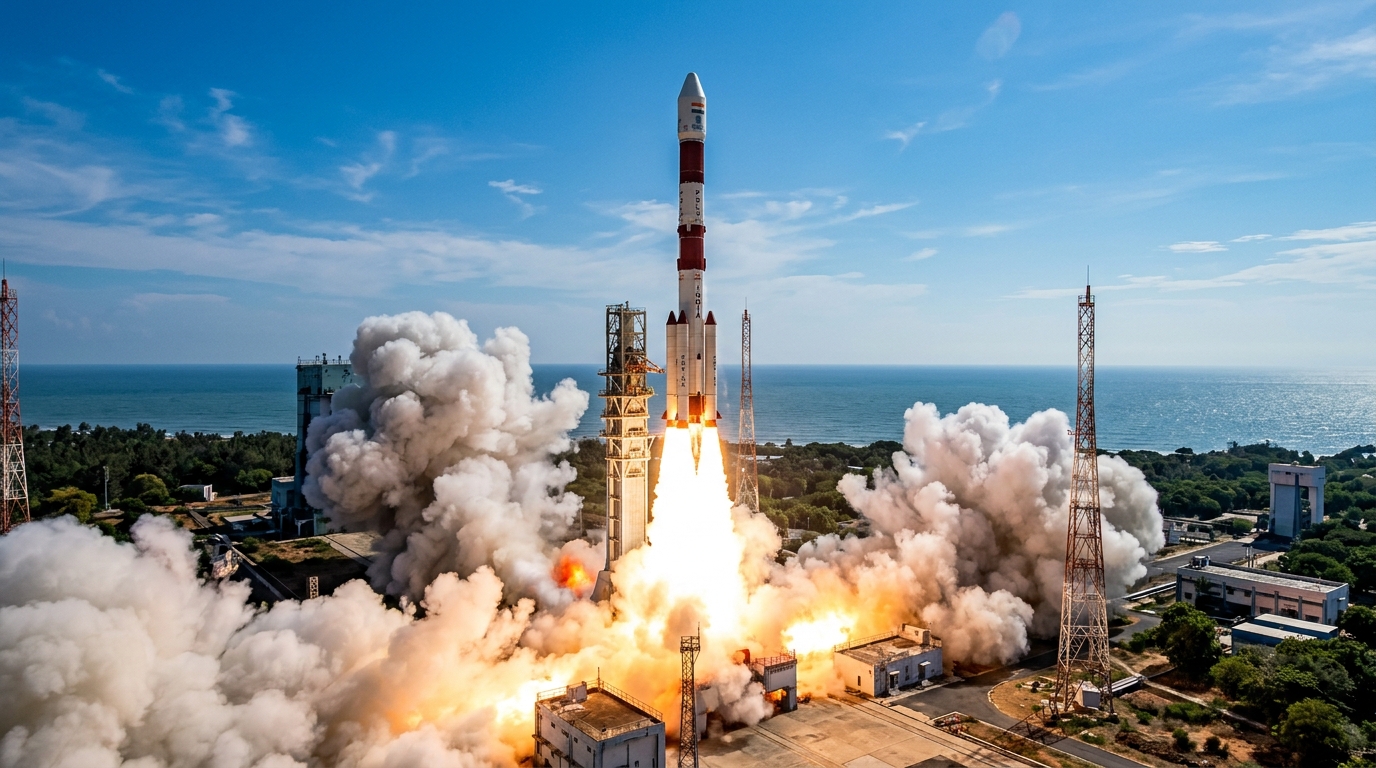
1. ISRO Achieves Pre-Launch Integration Milestone for ESA's Proba-3 Solar Mission on PSLV-XL
The Indian Space Research Organisation (ISRO) and its commercial arm, NewSpace India Limited (NSIL), have completed the final vehicle integration and mission readiness review for the launch of the European Space Agency's (ESA) landmark Proba-3 mission aboard the PSLV-XL (C59) from the Satish Dhawan Space Centre (SDSC-SHAR) in Sriharikota, Andhra Pradesh. Proba-3 represents humanity's first precision satellite formation-flying mission dedicated to high-resolution observation of the Sun's faint outer atmosphere—the solar corona.
Weighing a combined mass of approximately 550 kilograms, Proba-3 comprises two separate spacecraft: the Coronagraph spacecraft and the Occulter spacecraft. In a highly elliptical Earth orbit reaching an apogee of 60,500 kilometers, the Occulter will position itself exactly 144 meters ahead of the Coronagraph to millimeter-level accuracy, creating an artificial total solar eclipse in space for up to six continuous hours per orbit. This enables scientists to scrutinize the enigmatic coronal heating mechanism and Coronal Mass Ejections (CMEs) closer to the solar limb than ever before, seamlessly complementing data gathered by India's sovereign Aditya-L1 solar observatory at the Lagrangian Point 1 (L1).
🎯 Key Exam Prelims Pointers:
- Launch Vehicle & Site: Launched by ISRO's Polar Satellite Launch Vehicle in 'XL' variant (PSLV-XL) from Satish Dhawan Space Centre, Sriharikota; contracted commercially via NewSpace India Limited (NSIL).
- Dual Spacecraft Architecture: Consists of two coordinated satellites—the Occulter (blocking the intense solar disk) and the Coronagraph (capturing the faint coronal light)—flying 144 meters apart via autonomous laser and optical metrology.
- Scientific Synergy: Supplements India's Aditya-L1 observatory (VELC payload) by imaging the inner solar corona down to 1.1 solar radii, shedding light on space weather forecasting.
2. Global Negotiators Adopt Landmark $300 Billion New Collective Quantified Goal (NCQG) on Climate Finance
At the 29th Conference of the Parties (COP29) to the United Nations Framework Convention on Climate Change (UNFCCC), global negotiators achieved a breakthrough consensus by formalizing the New Collective Quantified Goal (NCQG) on climate finance. Replacing the decade-old, long-disputed annual pledge of $100 billion established in 2009 at Copenhagen, the newly adopted treaty decision obligates developed nations to lead in mobilizing at least $300 billion annually by 2035 for developing economies to support mitigation, climate resilience, and adaptation projects.
Furthermore, the pact sets a broader overarching global mobilization target of $1.3 trillion per year by 2035, encompassing multilateral development bank (MDB) reforms, sovereign bilateral channels, private blended capital, and green bond mechanisms. Developing countries, including India and the Like-Minded Developing Countries (LMDC) bloc, emphasized the principle of Common But Differentiated Responsibilities and Respective Capabilities (CBDR-RC), advocating that climate finance must remain grant-based and concessional rather than debt-creating loans.
🎯 Key Exam Prelims Pointers:
- Treaty Mandate: Governed under Article 9 of the Paris Agreement (2015), which mandated setting a new post-2025 financial goal prior to 2025.
- Financial Targets: Replaces the $100 billion/year target with $300 billion/year by 2035 directly led by developed nations, within an expanded multi-source ambition of $1.3 trillion annually.
- Core Principles: Reaffirms CBDR-RC and climate justice, prioritizing adaptation grants for Small Island Developing States (SIDS) and Least Developed Countries (LDCs).
3. Supreme Court Commemorates Constitution Day with Digital B.R. Ambedkar Archive and AI Translation Expansion
On the eve of the 75th anniversary of the adoption of the Constitution of India (observed annually on 26 November as Samvidhan Diwas), the Supreme Court of India unveiled an array of citizen-centric judicial technology initiatives. The Chief Justice of India operationalized the expanded Supreme Court Vidhik Anuvaad Software (SuVaS) 2.0, an indigenously trained Artificial Intelligence neural machine translation engine that has now translated over 40,000 landmark constitutional judgments into 16 scheduled Indian languages recognized under the Eighth Schedule.
Alongside, the apex court inaugurated the Digital B.R. Ambedkar Constitutional Repository, granting open-access public access to digitized high-resolution scans of the original handwritten and illustrated calligraphed Constitution (crafted by calligrapher Prem Behari Narain Raizada and decorated by artists of Shantiniketan led by Nandalal Bose). The initiative advances the constitutional imperative of open justice and eliminates linguistic barriers in understanding fundamental rights under Part III of the Constitution.
🎯 Key Exam Prelims Pointers:
- Constitution Day History: 26 November commemorates the formal adoption of the Constitution by the Constituent Assembly in 1949; officially notified as Constitution Day (Samvidhan Diwas) in 2015 by the Union Ministry of Social Justice and Empowerment.
- Language of Apex Judiciary: Article 348(1) of the Indian Constitution mandates that all proceedings in the Supreme Court and High Courts shall be in the English language until Parliament by law otherwise provides.
- Judicial AI Ecosystem: SuVaS (regional translation) and SUVAS/FASTER (Fast and Secured Transmission of Electronic Records) operate under the Supreme Court's e-Courts Integrated Mission Mode Project.
4. India and EFTA Formalize Implementation Roadmap for $100 Billion Trade & Economic Partnership (TEPA)
The Ministry of Commerce and Industry and representatives of the European Free Trade Association (EFTA)—comprising Switzerland, Norway, Iceland, and Liechtenstein—have concluded the inter-governmental implementation roadmap for the historic Trade and Economic Partnership Agreement (TEPA). The landmark treaty represents India's first free trade agreement containing an unprecedented, legally binding investment commitment: EFTA nations will invest $100 billion into India's manufacturing, green energy, and technology sectors over a 15-year period, projected to generate over 1 million direct employment opportunities.
In reciprocal terms, India offers tariff concessions on 82.7% of its tariff lines, benefiting Swiss precision machinery, horology (watches), transport equipment, and Norwegian maritime goods, while explicitly safeguarding sensitive domestic sectors like dairy, agriculture, gold bullion, and soya. The roadmap also establishes fast-track Mutual Recognition Agreements (MRAs) for organic certifications, nursing qualifications, and intellectual property enforcement under TRIPS-plus boundaries.
🎯 Key Exam Prelims Pointers:
- EFTA Composition: Established in 1960 under the Stockholm Convention; consists of four non-EU European nations—Switzerland, Norway, Iceland, and Liechtenstein.
- Unprecedented Investment Clause: First FTA where investment targets ($100B FDI commitment over 15 years) are legally tied to trade tariff benefits.
- Excluded Sensitive Sectors: India maintains stringent negative lists protecting domestic agriculture, dairy, soya, and gold jewellery from duty concessions.
5. Indian Navy Successfully Concludes 33rd Edition of SIMBEX Naval Exercise in Andaman Sea
The Indian Navy and the Republic of Singapore Navy (RSN) successfully concluded the 33rd edition of the Singapore-India Maritime Bilateral Exercise (SIMBEX 2026). Conducted in two rigorous phases—a Harbour Phase at Visakhapatnam followed by an advanced Sea Phase in the Andaman Sea and Bay of Bengal—the exercise saw the deployment of indigenous guided-missile stealth frigates, anti-submarine warfare corvettes, submarine assets, and long-range maritime reconnaissance aircraft P-8I Neptune.
The operational drills concentrated on complex Anti-Submarine Warfare (ASW), surface live-weapon firings, tactical air defense scenarios, and cross-deck helicopter flight operations. SIMBEX stands as the Indian Navy's longest uninterrupted bilateral maritime drill with any foreign navy since its inception in 1994, acting as a bedrock for freedom of navigation, rules-based maritime order, and sea lines of communication (SLOC) security across the vital Malacca Strait and Indo-Pacific littoral.
🎯 Key Exam Prelims Pointers:
- Operational Legacy: Originating in 1994 as 'Exercise Lion King', SIMBEX is India's longest continuously conducted bilateral naval exercise with any foreign maritime force.
- Strategic Geography: Operating in the Andaman Sea adjacent to the Strait of Malacca—one of the world's most critical maritime transit chokepoints carrying over 25% of global traded goods.
- Broader Trilateral Framework: Complemented by the SITMEX trilateral naval drill involving India, Singapore, and Thailand.
6. Ministry of Finance Sanctions ₹1.5 Lakh Crore Capital Expenditure Under SASCI Scheme
The Department of Expenditure under the Union Ministry of Finance has sanctioned fresh capital outlays under the Special Assistance to States for Capital Investment (SASCI) 2026-27 scheme. The flagship facility provides state governments with 50-year interest-free loans totaling ₹1.5 lakh crore to spur long-term capital creation across multimodal logistics, industrial corridors, rural road connectivity, and renewable transmission infrastructure.
To incentivize structural economic reforms, significant tranches of the financial allocation are tied directly to demonstrable milestones in urban planning, digital land records computerization, modernization of power distribution companies (DISCOMs), and the construction of unified 'Unity Malls' in state capitals to promote One District One Product (ODOP) and local GI-tagged handicrafts.
🎯 Key Exam Prelims Pointers:
- Loan Characteristics: 50-year tenor, 100% interest-free financial assistance provided over and above the normal borrowing ceiling of states under Article 293(3).
- Administering Body: Department of Expenditure, Ministry of Finance, Government of India.
- Reform-Linked Components: Tied to Gati Shakti national alignment, scrapping of outdated government vehicles, urban local body (ULB) reforms, and child-friendly Anganwadi infrastructure.
📝 Daily Prelims & Competitive Exam Practice MCQs
Q1. With reference to the Proba-3 mission launched by ISRO aboard PSLV-XL, consider the following statements:
1. It is the world's first precision formation-flying mission creating an artificial solar eclipse in space.
2. It consists of two satellites, the Coronagraph and the Occulter, flying 144 meters apart.
3. The mission operates from the Sun-Earth Lagrange Point 1 (L1).
Which of the statements given above are correct?
A) 1 and 2 only
B) 2 and 3 only
C) 1 and 3 only
D) 1, 2 and 3
Show Answer & Explanation
Correct Answer: A) 1 and 2 only
Explanation: Statement 3 is incorrect. Unlike India's Aditya-L1 which orbits the L1 Lagrange point, Proba-3 operates in a highly elliptical Earth orbit (apogee ~60,500 km). Statements 1 and 2 are accurate; the Occulter spacecraft blocks the solar disk 144 meters ahead of the Coronagraph to image the inner solar corona.
Q2. The New Collective Quantified Goal (NCQG) on climate finance agreed under the UNFCCC COP framework mandates developed nations to mobilize how much annual funding for developing nations by 2035?
A) $100 Billion
B) $300 Billion
C) $500 Billion
D) $1.3 Trillion
Show Answer & Explanation
Correct Answer: B) $300 Billion
Explanation: The NCQG agreement replaces the Copenhagen $100 billion target with a new direct pledge of at least $300 billion annually by 2035 from developed nations, while setting an overarching multi-source global mobilization target of $1.3 trillion.
Q3. Which Article of the Indian Constitution mandates that all proceedings in the Supreme Court and in every High Court shall be in the English language until Parliament by law otherwise provides?
A) Article 343
B) Article 345
C) Article 348
D) Article 351
Show Answer & Explanation
Correct Answer: C) Article 348
Explanation: Article 348(1)(a) specifies that all proceedings in the Supreme Court and High Courts, as well as authoritative texts of Bills, Acts, and Ordinances, shall be in English until Parliament enacts legislation to provide otherwise.
Q4. The European Free Trade Association (EFTA), with which India finalized the Trade and Economic Partnership Agreement (TEPA), comprises which of the following member nations?
A) Switzerland, Norway, Sweden, and Finland
B) Switzerland, Norway, Iceland, and Liechtenstein
C) Denmark, Norway, Iceland, and Ireland
D) Austria, Switzerland, Belgium, and Luxembourg
Show Answer & Explanation
Correct Answer: B) Switzerland, Norway, Iceland, and Liechtenstein
Explanation: EFTA was founded in 1960 and currently consists of four non-European Union member nations: Switzerland, Norway, Iceland, and Liechtenstein.
Q5. 'SIMBEX' is an annual bilateral maritime exercise conducted between the Indian Navy and the naval force of which country?
A) Sri Lanka
B) Seychelles
C) Singapore
D) South Africa
Show Answer & Explanation
Correct Answer: C) Singapore
Explanation: SIMBEX (Singapore-India Maritime Bilateral Exercise) has been conducted annually since 1994, representing the longest uninterrupted bilateral maritime drill of the Indian Navy with any foreign naval service.
Q6. Under the 'Scheme for Special Assistance to States for Capital Investment' (SASCI), what is the repayment duration and interest structure of financial loans granted to state governments?
A) 20-year loan at repo rate
B) 30-year loan at 2% concessional rate
C) 50-year loan with 100% interest-free terms
D) 15-year grant with zero repayment requirement
Show Answer & Explanation
Correct Answer: C) 50-year loan with 100% interest-free terms
Explanation: The SASCI scheme administered by the Department of Expenditure provides 50-year interest-free loans to state governments to stimulate long-term capital expenditure and infrastructure growth.

Comments & Reviews
Tap stars to rate this page: