Welcome to the comprehensive exam-oriented Daily Current Affairs roundup for 27 November 2026, curated specifically for UPSC Civil Services (Prelims & Mains), SSC CGL/CHSL, State PCS, Banking, Railways, and Defence examinations. Today's briefing covers the ISRO–ESA PROBA-3 precision formation-flying solar coronagraph mission, the Union Cabinet's ₹6,000 crore One Nation One Subscription (ONOS) scheme, the National Gopal Ratna Awards and White Revolution 2.0 livestock metrics, India's surge in the global Network Readiness Index (NRI), Asian Development Bank (ADB) urban climate loans, and the Nayi Chetna 3.0 gender campaign.
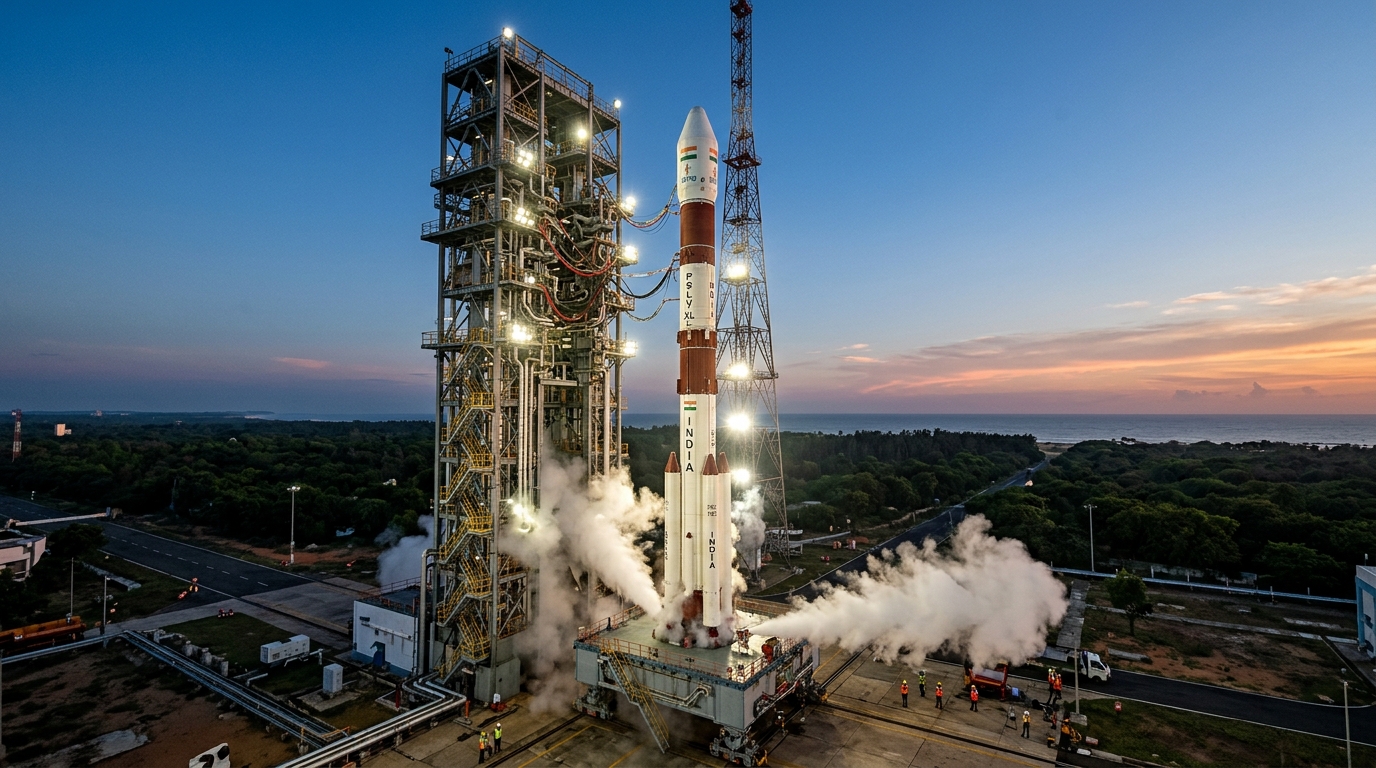
1. ISRO & ESA Finalize PROBA-3 Dual-Satellite Solar Coronagraph Mission Aboard PSLV-XL
The Indian Space Research Organisation (ISRO), through its commercial arm NewSpace India Limited (NSIL), completed final flight integration at the Satish Dhawan Space Centre (SDSC-SHAR), Sriharikota, for the European Space Agency's (ESA) landmark PROBA-3 (Project for On-Board Autonomy-3) mission aboard the Polar Satellite Launch Vehicle (PSLV-XL). PROBA-3 is the world's first precision formation-flying space mission, consisting of two independent satellites—the Coronagraph Spacecraft (CSC, 340 kg) and the Occulter Spacecraft (OSC, 200 kg)—that fly in tandem maintaining a fixed inter-satellite distance of 144 to 150 meters with millimeter-level accuracy.
Once injected into a High Earth Elliptical Orbit (600 km perigee × 60,530 km apogee with a 19.7-hour orbital period), the Occulter Spacecraft will block the Sun's bright photosphere and cast a controlled shadow onto the Coronagraph's optical instrument, ASPIICS (Association of Spacecraft for Polarimetric and Imaging Investigation of the Corona of the Sun). This creates an artificial total solar eclipse in space lasting up to 6 hours per orbit, enabling solar physicists to observe the faint inner solar corona (between 1.1 and 3 solar radii) where Coronal Mass Ejections (CMEs) and solar wind acceleration originate.
🎯 Key Exam Prelims Pointers:
- PROBA-3 Spacecraft Pair: Coronagraph Spacecraft (CSC, 340 kg) and Occulter Spacecraft (OSC, 200 kg) maintaining a 144–150 m formation baseline.
- Primary Scientific Payload: ASPIICS solar coronagraph and DARA (Davos Absolute Radiometer) for total solar irradiance measurement.
- Commercial Launch Interface: Executed under a commercial launch contract between ESA and NewSpace India Limited (NSIL, incorporated in March 2019 under the Department of Space).
- Comparison with Aditya-L1: India's first dedicated solar observatory, Aditya-L1, operates in a halo orbit around Sun–Earth Lagrange Point 1 (L1, 1.5 million km from Earth) and carries the Visible Emission Line Coronagraph (VELC).
2. Union Cabinet Operationalizes 'One Nation One Subscription' (ONOS) Scheme with ₹6,000 Crore Outlay
The Union Cabinet, chaired by Prime Minister Narendra Modi, approved and notified the implementation framework for the One Nation One Subscription (ONOS) scheme, a transformative central sector initiative designed to provide country-wide access to high-impact international scholarly research articles and journal publications. With a financial outlay of ₹6,000 crore for a three-calendar-year period, ONOS removes institutional paywalls for nearly 1.8 crore students, faculty members, and researchers across all government-managed Higher Education Institutions (HEIs) and central government R&D laboratories.
Under the scheme, fragmented library subscriptions negotiated separately by individual IITs, NITs, central universities, and state colleges are consolidated into a single national consortium contract covering 30 major international academic publishers (including Elsevier, Springer Nature, Wiley, IEEE, Taylor & Francis, Oxford University Press, Cambridge University Press, and SAGE). Over 13,000 peer-reviewed international journals are being made accessible through a unified digital portal coordinated by INFLIBNET, complementing the goals of the National Education Policy (NEP) 2020 and the Anusandhan National Research Foundation (ANRF).
🎯 Key Exam Prelims Pointers:
- Nodal Implementing Agency: Information and Library Network (INFLIBNET) Centre, Gandhinagar (an autonomous Inter-University Centre of the University Grants Commission established in 1991).
- Total Financial Outlay: ₹6,000 crore approved as a Central Sector Scheme covering 30 top global publishers and 13,000+ e-journals.
- Beneficiary Scope: Over 6,300 government Higher Education Institutions (central and state universities/colleges) and central R&D institutions, benefiting ~1.8 crore scholars including Tier-2 and Tier-3 districts.
- ANRF Link: Works in synergy with the Anusandhan National Research Foundation (ANRF) established under the ANRF Act, 2023.
3. National Gopal Ratna Awards Conferred & Basic Animal Husbandry Statistics Released
Following the observance of National Milk Day commemorating the birth anniversary of Dr. Verghese Kurien (Father of India's White Revolution), the Department of Animal Husbandry and Dairying under the Ministry of Fisheries, Animal Husbandry and Dairying conferred the National Gopal Ratna Awards and released the updated Basic Animal Husbandry Statistics (BAHS). The awards recognize excellence across three primary categories: Best Dairy Farmer rearing indigenous cattle and buffalo breeds, Best Artificial Insemination Technician (AIT), and Best Dairy Cooperative Society / Milk Producer Company / Dairy Farmer Producer Organization (FPO), including special awards for the North Eastern Region.
According to the latest BAHS data, India firmly retains its position as the world's largest milk producer, accounting for approximately 24.6% of global milk production with annual output crossing 239.30 million tonnes. Per capita availability of milk in India has risen to 471 grams per day, significantly surpassing the global average of ~322 grams per day. Uttar Pradesh, Rajasthan, Madhya Pradesh, Gujarat, and Maharashtra continue to lead among the top five milk-producing states in the country.
🎯 Key Exam Prelims Pointers:
- Rashtriya Gokul Mission (RGM): Launched in December 2014 for the development and conservation of indigenous bovine breeds (43 registered indigenous cattle breeds and 20 buffalo breeds registered by ICAR-NBAGR, Karnal).
- Operation Flood (1970–1996): Spearheaded by the National Dairy Development Board (NDDB, founded in 1965 at Anand, Gujarat) across three phases, making India the world's top milk producer by 1998.
- Top Milk-Producing States: 1. Uttar Pradesh (~16.2%), 2. Rajasthan (~14.5%), 3. Madhya Pradesh (~8.9%), 4. Gujarat (~7.7%), 5. Maharashtra (~6.7%).
4. India Climbs in Global Network Readiness Index (NRI) Driven by Digital Public Infrastructure & AI Research
In the latest Network Readiness Index (NRI) report published by the Washington D.C.-based Portulans Institute, India improved its global standing and retained the top rank among all Lower-Middle-Income economies. The NRI evaluates 133 economies across four foundational pillars—Technology, People, Governance, and Impact—spanning 54 socio-economic and digital transformation indicators.
The report specifically highlighted India's institutional leadership in Digital Public Infrastructure (DPI), noting that India secured the 1st global rank in AI scientific publications growth and AI talent concentration, 2nd rank in domestic market scale and telecommunication services annual investment, and top-15 rankings in mobile broadband internet traffic and building internet subscriptions. The rapid rollout of indigenous 5G networks across all districts and BharatNet optical fiber connectivity across Gram Panchayats served as primary growth drivers.
🎯 Key Exam Prelims Pointers:
- Publishing Institution: Portulans Institute (originally launched in 2002 by the World Economic Forum in collaboration with INSEAD).
- Four Core Pillars of NRI: Technology, People, Governance, and Impact.
- Global Top Performers: United States, Singapore, Finland, Sweden, and South Korea lead the overall global rankings, while India leads the Lower-Middle-Income group.
5. Asian Development Bank (ADB) Approves $200 Million Loan for Climate-Resilient Urban Infrastructure in India
The Asian Development Bank (ADB) approved a multi-tranche $200 million financial assistance package to modernize urban water supply, underground sewerage networks, stormwater drainage, and climate-resilient municipal services across fast-growing Tier-2 and Tier-3 cities in India. The project integrates nature-based solutions, smart SCADA-enabled non-revenue water reduction systems, and solar-powered sewage treatment plants (STPs) aligned with the AMRUT 2.0 (Atal Mission for Rejuvenation and Urban Transformation) framework.
Additionally, the financing incorporates institutional capacity building for Urban Local Bodies (ULBs) to enhance property tax digitization, municipal green bond readiness, and gender-inclusive sanitation facilities. India is a founding member and currently the fourth-largest shareholder of the Asian Development Bank.
🎯 Key Exam Prelims Pointers:
- Asian Development Bank (ADB): Established on 19 December 1966; Headquarters: Mandaluyong, Metro Manila, Philippines; Membership: 69 member countries (49 regional from Asia-Pacific and 20 non-regional).
- Major Shareholders in ADB: Japan and the United States (joint largest shareholders at ~15.6% each), followed by China (~6.4%) and India (~6.3%).
- AMRUT 2.0 Mission: Launched in October 2021 by the Ministry of Housing and Urban Affairs (MoHUA) to achieve 100% universal coverage of functional household tap water connections in all ~4,800 statutory towns.
6. Ministry of Rural Development Launches 'Nayi Chetna 3.0' National Campaign Under DAY-NRLM
The Union Ministry of Rural Development, in convergence with nine partner Union Ministries, launched the third edition of the month-long national gender campaign "Nayi Chetna 3.0 – Pahal Badlaav Ki" under the aegis of the Deendayal Ant्योdaya Yojana – National Rural Livelihoods Mission (DAY-NRLM). Running across all states and Union Territories until 23 December 2026, the campaign mobilizes over 10 crore women Self-Help Group (SHG) members organized under more than 90 lakh SHGs to combat gender-based violence and promote economic agency.
The 2026 edition carries the core slogan "Ek Disha, Ek Aawaz – Nari Hinsa Ke Khilaaf" and focuses on strengthening block-level Gender Resource Centres (GRCs), integrating SHG federations with One Stop Centres (Sakhi Centres) and the 181 Women Helpline, and expanding the Lakhpati Didi entrepreneurship ecosystem across rural clusters.
🎯 Key Exam Prelims Pointers:
- DAY-NRLM Nodal Ministry: Ministry of Rural Development (launched in June 2011 by restructuring the Swarnajayanti Gram Swarozgar Yojana - SGSY).
- Lakhpati Didi Target: Empowering 3 crore rural SHG women to achieve a sustainable annual household income of at least ₹1,00,000 through micro-enterprises, Drone Didi services, and कृषि/पशु सखी models.
- Inter-Ministerial Convergence: Coordinated between the Ministry of Rural Development, Ministry of Women and Child Development, Ministry of Panchayati Raj, Ministry of Home Affairs, and Department of Justice.
📝 Daily Prelims & Competitive Exam Practice MCQs
Q1. With reference to the PROBA-3 space mission, consider the following statements:
1. It is a European Space Agency (ESA) mission launched aboard ISRO's PSLV-XL under a commercial contract with NewSpace India Limited (NSIL).
2. It utilizes two independent spacecraft flying in millimeter-accurate formation ~150 meters apart to create an artificial solar eclipse in orbit.
3. It operates in a geostationary circular orbit at 35,786 km above the equator.
Which of the statements given above are correct?
A) 1 and 2 only
B) 2 and 3 only
C) 1 and 3 only
D) 1, 2 and 3
Show Answer & Explanation
Correct Answer: A) 1 and 2 only
Explanation: Statements 1 and 2 are correct. Statement 3 is incorrect because PROBA-3 operates in a highly elliptical orbit (600 km perigee × 60,530 km apogee), where gravitational perturbations are minimal near apogee during the 6-hour precision formation-flying solar corona observation window.
Q2. Which autonomous centre of the University Grants Commission (UGC) serves as the national coordinating agency for the ₹6,000 crore 'One Nation One Subscription' (ONOS) scheme?
A) National Assessment and Accreditation Council (NAAC), Bengaluru
B) Information and Library Network (INFLIBNET) Centre, Gandhinagar
C) Inter-University Accelerator Centre (IUAC), New Delhi
D) Consortium for Educational Communication (CEC), New Delhi
Show Answer & Explanation
Correct Answer: B) Information and Library Network (INFLIBNET) Centre, Gandhinagar
Explanation: INFLIBNET (Gandhinagar, Gujarat) manages the centralized digital access portal for over 13,000 international journals across 30 major academic publishers under the ONOS scheme.
Q3. According to the Basic Animal Husbandry Statistics (BAHS), what is the correct descending order of the top three milk-producing states in India?
A) Rajasthan > Uttar Pradesh > Gujarat
B) Uttar Pradesh > Rajasthan > Madhya Pradesh
C) Uttar Pradesh > Gujarat > Punjab
D) Rajasthan > Madhya Pradesh > Maharashtra
Show Answer & Explanation
Correct Answer: B) Uttar Pradesh > Rajasthan > Madhya Pradesh
Explanation: Uttar Pradesh ranks 1st (~16.2% of national milk output), followed by Rajasthan (~14.5%), Madhya Pradesh (~8.9%), Gujarat (~7.7%), and Maharashtra (~6.7%).
Q4. The global 'Network Readiness Index' (NRI), which evaluates countries across Technology, People, Governance, and Impact pillars, is published annually by:
A) International Telecommunication Union (ITU)
B) Portulans Institute
C) World Intellectual Property Organization (WIPO)
D) United Nations Conference on Trade and Development (UNCTAD)
Show Answer & Explanation
Correct Answer: B) Portulans Institute
Explanation: Originally created by the World Economic Forum (WEF), the Network Readiness Index is now published annually by the Washington D.C.-based Portulans Institute.
Q5. With reference to the Asian Development Bank (ADB), which of the following statements is correct?
A) Its headquarters is located in Shanghai, China.
B) Membership in ADB is restricted exclusively to Asian countries.
C) Japan and the United States hold the largest equal shareholding in the bank, while India is a founding member.
D) It was established under the Bretton Woods Conference of 1944.
Show Answer & Explanation
Correct Answer: C) Japan and the United States hold the largest equal shareholding in the bank, while India is a founding member.
Explanation: ADB was founded in December 1966 and is headquartered in Mandaluyong, Metro Manila, Philippines. It admits both regional (49) and non-regional (20) members, with Japan and the USA as the top shareholders followed by China and India.
Q6. The 'Nayi Chetna 3.0' national gender campaign, mobilizing over 10 crore Self-Help Group (SHG) women against gender-based violence, is spearheaded by which Union Ministry?
A) Ministry of Social Justice and Empowerment
B) Ministry of Rural Development (under DAY-NRLM)
C) Ministry of Skill Development and Entrepreneurship
D) Ministry of Labour and Employment
Show Answer & Explanation
Correct Answer: B) Ministry of Rural Development (under DAY-NRLM)
Explanation: Nayi Chetna 3.0 is organized by the Deendayal Antyodaya Yojana – National Rural Livelihoods Mission (DAY-NRLM) under the Ministry of Rural Development in convergence with nine partner ministries.

Comments & Reviews
Tap stars to rate this page: