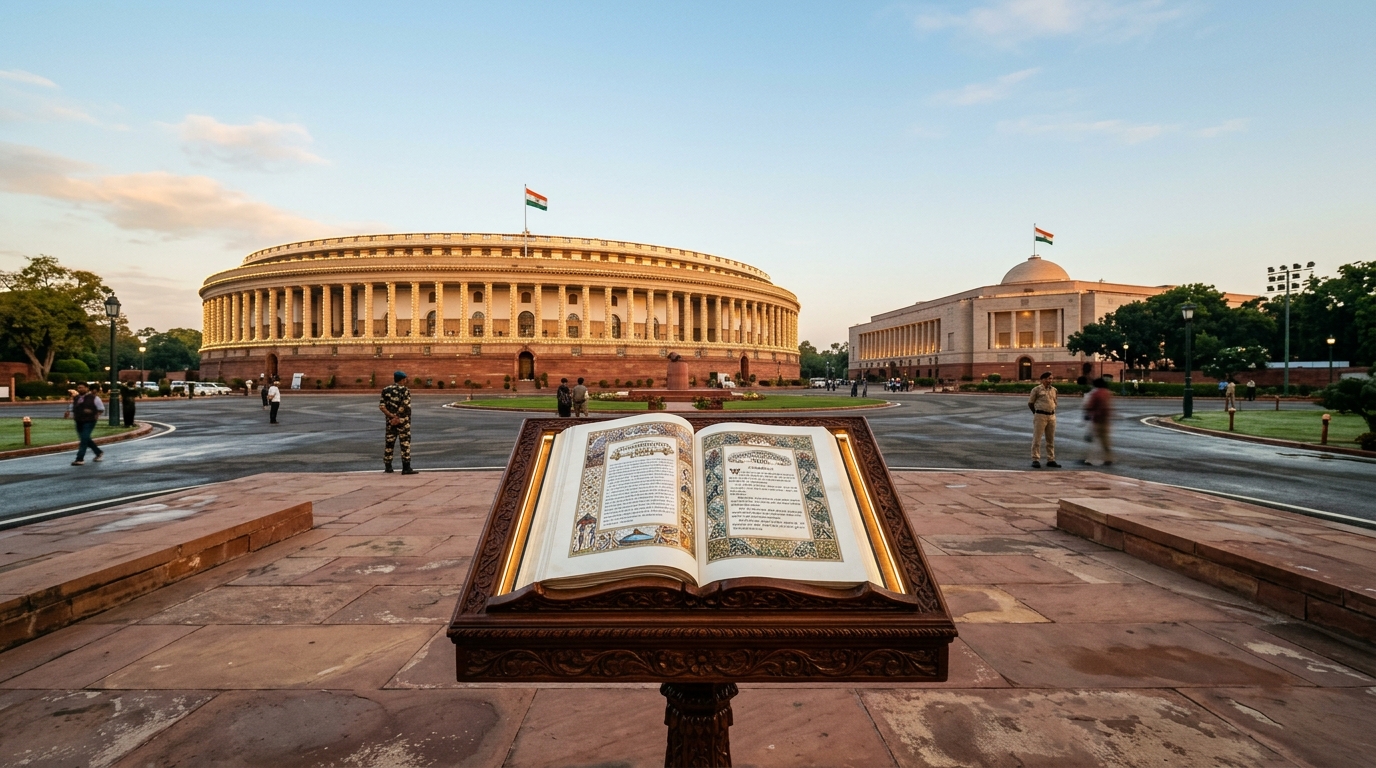
1. India Celebrates Constitution Day (Samvidhan Divas) on 26 November Marking 75 Years of Constitutional Adoption
On 26 November, India observes Constitution Day (Samvidhan Divas) to commemorate the historic adoption of the Constitution of India by the Constituent Assembly on 26 November 1949. Leading the national celebrations at the Central Hall of Samvidhan Sadan in New Delhi, the President of India addressed a joint gathering of both Houses of Parliament and released a commemorative coin, postal stamp, and digital constitutional compendiums in Sanskrit and Maithili.
While the full Constitution came into effect on 26 January 1950 (Republic Day), Article 394 brought 16 crucial articles—covering citizenship (Articles 5–9), the Presidential oath (Article 60), the Election Commission (Article 324), and transitional provisions—into immediate force on 26 November 1949. The Ministry of Social Justice and Empowerment formally notified 26 November as Samvidhan Divas in 2015 to honor the 125th birth anniversary year of Drafting Committee Chairman Dr. B. R. Ambedkar (previously observed as National Law Day since 1979 on the initiative of Dr. L. M. Singhvi and the Supreme Court Bar Association).
🎯 Key Exam Prelims Pointers:
- Drafting Committee (29 August 1947): 7 members — Dr. B. R. Ambedkar (Chairman), N. Gopalaswami Ayyangar, Alladi Krishnaswami Ayyar, Dr. K. M. Munshi, Syed Mohammad Saadullah, N. Madhava Rau (replaced B. L. Mitter), and T. T. Krishnamachari (replaced D. P. Khaitan).
- Key Constitutional Functionaries: Dr. Rajendra Prasad (President of Constituent Assembly), Sir B. N. Rau (Constitutional Advisor), H. V. R. Iyengar (Secretary), S. N. Mukherjee (Chief Draftsman), Prem Behari Narain Raizada (Calligrapher), and Nandalal Bose (Chief Illuminator).
- 8th Schedule Languages Context: Maithili was added to the Eighth Schedule by the 92nd Constitutional Amendment Act, 2003 (alongside Bodo, Dogri, and Santhali).
2. National Milk Day Observed on 26 November to Honor Dr. Verghese Kurien and Launch Livestock Digitization Drive
India celebrates National Milk Day every year on 26 November to mark the birth anniversary of Dr. Verghese Kurien (1921–2012), revered as the "Father of the White Revolution in India". To mark the occasion, the Union Ministry of Fisheries, Animal Husbandry and Dairying conferred the prestigious National Gopal Ratna Awards (NGRA) across indigenous cattle rearing, dairy cooperative management, and artificial insemination technician categories, while expanding the "Bharat Pashudhan" (NDLM) digital livestock database.
Dr. Kurien architected Operation Flood (launched on 13 January 1970) under the National Dairy Development Board (NDDB), transforming India from a milk-deficient nation into the world's largest milk producer—accounting for nearly 24.6% of global milk output (over 239 million tonnes annually). The cooperative village-level procurement model pioneered at Kaira District Co-operative Milk Producers' Union (Amul) in Anand, Gujarat, remains a cornerstone of rural women's livelihood empowerment and agricultural value addition.
🎯 Key Exam Prelims Pointers:
- Operation Flood Phases: Implemented in three phases (Phase I: 1970–1980; Phase II: 1981–1985; Phase III: 1985–1996) linking rural milk sheds with major metropolitan consumer markets via a three-tier cooperative structure (Village Society, District Union, State Federation).
- National Dairy Development Board (NDDB): Founded in 1965 at Anand, Gujarat; declared an institution of national importance by the NDDB Act, 1987.
- National Gopal Ratna Award: Highest national award in the livestock and dairy sector instituted under the Rashtriya Gokul Mission (RGM) to conserve and develop indigenous bovine breeds.
3. Union Cabinet Approves ₹2,750 Crore Atal Innovation Mission 2.0 (AIM 2.0) Under NITI Aayog
The Union Cabinet has approved the continuation and expansion of the Atal Innovation Mission (AIM) into its second phase—AIM 2.0—under NITI Aayog with a total financial outlay of ₹2,750 crore through March 2028. Originally established in 2016 as India's flagship innovation and entrepreneurship umbrella, AIM 2.0 shifts focus from institutional creation to filling geographic and linguistic gaps across India's startup and deep-tech ecosystem.
AIM 2.0 introduces two major structural programs: the Language Inclusive Program of Innovation (LIPI), which will establish 30 Vernacular Innovation Centers (VICs) across all 22 Eighth Schedule languages to empower non-English-speaking innovators, and the Frontiers Program, which will build 2,500 new Atal Tinkering Labs (ATLs) and custom incubation infrastructure in Jammu & Kashmir, Ladakh, the North-Eastern states, Aspirational Districts, and Aspirational Blocks.
🎯 Key Exam Prelims Pointers:
- Nodal Agency & Outlay: NITI Aayog; ₹2,750 crore approved up to 31 March 2028 (India currently ranks 39th in the Global Innovation Index published by WIPO).
- LIPI (Language Inclusive Program of Innovation): Establishes 30 Vernacular Innovation Centers across India's 22 scheduled constitutional languages to lower language barriers in deep-tech incubation.
- Industrial & Global Scaling: Includes the Human Capital Development Program, Deeptech Reactor for research commercialization, and Global Tinkering Olympiad.
4. ISRO Finalizes 19 Scientific Payloads for Venus Orbiter Mission (Shukrayaan-1) targeting 2028 Launch Window
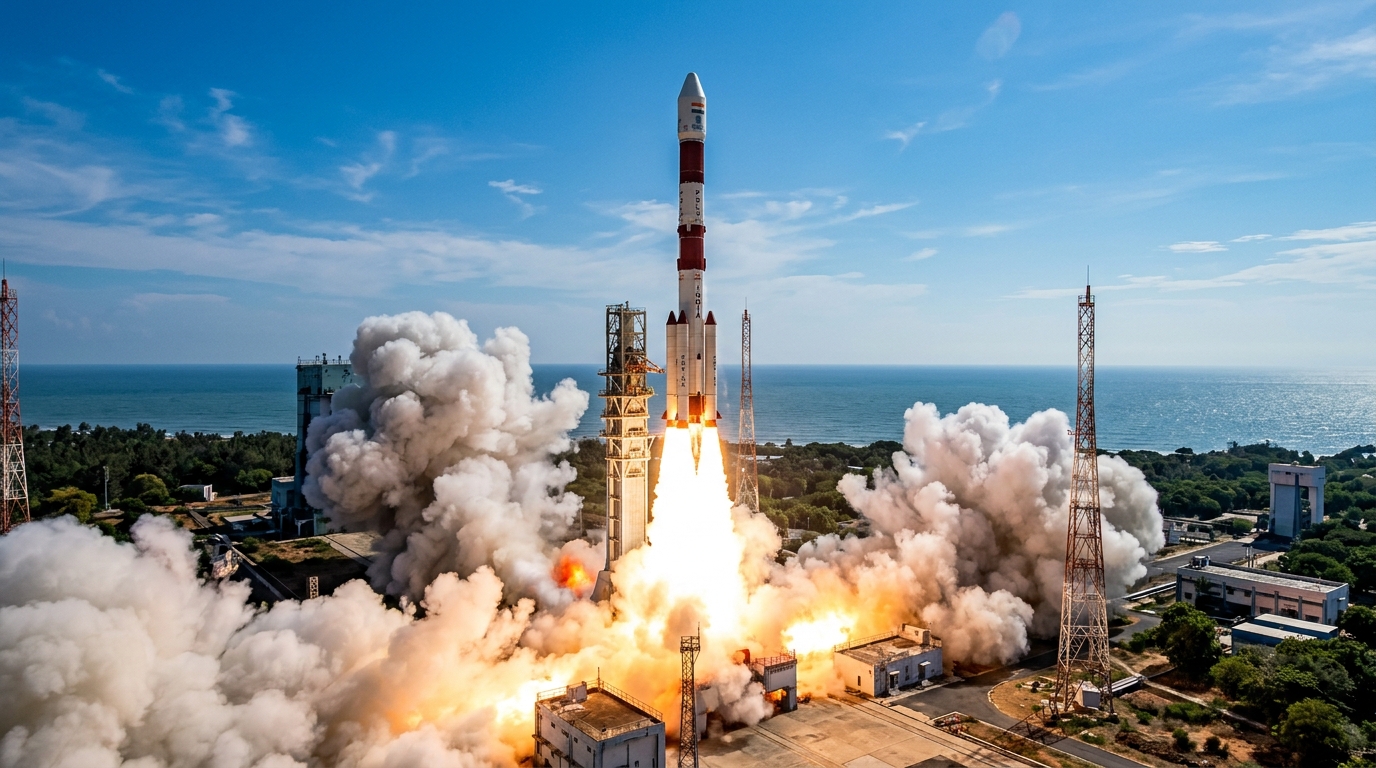
The Indian Space Research Organisation (ISRO) has completed payload configuration reviews for India's maiden planetary expedition to Venus—the Venus Orbiter Mission (VOM / Shukrayaan-1)—approved by the Union Cabinet with a budget of ₹1,236 crore. Scheduled for launch in March 2028 aboard the heavy-lift LVM3 (Launch Vehicle Mark-3) rocket, the spacecraft will enter a highly elliptical polar orbit around Venus before aero-braking to a 200 km × 600 km science orbit.
The mission carries 16 Indian payloads, 2 collaborative international payloads, and 1 international instrument, spearheaded by an advanced S-Band Synthetic Aperture Radar (VSAR) capable of piercing Venus's dense carbon-dioxide and sulfuric-acid cloud cover to map subsurface volcanic stratigraphy, active lightning, super-rotating atmospheric winds, and solar wind interactions with the Venusian ionosphere.
🎯 Key Exam Prelims Pointers:
- Venus Planetary Characteristics: Hottest planet in the Solar System (~465°C surface temperature) due to a runaway greenhouse effect (~96.5% CO₂ atmosphere and thick H₂SO₄ clouds); exhibits retrograde rotation (East to West, similar only to Uranus) where a single sidereal day (243 Earth days) is longer than its orbital year (224.7 Earth days).
- Flagship Instruments on VOM: Venus S-Band Synthetic Aperture Radar (VSAR), Venus Sub-Surface Radar (VSSR), Venusian Neutrals Analyzer (VNA), and VIRAL (Venus Infrared Atmospheric Gases Linker, in collaboration with Russia's IKI and France's LATMOS).
- Launch Vehicle: LVM3 (three-stage heavy-lift launch vehicle comprising S200 solid boosters, L110 liquid core, and C25 cryogenic upper stage).
5. Global Negotiators Convene at INC-5 in Busan, South Korea to Finalize Legally Binding UN Global Plastics Treaty
Delegations from over 175 nations have convened in Busan, South Korea for the fifth session of the Intergovernmental Negotiating Committee (INC-5) hosted under the United Nations Environment Programme (UNEP) to finalize a historic, legally binding international instrument on plastic pollution, including in the marine environment.
Mandated by UN Environment Assembly (UNEA) Resolution 5/14 adopted in Nairobi in March 2022, the negotiations center on addressing the full life cycle of plastics—from polymer production caps and elimination of hazardous chemical additives (such as phthalates, PFAS, and bisphenols) to mandatory Extended Producer Responsibility (EPR), circular product design, and dedicated multilateral financial mechanisms for developing countries. India has strongly advocated for transfer of low-cost recycling technologies, sustainable alternatives, and the Principle of Common But Differentiated Responsibilities (CBDR).
🎯 Key Exam Prelims Pointers:
- Foundational Mandate: UNEA Resolution 5/14 ("End Plastic Pollution: Towards an International Legally Binding Instrument") adopted at UNEA-5.2 in Nairobi, Kenya (2022).
- INC-5 Host City: Busan, Republic of Korea (following INC-1 Punta del Este, INC-2 Paris, INC-3 Nairobi, and INC-4 Ottawa).
- India's Domestic Plastic Rules: Under the Plastic Waste Management Amendment Rules (notified under the Environment Protection Act, 1986), India banned identified single-use plastic items with low utility and high littering potential from 1 July 2022 and mandated a minimum thickness of 120 microns for plastic carry bags.
6. Indian Railways Sanctions Nationwide Rollout of Indigenous "Kavach 4.0" Automatic Train Protection System
The Ministry of Railways has accelerated the deployment of Kavach Version 4.0—the latest RDSO-approved specification of India's indigenously developed Automatic Train Protection (ATP) system—across 10,000 locomotives and major high-density corridors including the Delhi–Mumbai and Delhi–Howrah trunk routes. Certified to the highest global safety benchmark, Safety Integrity Level 4 (SIL-4), Kavach 4.0 incorporates enhanced location accuracy, direct locomotive-to-station fiber-optic communication, and seamless integration with existing electronic interlocking systems.
Developed jointly by the Research Designs and Standards Organisation (RDSO) and three Indian industry partners, Kavach prevents accidents caused by human error by automatically applying brakes whenever a loco pilot fails to act on a Signal Passed at Danger (SPAD), enforces speed limits on curves and bridges, prevents head-on and rear-end collisions through Ultra High Frequency (UHF) radio and RFID track tags, and relays live cab-signaling in dense winter fog.
🎯 Key Exam Prelims Pointers:
- Developing Institution: Research Designs and Standards Organisation (RDSO), Lucknow (technical R&D wing of the Ministry of Railways).
- Safety Certification: Safety Integrity Level 4 (SIL-4), indicating a probability of less than one dangerous failure in 10,000 years.
- Core Technical Components: Stationary Kavach unit at stations, On-board Locomotive Kavach, passive Radio Frequency Identification (RFID) tags mounted on railway sleepers every 1 km, and UHF/LTE communication towers.
📝 Daily Prelims & Competitive Exam Practice MCQs
Q1. With reference to the framing of the Constitution of India commemorated on Samvidhan Divas (26 November), consider the following pairs:
1. Constitutional Advisor to the Constituent Assembly : Sir B. N. Rau
2. Chief Draftsman of the Constitution : S. N. Mukherjee
3. Calligrapher of the Original English Manuscript : Prem Behari Narain Raizada
How many of the pairs given above are correctly matched?
A) Only one pair
B) Only two pairs
C) All three pairs
D) None of the pairs
Show Answer & Explanation
Correct Answer: C) All three pairs
Explanation: Sir B. N. Rau served as the Constitutional Advisor, S. N. Mukherjee was the Chief Draftsman of the Constitution in the Constituent Assembly, and Prem Behari Narain Raizada hand-calligraphed the original English text in flowing italic script. All three pairs are correctly matched.
Q2. National Milk Day is observed in India on 26 November to mark the birth anniversary of Dr. Verghese Kurien. In which year was "Operation Flood" launched by the National Dairy Development Board (NDDB)?
A) 1965
B) 1970
C) 1976
D) 1982
Show Answer & Explanation
Correct Answer: B) 1970
Explanation: Operation Flood, the world's largest dairy development program spearheaded by Dr. Verghese Kurien and NDDB, was launched on 13 January 1970 and executed across three phases up to 1996.
Q3. The "LIPI" (Language Inclusive Program of Innovation) initiative, recently approved by the Union Cabinet to set up 30 Vernacular Innovation Centers across 22 scheduled languages, is a component of which mission?
A) National Quantum Mission (NQM)
B) Atal Innovation Mission 2.0 (AIM 2.0)
C) Digital India Bhashini Mission
D) PM Vishwakarma Kaushal Samman
Show Answer & Explanation
Correct Answer: B) Atal Innovation Mission 2.0 (AIM 2.0)
Explanation: Approved with a ₹2,750 crore outlay under NITI Aayog until March 2028, AIM 2.0 includes the Language Inclusive Program of Innovation (LIPI) to build 30 Vernacular Innovation Centers across all 22 Eighth Schedule languages.
Q4. With reference to planet Venus and ISRO's upcoming Venus Orbiter Mission (Shukrayaan-1), consider the following statements:
1. Venus exhibits retrograde rotation, rotating from East to West on its axis.
2. A single sidereal day on Venus is longer than its orbital year around the Sun.
3. Shukrayaan-1 will carry an S-Band Synthetic Aperture Radar (VSAR) to map the planet's surface beneath its dense sulfuric acid clouds.
Which of the statements given above are correct?
A) 1 and 2 only
B) 2 and 3 only
C) 1 and 3 only
D) 1, 2 and 3
Show Answer & Explanation
Correct Answer: D) 1, 2 and 3
Explanation: All three statements are correct. Venus rotates from East to West (retrograde), takes 243 Earth days to rotate once on its axis compared to 224.7 Earth days to orbit the Sun, and ISRO's Venus Orbiter Mission utilizes an S-Band Synthetic Aperture Radar (VSAR) to penetrate its opaque cloud cover.
Q5. In which city was the fifth session of the Intergovernmental Negotiating Committee (INC-5) convened under UNEP to finalize a legally binding Global Plastics Treaty?
A) Ottawa, Canada
B) Punta del Este, Uruguay
C) Busan, South Korea
D) Nairobi, Kenya
Show Answer & Explanation
Correct Answer: C) Busan, South Korea
Explanation: INC-5 was hosted in Busan, Republic of Korea under UNEP pursuant to UNEA Resolution 5/14 (following INC-1 in Punta del Este, INC-2 in Paris, INC-3 in Nairobi, and INC-4 in Ottawa).
Q6. India's indigenous Automatic Train Protection (ATP) system "Kavach 4.0" has been developed in collaboration with which technical wing of the Ministry of Railways?
A) Rail India Technical and Economic Service (RITES)
B) Research Designs and Standards Organisation (RDSO)
C) Centre for Railway Information Systems (CRIS)
D) Dedicated Freight Corridor Corporation of India (DFCCIL)
Show Answer & Explanation
Correct Answer: B) Research Designs and Standards Organisation (RDSO)
Explanation: Kavach is an SIL-4 certified indigenous Automatic Train Protection system developed by Lucknow-based Research Designs and Standards Organisation (RDSO) in partnership with Indian industry manufacturers.
Comments & Reviews
Tap stars to rate this page: