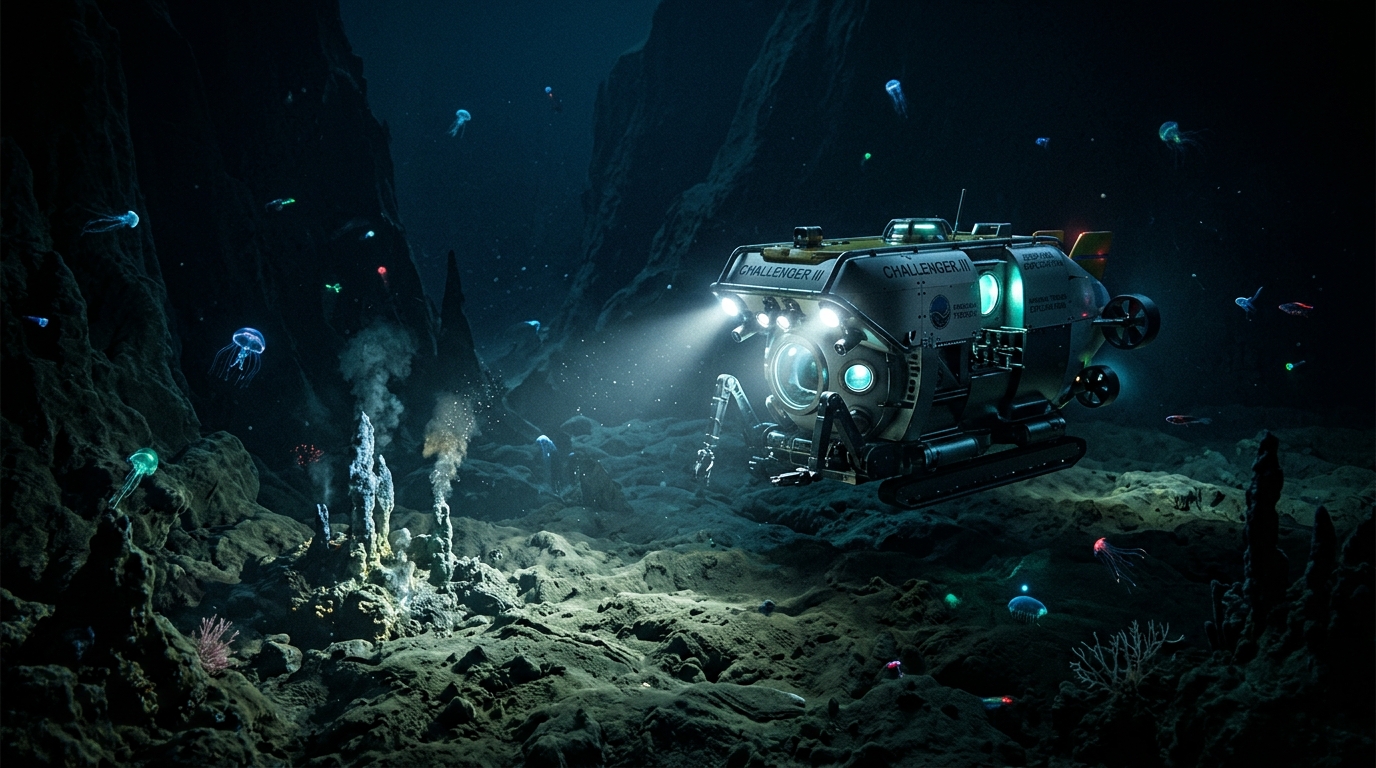
Deep beneath the ocean surface lies one of Earth's most eerie and extraordinary geological phenomena: underwater lakes known as brine pools. Formed where ancient subterranean salt deposits dissolve and leach into the sea floor, these hyper-saline bodies of water are so dense that they do not mix with the surrounding seawater. Featuring their own distinct shorelines, underwater waves, and toxic chemical environments, brine pools exist in perpetual darkness, hosting specialized extremophilic organisms while acting as lethal traps for unadapted marine life.
Physics and Geological Formation of Subsea Lakes
Brine pools are created through complex geological processes spanning millions of years, forming sharp hydrographic boundaries on the ocean floor.
- Salt Diapirism: During the Jurassic period, evaporating epicontinental seas left behind massive subterranean salt beds. Tectonic movements push these low-density salt domes (diapirs) upward, exposing them to seawater along seabed faults where they dissolve to form hyper-saline brine.
- Halocline & Density Separation: The salinity inside brine pools reaches up to 3 to 8 times that of ordinary ocean water (approx. 200–300 practical salinity units). This density gradient creates a physical boundary called a halocline, rendering the pool fluids completely un-mixable with the ocean water above.
- Subsurface Hydrodynamics: Driven by density differentials, internal waves ripple across the surface of the brine pool, exhibiting fluid dynamics almost identical to atmospheric winds moving across a terrestrial lake.
Chemosynthetic Ecosystems and Astrobiological Significance
Despite being fatal to most marine organisms, the periphery of brine pools harbors unique ecosystems supported entirely by chemical energy.
- Methanotrophic Symbiosis: Massive beds of deep-sea mussels (Bathymodiolus childressi) and tube worms ring the shoreline of brine pools. These organisms host symbiotic methanotrophic archaea in their tissue, which convert methane bubbling out of the brine pool into cellular energy.
- The Toxic Preservation Trap: Animals like crabs or fish that accidentally venture into the brine pool suffer rapid osmotic shock (severe dehydration) and toxic shock from high hydrogen sulfide concentrations, causing instant death and natural preservation without decay.
- Extraterrestrial Analogues: Astrobiologists study these hyper-saline, high-pressure, lightless environments as terrestrial models for potential liquid oceans buried beneath the icy crusts of Jupiter's moon Europa and Saturn's moon Enceladus.
Technical & Scientific Specifications
📐 Oceanographic & Geochemical Specifications
- Salinity Level: 200–300 g/L (3 to 8 times higher than open seawater salinity of 35 g/L)
- Depth Range: Typically located at depths of 1,000 to 3,000 meters in basins like the Gulf of Mexico, Red Sea, and Mediterranean
- Chemical Composition: Dominant Sodium Chloride (NaCl) solution enriched with dissolved Methane ($CH_4$) and Hydrogen Sulfide ($H_2S$)
- Famous Example: The 'Jacuzzi of Despair' in the Gulf of Mexico ( discovered at ~1,000 meters depth, measuring 30m in circumference)
Key Exam & Knowledge Takeaways
🎯 Important Examination Points
- Halocline Dynamics: A halocline is a sharp vertical salinity gradient that prevents mixing between fluids of contrasting densities, maintaining the integrity of subsea lakes.
- Chemosynthesis vs. Photosynthesis: Brine pool biomes rely on chemosynthetic primary production powered by methanotrophic and sulfur-oxidizing microorganisms rather than sunlight.
- Salt Diapirism: Geological uplift of ancient evaporite salt beds through denser overlying sedimentary rocks leads to seabed salt exposure and brine formation.
- Osmotic Shock: The extreme osmotic gradient across brine boundaries causes immediate dehydration and cellular collapse in non-adapted marine organisms.
- Astrobiological Significance: Brine pools serve as key terrestrial analogues for sub-surface liquid ocean environments on icy celestial bodies like Europa and Enceladus.
Legacy and Scientific Significance
Deep-sea brine pools stretch the boundaries of our understanding of marine biology and fluid dynamics. By illustrating how life can flourish in lightless, highly toxic, hyper-saline conditions through chemosynthesis, these bizarre underwater lakes not only reveal hidden geological processes of Earth's ocean floors but also illuminate the pathways by which life might exist in the subterranean oceans of distant worlds.
Comments & Reviews
Tap stars to rate this page: