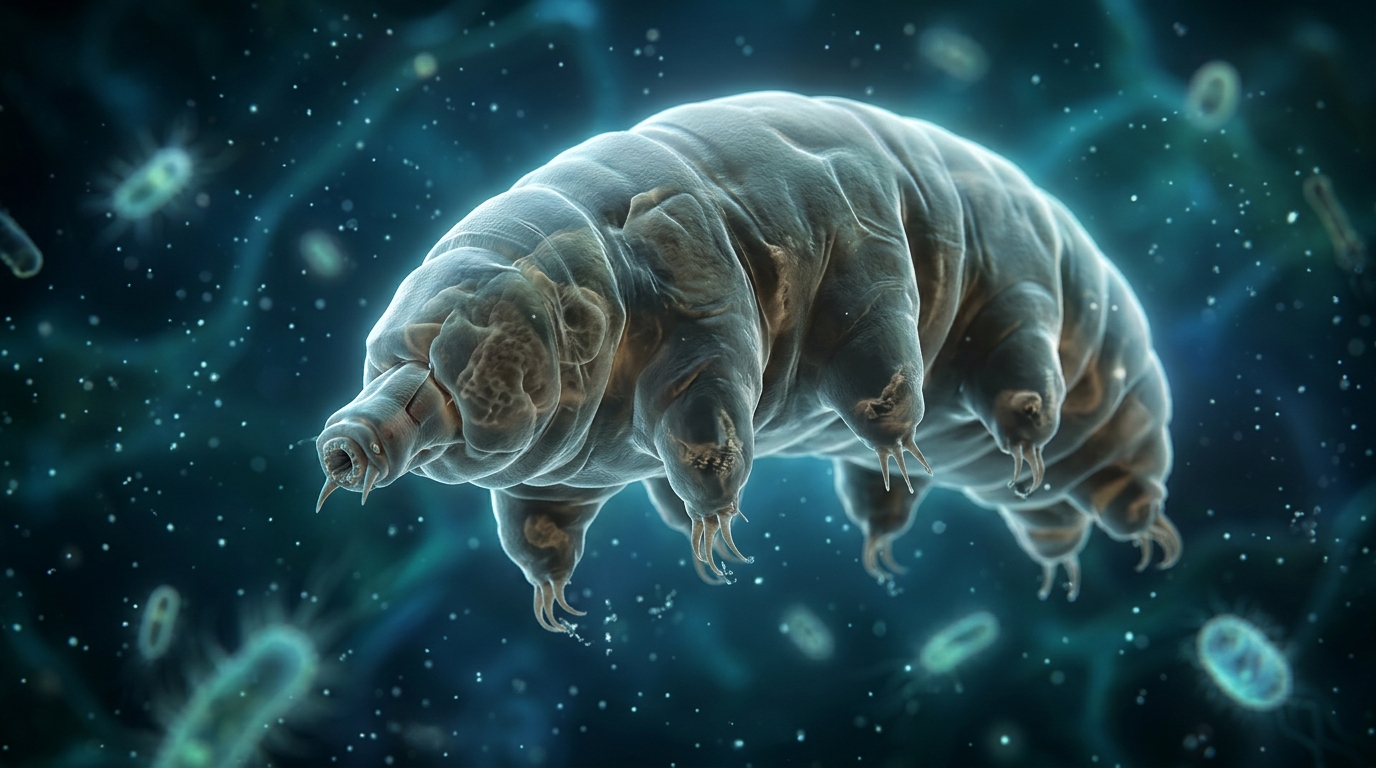
In 1956, scientists attempting to sterilize canned meat using intense gamma radiation observed something unexpected: while all known microbes perished, one reddish organism thrived. Dubbed 'Conan the Bacterium' by the Guinness Book of World Records, Deinococcus radiodurans is arguably the most radiation-resistant organism known to modern science. It effortlessly withstands ionizing radiation doses exceeding 5,000 Gray without any loss of viability, a lethal threshold nearly a thousand times higher than that which proves fatal to humans. D. radiodurans is a polyextremophile—thriving not just under blistering radiation, but also in conditions of severe dehydration, cold, vacuum, and acid, presenting profound insights into DNA repair mechanisms and the possibilities of extraterrestrial life.
The Shattered Genome: Extended Synthesis-Dependent Strand Annealing
When exposed to massive radiation doses, an organism's chromosomal DNA is shredded into hundreds of fragments. While human cells die when suffering just a few dozen double-strand breaks, D. radiodurans reassembles hundreds of fractured pieces in mere hours.
- Toroidal Genomic Architecture: The bacterium maintains four to ten copies of its genome organized into tightly packed, toroid-shaped (doughnut-like) structures. This spatial confinement prevents shattered DNA fragments from diffusing away, keeping cohesive ends in immediate physical proximity.
- Two-Stage Recombination: Repair occurs through a specialized process called Extended Synthesis-Dependent Strand Annealing (ESDSA), followed by RecA-mediated homologous recombination. Broken fragments serve as overlapping templates, enabling polymerase enzymes to systematically reconstruct the entire 3.28-megabase sequence.
- Absence of Radiation Evolution: Earth has never possessed natural surface radiation fields intense enough to drive the natural selection of such high radiation resistance. Evolutionary biologists believe this capacity evolved as a survival mechanism against severe desiccation, which mimics ionizing radiation by inducing double-strand DNA breakage.
The Manganese Antioxidant Shield: Protecting Proteins over DNA
For decades, biologists assumed that radiation lethality was solely driven by direct DNA damage. Groundbreaking research revealed that D. radiodurans survives primarily because it protects its metabolic and enzymatic proteome from oxidative destruction.
- Manganese-Peptide Complexes: Unlike radiation-sensitive microbes that suffer extensive protein carbonylation, D. radiodurans accumulates remarkably high intracellular concentrations of non-enzymatic manganese (Mn2+) ions chelated to small peptides and orthophosphate.
- Superoxide Radical Scavenging: These Mn-complexes selectively neutralize lethal reactive oxygen species (ROS)—particularly superoxide and hydroxyl radicals—generated during radiolysis, while leaving proteins intact.
- Proteome Preservation: By shielding repair enzymes such as DNA polymerases and ligases from oxidative damage, the cellular machinery remains fully functional to repair the genome once radiation ceases, shifting the scientific paradigm from 'DNA damage' to 'proteome preservation'.
Technical & Scientific Specifications
📐 Scientific & Physiological Benchmarks
- Radiation Tolerance Limit: 15,000 Gray (Gy) with 37% survival; 5,000 Gy with 100% viability (Human LD50 is ~4-5 Gy)
- Intracellular Ratio: Mn/Fe ratio > 0.20 (High manganese-to-iron ratio minimizes Fenton chemistry and hydroxyl radical formation)
- Genome Configuration: Multipartite circular genome of 3.28 Mb (comprising 2 chromosomes, a megaplasmid, and a small plasmid)
- Morphology & Gram Stain: Non-motile, non-spore-forming spherical tetrad; Gram-positive cell envelope with a thick peptidoglycan and outer membrane-like surface layer
Key Exam & Knowledge Takeaways
🎯 Important Examination Points
- Polyextremophile Classification: Survives combined extremes including ionizing radiation, UV-C radiation, desiccation, sub-zero cold, vacuum, and oxidative stress.
- Panspermia & Astrobiology: Demonstrated survival in low Earth orbit exposure experiments (Tanpopo mission on the ISS), reinforcing theories that microbial life could endure interplanetary transit inside meteorites or cosmic dust.
- Mechanism of Action: Radiation resistance is driven by high intracellular Mn(II) antioxidant complexes protecting proteins, paired with the RecA-dependent Extended Synthesis-Dependent Strand Annealing (ESDSA) DNA repair mechanism.
- Bioremediation Applications: Genetically engineered strains carrying mercuric reductase genes are deployed to clean up hazardous radioactive waste sites containing toxic heavy metals like mercury and toluene.
Legacy and Scientific Significance
Deinococcus radiodurans fundamentally reshaped our comprehension of the limits of cellular life. By demonstrating that biological survival in extreme environments hinges not on preventing physical damage, but on shielding the molecular repair machinery itself, this microscopic powerhouse provides crucial models for advanced medicine—such as protecting healthy tissue during cancer radiation therapy—and provides tangible evidence that life can endure the merciless void of space.



Comments & Reviews
Tap stars to rate this page: