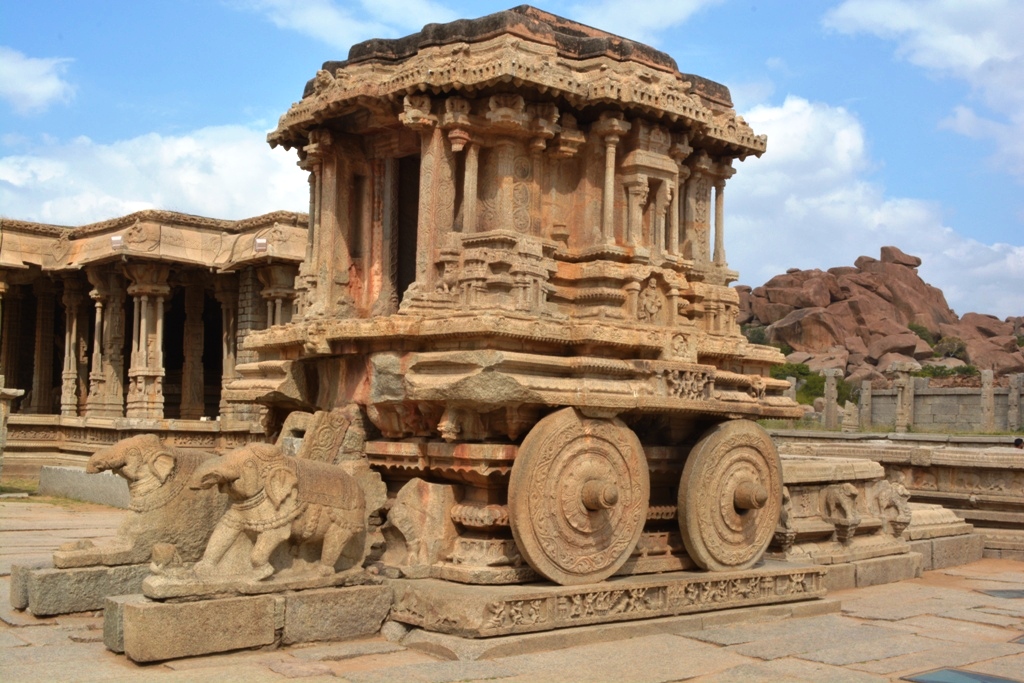
On the southern bank of the sacred Tungabhadra River, nestled amid the rugged boulder-strewn terrain of Hampi, stands the crowning glory of 16th-century Vijayanagara art and engineering: the Vijaya Vitthala Temple. Commissioned in the 15th century during the reign of King Devaraya II and significantly expanded under Emperor Krishnadevaraya, the temple is dedicated to Lord Vitthala, an incarnation of Vishnu. Beyond its monumental Dravidian scale, the temple is celebrated worldwide for an astonishing physical marvel: 56 monolithic granite pillars that emit distinct musical notes and percussive tones when tapped.
The Acoustic Science of the 56 Musical Pillars
Inside the grand open-pillared hall known as the Ranga Mandapa (or Maha Mandapa), master artisans accomplished an acoustic feat that continues to astonish modern physicists and metallurgists:
- The Saptaswara Configuration: Each principal architectural column is surrounded by a cluster of seven slender sub-pillars carved from a single block of resonant granite. These colonnettes are tuned to produce the fundamental notes of Indian classical music—Sa, Re, Ga, Ma, Pa, Dha, Ni.
- Percussive and Melodic Tones: Depending on their dimensions, different colonnettes produce sounds mimicking traditional musical instruments, including the mridangam, damru, bells (ghanta), and stringed instruments (veena). Dancers performed in the pavilion while musicians accompanied them by gently tapping the pillars with thumb-pads or sandalwood sticks.
- Geological Composition and Density: Petrographic and ultrasonic studies conducted by scientific institutions reveal that the pillars were carved from granite unusually rich in silica and metallic oxides. By subtly altering the girth, height, and resonant cavity of each slender column during chiseling, sculptors tuned individual natural vibrational frequencies.
The British Drilling Mystery: Solid Stone, Not Hollow Metal
During the colonial era, British engineers were so baffled by the acoustic properties of the pillars that they suspected a hidden mechanical trick:
- The Excavation Test: Convinced that the pillars contained hollow conduits, metal resonators, or concealed brass bells inside, British authorities sawed through two pillars to inspect their interior.
- The Shocking Discovery: To their utter amazement, the pillars were found to be completely solid blocks of natural granite from top to bottom. No hollow tubes or foreign materials existed—the resonance was entirely a product of the stone's metallurgical density, precise geometry, and acoustic tension under the massive load of the stone ceiling.
- Conservation Legacy: Those two cut pillars can still be seen today within the temple precinct, standing as silent proof of ancient India's supreme acoustic craftsmanship.
The Monolithic Stone Chariot: Architectural Masterpiece
Facing the main sanctum in the temple's courtyard sits one of the most recognizable cultural icons of India: the Stone Chariot (Kallina Ratha):
- Garuda Shrine: Though styled as a celestial war chariot, it is actually a dedicated shrine housing Garuda, the mythical eagle mount of Lord Vishnu, positioned directly opposite the sanctum.
- Modular Stone Construction: Built on a rectangular platform, the chariot appears monolithic, but its intricate components—including wheels, axles, brackets, and miniature battlements—were carved from chlorite schist and interlocking granite blocks with joints disguised so exquisitely that the entire monument appears sculpted from a single rock.
- Rotatable Wheels: Originally, the giant stone wheels adorned with concentric floral motifs were capable of rotating on their stone axles before authorities cemented them to prevent wear. In front of the chariot stand two stone elephants, placed there by later restorers to flank the original stone horses.
Architectural & Acoustic Specifications
📐 Architectural & Acoustic Specifications
- Patrons & Era: Initiated under King Devaraya II (Sangama Dynasty, 15th Century); vastly embellished by Emperor Krishnadevaraya (Tuluva Dynasty, c. 1513–1526 CE).
- Geographic Setting: Hampi, Vijayanagara District, Karnataka (Bank of the Tungabhadra River).
- Architectural Order: Mature Vijayanagara style of Dravidian architecture with composite yali pillars and deeply undercut cornices.
- Musical Pillars: 56 clustered monolithic columns in the Maha Mandapa producing distinct frequencies and melodic overtones upon tapping.
- Stone Chariot: One of only three famous stone chariots in India (along with Konark in Odisha and Mahabalipuram in Tamil Nadu).
Key Exam & Knowledge Takeaways
🎯 Key Exam & Knowledge Points
- UNESCO Heritage: Inscribed as a UNESCO World Heritage Site in 1986 under the "Group of Monuments at Hampi".
- Indian Currency Feature: The Hampi Stone Chariot is proudly depicted on the reverse side of India's Fluorescent Blue ₹50 Banknote issued by the Reserve Bank of India in 2017.
- Historical Capital: Hampi was the capital of the Vijayanagara Empire (founded in 1336 CE by brothers Harihara I and Bukka Raya I), described by medieval travelers like Domingo Paes and Abdur Razzaq as one of the richest cities in the world.
- Acoustic Protection: The Archaeological Survey of India (ASI) has placed protective cordons around the musical pillars to preserve their delicate resonance from surface wear caused by continuous tapping.
An Eternal Symphony Carved in Granite
The Vijaya Vitthala Temple of Hampi represents the sublime apex of ancient Indian civil engineering, combining architectural majesty, spiritual symbolism, and acoustic physics. In an era long before electronic instruments or computer-aided acoustics, Vijayanagara sculptors transformed hard, unforgiving granite into a living musical orchestra that continues to inspire awe centuries later.
 🔬 History & Science
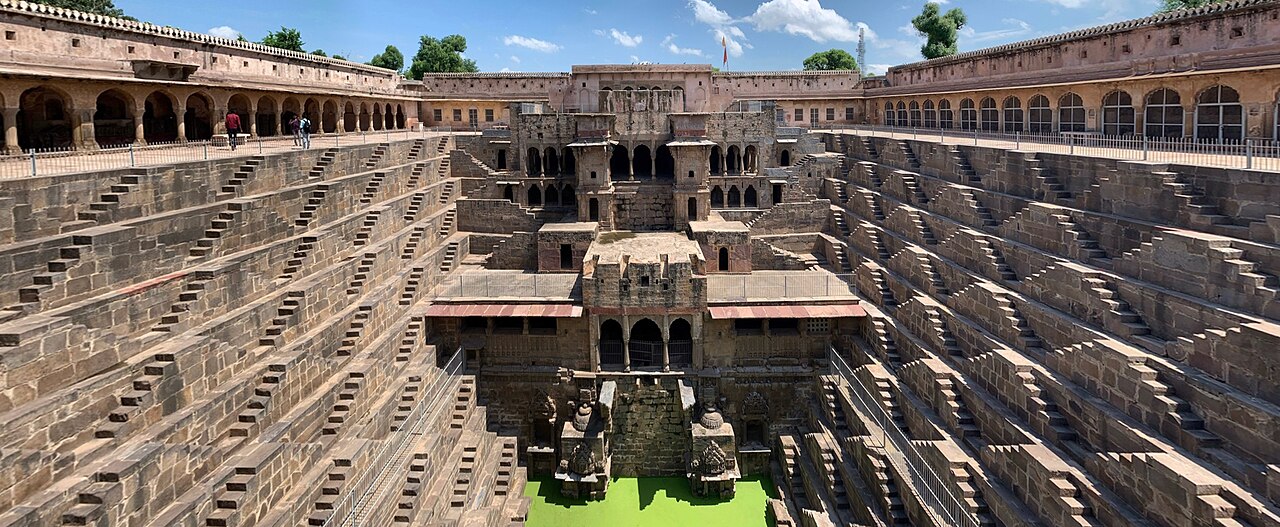
Chand Baori: The Ancient 3,500-Step Symmetrical Geometric Wonder of Abhaneri
In the quiet, dust-kissed village of Abhaneri in Rajasthan's Dausa district stands one of humanity's most hypnotic architectural and hydraulic feats: Chand Baori. Built between the 8th and 9th centuries CE by King Chanda of the Nikumbha Rajput dynast...
 💡 Astrophysics
Lagrange Points: The Invisible Gravitational Parking Spots of Deep Space
In the vast expanse of space, where massive celestial bodies exert immense gravitational pulls on each other, there exist rare, invisible harbors of stability known as Lagrange Points. Discovered mathematically by Italian-French astronomer Joseph-Lou...
 🔬 Earth Science & Oceanography
The Pycnocline: Earth's Invisible Liquid Walls and Ocean Stratification
Beneath the restless surface of the world's oceans lies a hidden architectural marvel of fluid dynamics: the pycnocline. This invisible boundary layer separates the sunlit upper mixed ocean from the crushing, frigid depths below. By acting as a dense...
Comments & Reviews
Tap stars to rate this page: