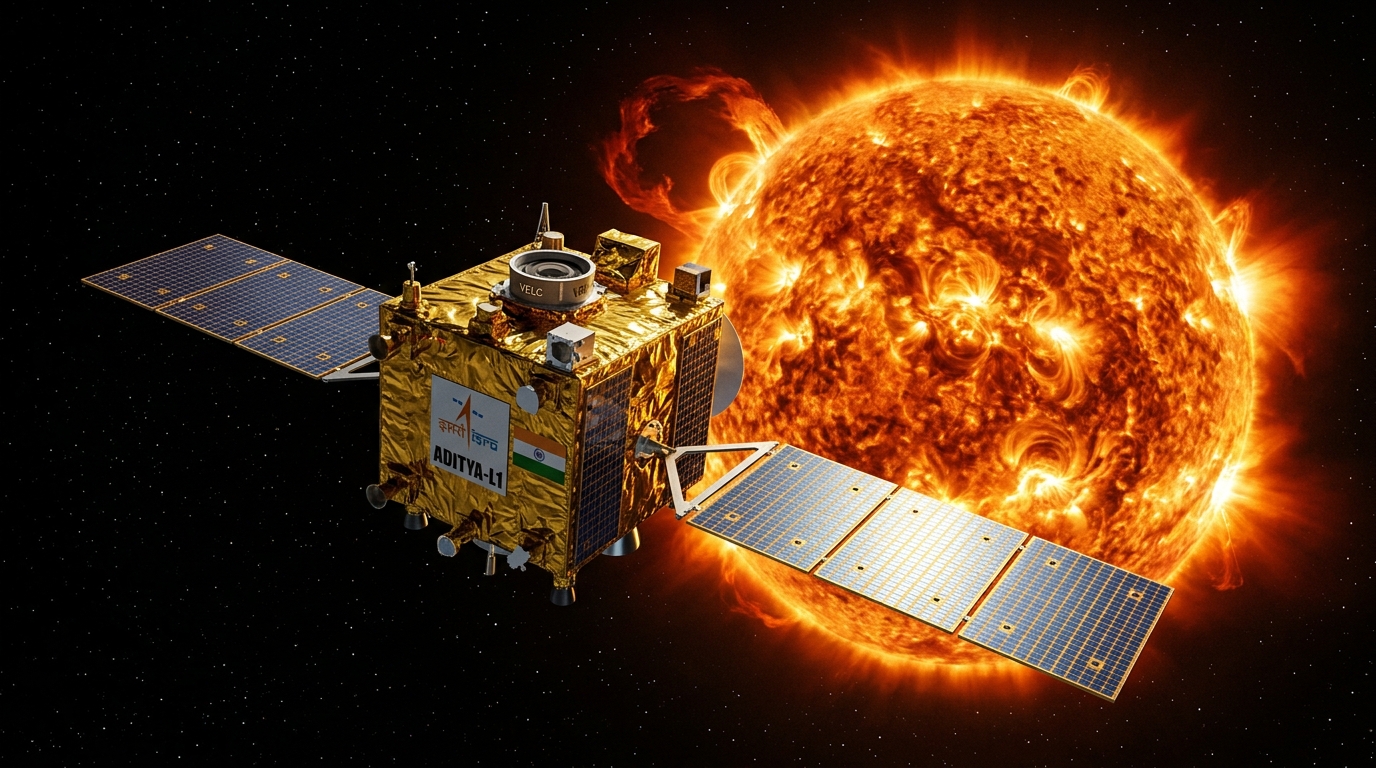
In the vast expanse of space, where massive celestial bodies exert immense gravitational pulls on each other, there exist rare, invisible harbors of stability known as Lagrange Points. Discovered mathematically by Italian-French astronomer Joseph-Louis Lagrange in 1772, these five unique locations in a two-body system (such as the Sun and Earth) allow a smaller third body to maintain a fixed relative position with minimal fuel consumption. Serving as nature's cosmic parking spots, Lagrange points have transformed modern space exploration, enabling flagship observatories to peer into the deep universe and continuously monitor solar activity.
The Physics of Orbital Equilibrium: How Lagrange Points Function
Lagrange points are dynamic positions in space where gravitational forces and centrifugal acceleration precisely cancel each other out.
- Gravitational Equilibrium: The gravitational pulls of two massive primary bodies (such as the Sun and Earth) provide precisely the centripetal force required for a third smaller object to orbit alongside them.
- Stable vs. Unstable Points: Of the five points, L1, L2, and L3 lie along the imaginary line connecting the two primary masses and are dynamically unstable, requiring periodic propulsive adjustments (station-keeping). In contrast, L4 and L5 form equilateral triangles with the primaries and are naturally stable.
- Coriolis Stabilization: Objects near L4 and L5 are held in stable orbital loops due to the influence of the Coriolis force, acting as celestial gravitational sinks that naturally trap interplanetary dust and Trojan asteroids.
- Halo and Lissajous Orbits: Spacecraft at unstable points like L1 and L2 do not sit static at a single point; instead, they execute complex 3D halo or Lissajous orbits around these mathematical points to maintain communication and solar power efficiency.
Strategic Role in Modern Astronomy: Applications of L1 through L5
Each Lagrange point offers distinct geometric and thermal advantages for planetary science, deep-space observation, and heliophysics.
- Sun Observer L1: Situated approximately 1.5 million kilometers inside Earth's orbit toward the Sun, L1 offers an uninterrupted line of sight to the solar disk, making it ideal for solar observatories like SOHO and ISRO's Aditya-L1.
- Deep-Space Window L2: Positioned 1.5 million kilometers directly behind Earth away from the Sun, L2 allows spacecraft like the James Webb Space Telescope (JWST) to block solar radiation using a thermal shield and look into the deep, cold infrared universe.
- Far-Side Relay L3: Hidden permanently behind the Sun opposite Earth's orbit, L3 remains a theoretical location often leveraged in orbital dynamics concepts and science fiction.
- Trojan Asteroid Sanctuaries (L4 & L5): Located 60 degrees ahead and behind Earth in its orbital path, L4 and L5 harbor ancient space debris and Trojan asteroids, providing pristine clues about the early formation of the Solar System.
Technical & Scientific Specifications
📐 Orbital & Mathematical Specifications
- Total Equilibrium Points: 5 per two-body gravitational system (L1 to L5)
- Sun-Earth L1/L2 Distance: ~1.5 million kilometers from Earth (~0.01 AU)
- L4 & L5 Angular Displacement: Exactly 60 degrees ahead/behind in orbit
- Mass Ratio Stability Threshold: Primary-to-secondary mass ratio > 24.96 for L4/L5 stability
- Mathematical Origin: Formulated by Joseph-Louis Lagrange in 1772 via the Restricted Three-Body Problem
Key Exam & Knowledge Takeaways
🎯 Important Examination Points
- Three-Body Problem Solution: Lagrange points are exact analytical solutions to the restricted three-body problem in classical orbital mechanics.
- Stability Classifications: Collinear points (L1, L2, L3) are dynamically unstable saddle points; collinear orbits require active fuel burn to maintain halo orbits.
- Aditya-L1 Mission Purpose: ISRO placed Aditya-L1 in a halo orbit around Sun-Earth L1 to observe the solar corona, flares, and coronal mass ejections without optical occultation.
- JWST Thermal Optimization: JWST operates around L2 so that its giant tennis-court-sized sunshield can continuously block heat from the Sun, Earth, and Moon simultaneously.
- Trojan Asteroid Trap: Jupiter's L4 and L5 points hold thousands of Trojan asteroids trapped since the formation of the early solar system.
Legacy and Scientific Significance
Lagrange points stand as a remarkable triumph of theoretical mathematics preceding real-world application by centuries. By giving humanity cosmic footholds where gravity works in balance with orbital dynamics, these celestial locations will remain pivotal gateways for future deep-space observatories, lunar staging gateways, and interplanetary transit networks.


Comments & Reviews
Tap stars to rate this page: