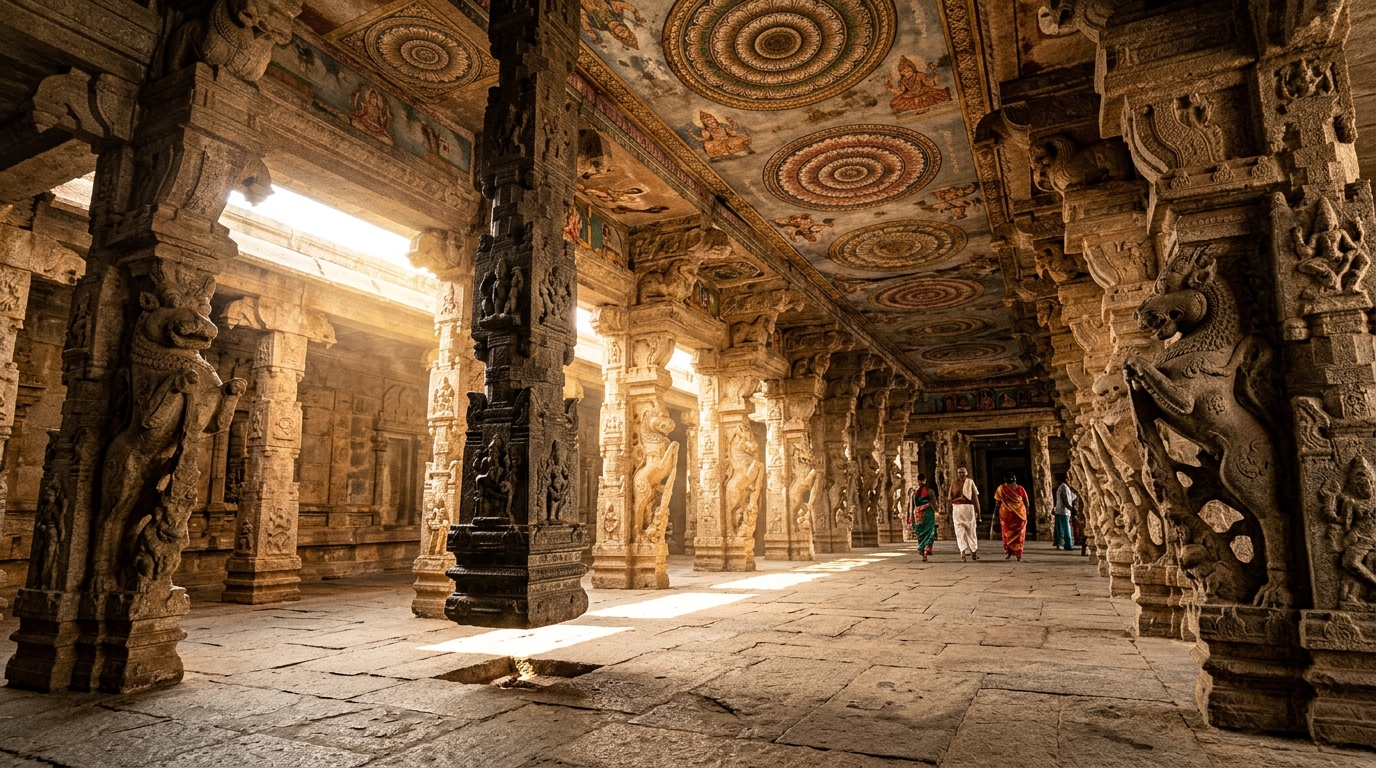
In the quiet town of Lepakshi in Andhra Pradesh stands a 16th-century monument that continues to confound modern civil engineers and architects: the Veerabhadra Temple. Built during the zenith of the Vijayanagara Empire, this stone complex is celebrated for its extraordinary sculptural virtuosity. Yet, its most famous feature is a gravity-defying mechanical puzzle: among the 70 elaborately carved stone pillars supporting the temple's dance pavilion, one pillar does not touch the ground at all—it hangs suspended from the ceiling, with an open gap underneath through which cloth and paper can be passed freely from side to side.
The Mystery of the Hanging Pillar (Aakaasa Sthambha)
The famous Aakaasa Sthambha (Sky Pillar) is carved from solid hard granite, yet it remains anchored exclusively to the heavy stone roof rather than resting on the temple plinth.
- The Flawed British Experiment: During the British colonial era in the early 20th century, a British civil engineer named Hamilton attempted to uncover the secret of the pillar. Assuming it was a minor architectural trick, he attempted to dislodge it with an iron crowbar. To his horror, the moment he shifted the pillar by mere millimeters, the entire ceiling structure groaned and adjacent load-bearing pillars began to tilt and fracture—proving the hanging pillar was an essential cantilever balancer distributing gravitational stress across the roof! Hamilton abandoned the experiment immediately.
- Cantilever Tension Mechanics: Modern structural analyses suggest the pillar operates as an ingenious tension-cantilever counterbalance. Ancient Vijayanagara sthapatis (architects) designed the vaulted ceiling using interlocking stone lintels, where the hanging pillar acts as a keystone damper absorbing thermal expansion and seismic vibrations.
Monolithic Masterpieces: India's Largest Nandi and the Nagalinga
Beyond the suspended pillar, the Lepakshi complex hosts some of the most monumental rock-cut sculptures ever achieved on the Indian subcontinent.
- The Colossal Monolithic Nandi: Located 200 metres before the main temple gates lies India's largest monolithic statue of Nandi (the sacred bull). Carved from a single massive granite outcrop, it measures an astonishing 27 feet (8.2 metres) in length and 15 feet (4.5 metres) in height, adorned with intricately carved bells, flower garlands, and realistic skin folds.
- The Seven-Hooded Nagalinga: Inside the temple courtyard stands a monumental granite Nagalinga, carved from a single continuous boulder. A colossal coiled serpent with seven raised hoods arches protectively over a polished black granite Shiva Linga, reputed to have been sculpted by royal artisans in a single afternoon while waiting for lunch.
- Asia's Largest Ceiling Fresco: The ceiling of the main hall features a stunning 24-foot by 14-foot fresco depicting the 14 avatars of Lord Shiva. Executed with natural mineral and vegetable pigments, these paintings represent the largest single continuous ceiling mural of the Vijayanagara period.
Architectural & Structural Specifications
📐 Architectural & Structural Specifications
- Patron & Construction Period: Built around 1530–1545 CE by brothers Virupanna and Veeranna, royal treasurers under Emperor Achyuta Deva Raya (Vijayanagara Dynasty).
- Architectural Style: Classic Vijayanagara School of Dravidian Architecture (noted for high open mantapas and rearing Yali balustrades).
- Pillar Count & Material: 70 monolithic granite pillars inside the Mukha Mantapa; constructed without mortar using mortise-and-tenon interlocking stone joinery.
- Suspension Clearance: Approximately 0.5 to 1.5 inches of clearance beneath the base of the central hanging pillar.
Competitive Exam & GK Takeaways
🎯 Key Exam & Knowledge Points
- Located in Lepakshi, Sri Sathya Sai (formerly Anantapur) District, Andhra Pradesh.
- Placed on the Tentative List of UNESCO World Heritage Sites in 2022 under the 'Monuments and Forts of the Deccan Sultanate and Vijayanagara' category.
- According to local lore connected to the Ramayana, Lepakshi is believed to be the spot where the demi-god bird Jatayu fell after battling Ravana, where Lord Rama said 'Le Pakshi' (Rise, bird, in Telugu).
- Protected and preserved as a Monument of National Importance by the Archaeological Survey of India (ASI).
A Living Testament to Medieval Engineering Genius
The Veerabhadra Temple at Lepakshi stands as a humbling reminder of the sophisticated understanding of physics, balance, and material science possessed by ancient Indian builders. Long before modern load-bearing simulations and tension mathematics, Vijayanagara masters created a suspended stone monument that continues to enchant travellers and scientists half a millennium later.

Comments & Reviews
Tap stars to rate this page: