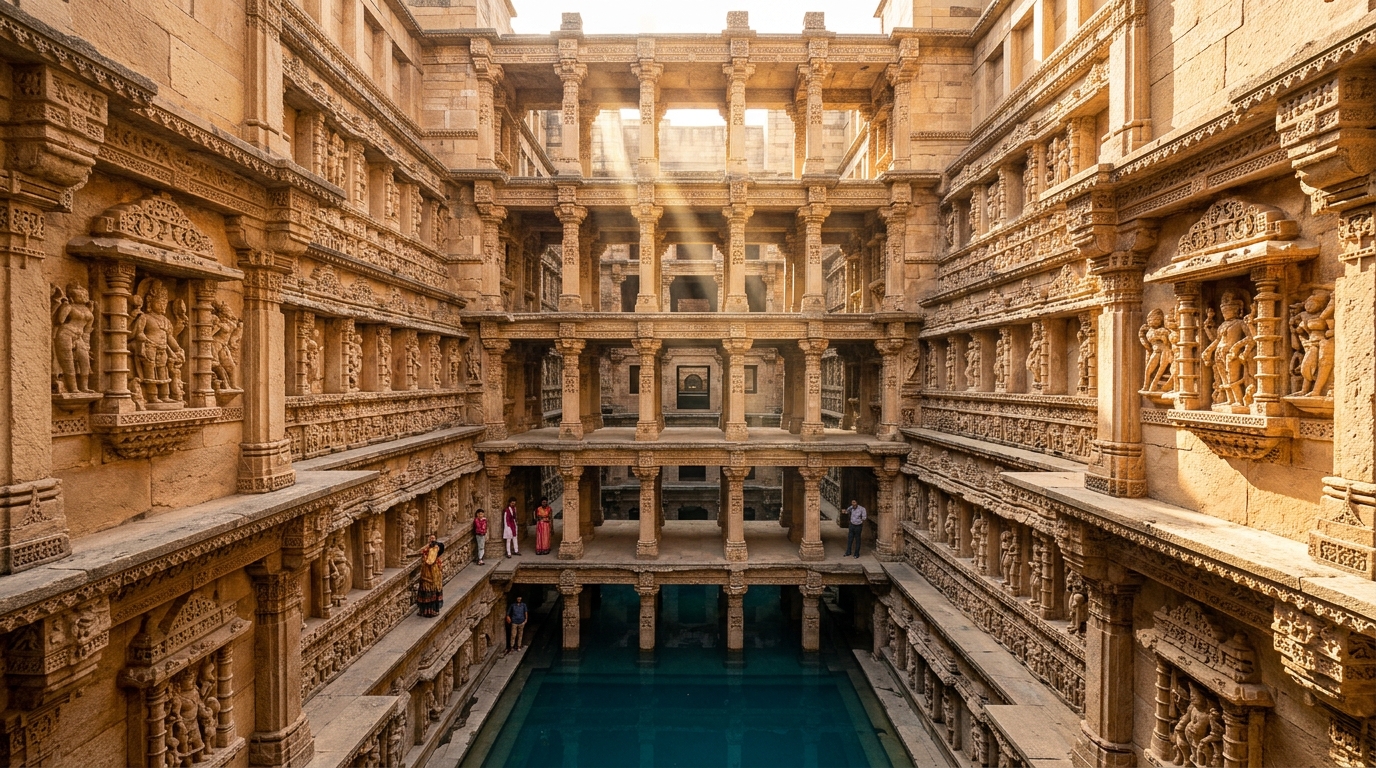
In the arid plains of Patan in northern Gujarat lies an architectural masterpiece that turns traditional Indian temple architecture completely upside down: Rani ki Vav (The Queen's Stepwell). Built during the 11th century CE by Queen Udayamati in loving memory of her husband, King Bhima I of the Chaulukya (Solanki) Dynasty, this monument is not merely a water reservoir. It is conceived as a magnificent inverted subterranean temple, stepping down into the womb of Mother Earth to sanctify the most precious desert resource: water.
The Concept of the Inverted Temple
While classical Indian shrines ascend vertically toward the heavens, Rani ki Vav descends seven majestic subterranean storeys toward the water table.
- Stepped Pavilion Architecture: Designed in the sophisticated Maru-Gurjara architectural style, the stepwell measures roughly 65 metres long, 20 metres wide, and over 27 metres deep.
- Sanctification of Water: In ancient arid India, water was revered as the divine source of cosmic life. By descending through pillared pavilions flanked by celestial deities, entering the stepwell transformed the mundane task of drawing water into a sacred pilgrimage.
- The Vishnu Iconography: More than 500 principal sculptures and over 1,000 minor carvings adorn the subterranean stone walls. The presiding deity is Lord Vishnu, depicted in His cosmic sleep upon the serpent Adishesha (Sheshashayi Vishnu) at water level, alongside all ten classical incarnations (Dashavatara)—including Varaha, Narasimha, Vamana, and Rama.
Preserved Under River Silt for 800 Years
One of the most extraordinary facets of Rani ki Vav is its miraculous preservation through an accident of natural history.
- Saraswati River Floods: In the 13th century, catastrophic flooding and course changes of the ancient Saraswati river buried the entire structure under thick alluvial silt and sand.
- Natural Protective Cocoon: For nearly eight centuries, this subterranean monument lay completely hidden underground. The anaerobic silt acted as a protective time capsule, shielding delicate sandstone carvings from wind erosion, weathering, and medieval desecration.
- The ASI Excavation: The Archaeological Survey of India (ASI) meticulously desilted and restored the stepwell between 1958 and the 1980s, revealing the pristine craftsmanship almost exactly as it stood a millennium ago.
Architectural & Hydraulic Specifications
📐 Architectural & Hydraulic Specifications
- Builder & Period: Commissioned by Queen Udayamati (reign of Solanki/Chaulukya Dynasty, c. 1063–1068 CE).
- Dimensions: Length: ~65 m | Width: ~20 m | Depth: ~28 m across 7 tiered subterranean levels.
- Architectural Typology: Nanda-type stepwell (single entrance opening to an elongated stepped corridor with multiple pillared pavilion storeys).
- Structural Material: Local sandstone intricately joined using stone mortise-and-tenon mechanical brackets.
- Hydraulic Engineering: Multistage stepped reservoir acting as a natural rainwater percolation, sedimentation, and silt-filtering cistern.
Competitive Exam & GK Takeaways
🎯 Key Exam & Knowledge Points
- Inscribed as a UNESCO World Heritage Site in June 2014 under the Cultural Heritage category.
- Depicted on the reverse side of India's new Lavender ₹100 Currency Banknote issued by the Reserve Bank of India in 2018.
- Regarded by historians as the pinnacle of the Maru-Gurjara (Solanki) architectural school that flourished in medieval Gujarat and Rajasthan.
- Celebrated as one of the world's most intricate surviving examples of traditional community-based subterranean water management and rainwater harvesting.
A Subterranean Ode to Water and Art
Rani ki Vav represents the sublime meeting of utilitarian hydraulic engineering and spiritual aesthetic brilliance. In an arid land where every drop of rain meant life, ancient Indian artisans turned a community water well into a grand, sacred subterranean palace that continues to inspire engineers, artists, and historians across the globe.

Comments & Reviews
Tap stars to rate this page: