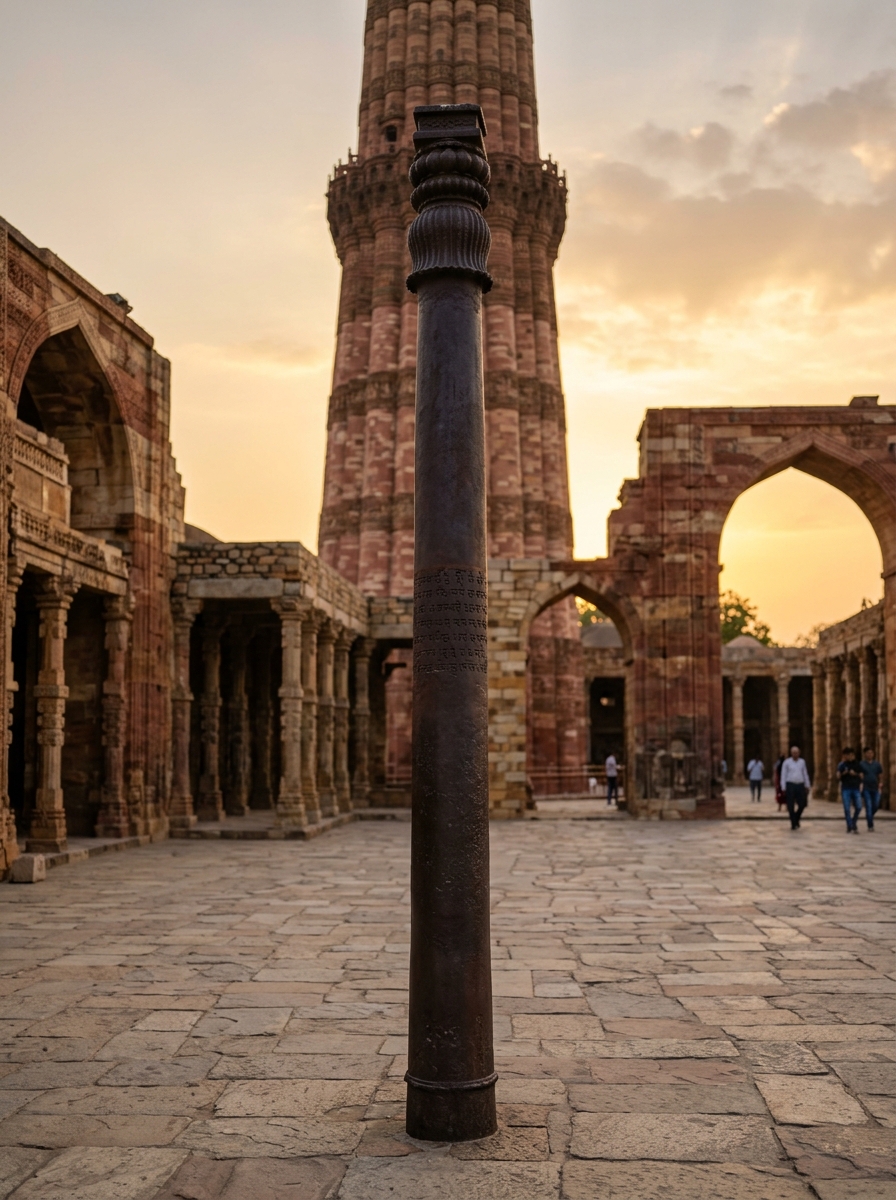
Standing tall in the open courtyard of the Qutb Complex in Mehrauli, New Delhi, stands one of the world's greatest metallurgical and historical wonders: the Iron Pillar of Delhi. Standing over 7.21 meters (23 feet 8 inches) high and weighing over six metric tonnes (6,511 kg), this colossal wrought-iron column has withstood 1,600 years of blistering summer heat, monsoonal downpours, winter frost, and urban pollution—without succumbing to devastating rust or corrosion.
Historical Genesis: King Chandra and the Gupta Golden Age
The pillar bears a six-line, three-stanza Sanskrit inscription in classical Gupta Brahmi script. The poetic inscription eulogizes the martial triumphs of a powerful monarch named King Chandra, universally identified by modern historians and epigraphists as the Gupta emperor Chandragupta II Vikramaditya (reigned c. 375–415 CE):
- Garuda Dhvaja: The inscription records that the pillar was erected as a sacred victory standard (Vishnudhvaja) on a hill called Vishnupada (likely modern Udayagiri in Madhya Pradesh) dedicated to Lord Vishnu. The capital atop the pillar originally supported an image of Garuda, Vishnu's celestial mount.
- Relocation to Delhi: Historical records indicate that the Tomara Rajput king Anangpal II relocated the pillar from central India to his fortified city of Lal Kot (Delhi) in the 11th century CE, where it was later incorporated into the Quwwat-ul-Islam mosque courtyard.
The Metallurgical Secret: Why Doesn't It Rust?
For centuries, travelers and early European colonial metallurgists believed the pillar was cast from a lost alien alloy or pure bronze. However, scientific investigations led by materials scientists from IIT Kanpur (notably Professor R. Balasubramaniam) dismantled these myths using modern electron microscopy and X-ray diffraction, revealing the genius of ancient Indian metallurgists:
- Forge-Welding Technology (Shindur Method): The pillar is not cast iron; it was manufactured through forge-welding of high-purity wrought iron lumps (spongy iron blooms produced in charcoal-fueled extraction furnaces). Hundreds of red-hot 20 kg to 30 kg iron lumps were hammered together in a monumental display of hammer-forging.
- Abnormal High Phosphorus, Zero Sulfur: Modern structural steel typically contains less than 0.05% phosphorus because high phosphorus causes cold-shortness (brittleness). However, ancient Indian smiths extracted iron using wood charcoal without adding limestone as a flux. Consequently, phosphorus remained trapped in the metal at an exceptionally high concentration of 0.25% to 0.40%.
- Formation of the Protective 'Misawite' Passive Layer: When iron corrodes, phosphorus acts as a powerful catalyst. Instead of forming porous, flaky rust (hematite / Fe₂O₃), the chemical interaction between phosphorus, iron, and atmospheric oxygen created an ultra-thin (less than 1/20th of a millimeter), amorphous, highly adherent protective passive film composed of crystalline iron hydrogen phosphate hydrate (FePO₄·H₃PO₄·4H₂O) and misawite (δ-FeOOH).
- Self-Healing Barrier: This nano-scale passive film acts as a permanent barrier that completely seals the core metal from atmospheric moisture and oxygen. Even if the surface suffers a superficial scratch, the high phosphorus content instantly re-oxidizes to repair the protective film within days.
Dimensions and Mechanical Architecture
📐 Engineering Specifications of the Pillar
- Total Height: 7.21 meters (6.09 m above ground, 1.12 m buried below surface in a lead-soldered base).
- Total Weight: Approximately 6,511 kg (over 6.5 tonnes).
- Diameter: Tapers gracefully from 42 cm (16.5 inches) at the base to 30 cm (12 inches) just below the decorative capital.
- Decorative Capital: Carved in classical Amalaka and bell-lotus motifs reflecting mature Gupta architecture.
Competitive Exam & GK Takeaways
🎯 High-Yield History & Science Facts for UPSC & State PSC
- Associated Dynasty: Gupta Dynasty (Golden Age of Indian art and metallurgy); King Chandragupta II Vikramaditya.
- Script & Language: Gupta Brahmi Script; Classical Sanskrit poetry.
- Scientific Catalyst for Rust Resistance: High concentration of Phosphorus (P) and the formation of a protective misawite (δ-FeOOH) / iron hydrogen phosphate passive film.
- Manufacturing Method: Hammer-forge welding (not casting).
- Similar Historic Iron Wonders in India: Dhar Iron Pillar (Madhya Pradesh) and Kodachadri Iron Pillar (Karnataka).
Legacy and Global Significance
The Iron Pillar of Delhi stands as living testimony that ancient India led the world in metallurgical chemistry over a thousand years before the European Industrial Revolution. Today, it remains a designated UNESCO World Heritage Site feature within the Qutb Complex, studied by materials engineers worldwide developing sustainable, eco-friendly rust-inhibiting alloys for space and ocean exploration.
Comments & Reviews
Tap stars to rate this page: