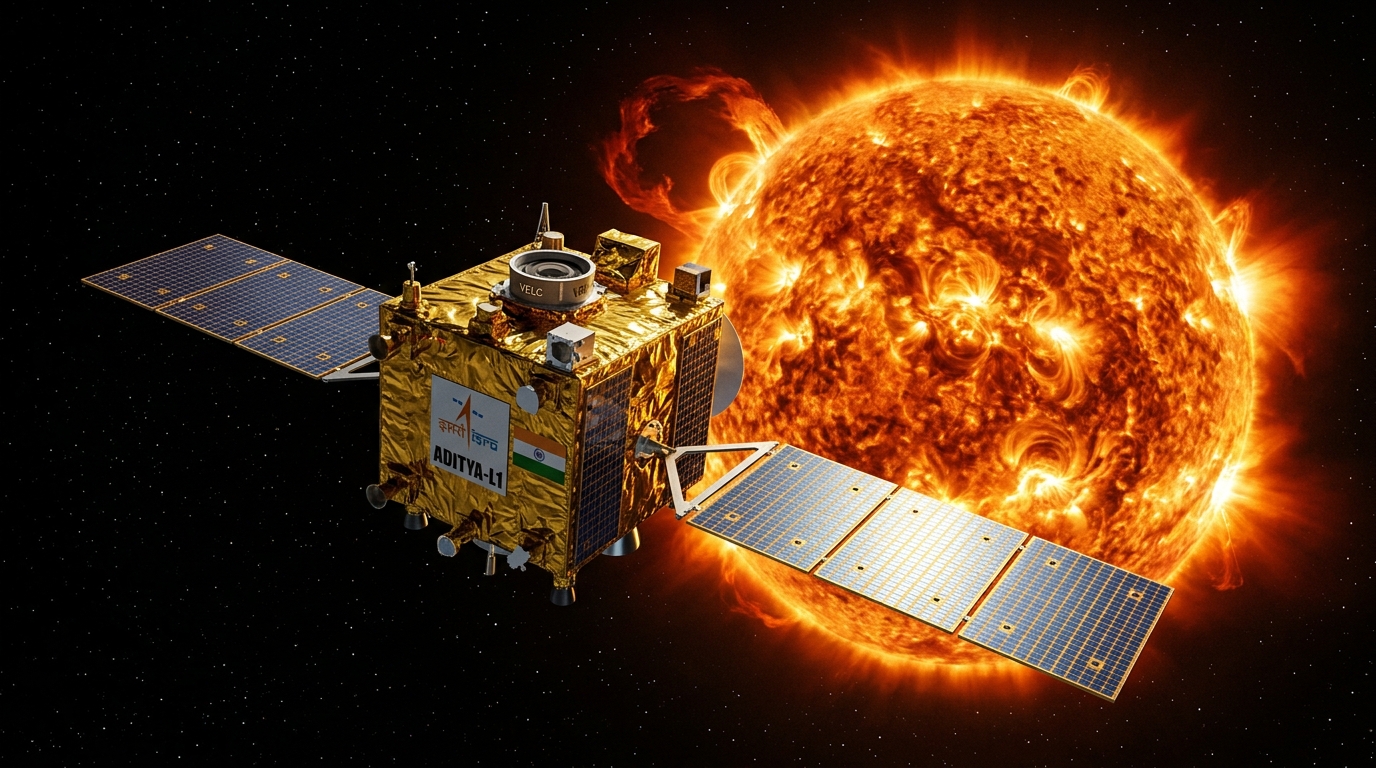
On 2 September 2023, following the historic triumph of the Chandrayaan-3 lunar landing, the Indian Space Research Organisation (ISRO) launched its maiden dedicated space observatory to study our closest star: Aditya-L1. Flying aboard the workhorse PSLV-C57 rocket from the Satish Dhawan Space Centre in Sriharikota, this sophisticated 1,475-kilogram spacecraft completed an intricate four-month journey traversing 1.5 million kilometers across interplanetary space before successfully injecting into a periodic halo orbit around the Sun-Earth Lagrange Point 1 (L1).
The Physics of Lagrange Point 1 (L1): Gravitational Equilibrium
In classical orbital celestial mechanics, placing a satellite in low Earth orbit limits solar observations because the spacecraft spends roughly half of each orbit passing through Earth's nightside shadow, and atmospheric absorption blocks crucial ultraviolet and X-ray wavelengths. Lagrange points offer an ingenious solution to this orbital dilemma:
- Three-Body Problem Solved: Formulated by Italian-French mathematician Joseph-Louis Lagrange in 1772, there are five specific gravitational equilibrium points in a two-body orbital system (such as the Sun and Earth) where the combined gravitational pulls of the two large masses precisely balance the orbital centrifugal force experienced by a third small mass.
- Uninterrupted Solar View at L1: Positioned roughly 1.5 million kilometers from Earth directly along the Sun-Earth line (approx. 1% of the total 150 million km Sun-Earth distance), L1 orbits the Sun with the exact same 365.25-day period as Earth.
- Zero Solar Eclipses: A spacecraft stationed at L1 never experiences an eclipse or occultation by Earth or the Moon, enjoying a permanent, 24/7/365 uninterrupted panoramic view of the burning solar disc.
The Halo Orbit: Balancing on a Gravitational Saddle
Unlike Lagrange points L4 and L5, which form stable gravitational 'wells', L1 is a dynamically unstable equilibrium point—analogous to balancing a marble on top of a curved saddle. Without active station-keeping, any minor perturbation would cause the satellite to drift away into deep solar orbit or fall back toward Earth.
ISRO navigation engineers solved this by placing Aditya-L1 into a specialized Halo Orbit. Rather than sitting frozen at the exact L1 mathematical coordinates, the spacecraft glides along a continuous, three-dimensional elliptical loop around L1. Performing tiny, precise thruster burns every few weeks requires minimal propellant while keeping solar panels permanently illuminated and maintaining continuous line-of-sight communication with ISRO Telemetry, Tracking and Command Network (ISTRAC) ground stations.
Scientific Payloads: Unravelling the Great Solar Mysteries
Aditya-L1 carries seven indigenously developed, state-of-the-art scientific payloads designed to observe the solar photosphere, chromosphere, and the mysterious corona, alongside sampling local plasma environments:
- VELC (Visible Emission Line Coronagraph): Developed by the Indian Institute of Astrophysics (IIA), Bangalore. Functions as an internal artificial total solar eclipse, blocking the blinding solar disc to capture high-speed spectroscopic imaging of the faint, million-degree corona down to 1.05 solar radii.
- SUIT (Solar Ultraviolet Imaging Telescope): Built by IUCAA, Pune. Captures full-disk ultra-high-resolution images of the Sun in near-ultraviolet wavelengths (200–400 nm) to study solar energy variations that directly impact Earth's climate.
- ASPEX & PAPA: The Aditya Solar Wind Particle Experiment and the Plasma Analyser Package for Aditya directly sample the velocity, density, and ion composition of the solar wind and energetic proton streams.
- SoLEXS & HEL1OS: Soft and Hard X-ray spectrometers analyzing high-energy radiation released during sudden solar flares and coronal mass ejections.
- Advanced Tri-axial High Resolution Digital Magnetometer: Deployed on a 6-meter boom to measure subtle interplanetary magnetic field variations.
Solving the Solar Corona Temperature Paradox
One of the greatest unsolved puzzles in astrophysics is why the Sun's outer atmosphere (the corona) blazes at an astonishing 1 to 3 million degrees Celsius, while the visible solar surface (the photosphere) beneath it sits at a comparatively cool 5,500°C. In everyday physics, heat always flows from hotter objects to colder ones—a campfire does not get hotter the further away you stand.
By capturing simultaneous ultraviolet, visible, and X-ray emission lines with sub-second temporal resolution, Aditya-L1 is providing decisive data on whether coronal heating is fueled by magnetic reconnection 'nanoflares' or by acoustic Alfven magnetohydrodynamic waves rippling upward through the solar magnetic carpet.
Competitive Exam & GK Takeaways
🎯 High-Yield Space Science Facts for UPSC, SSC & Defense Exams
- Launch Vehicle: PSLV-C57 (Polar Satellite Launch Vehicle - XL configuration), launched 2 September 2023.
- Orbit Type: Halo orbit around Sun-Earth Lagrange Point 1 (L1), 1.5 million km from Earth.
- Primary Payload: VELC (Visible Emission Line Coronagraph), developed by IIA Bengaluru.
- Space Weather Defense: Aditya-L1 provides critical early warnings (approx. 45–60 minutes in advance) before violent Coronal Mass Ejections (CMEs) hit Earth's magnetosphere, protecting communication satellites and terrestrial power grids.
Conclusion
Aditya-L1 cements India's elite standing in space science alongside NASA and ESA. By maintaining an unblinking vigil over our star, ISRO's solar observatory is not only protecting global technological infrastructure from space weather catastrophes, but also unlocking fundamental cosmic secrets that govern star physics across the universe.

Comments & Reviews
Tap stars to rate this page: