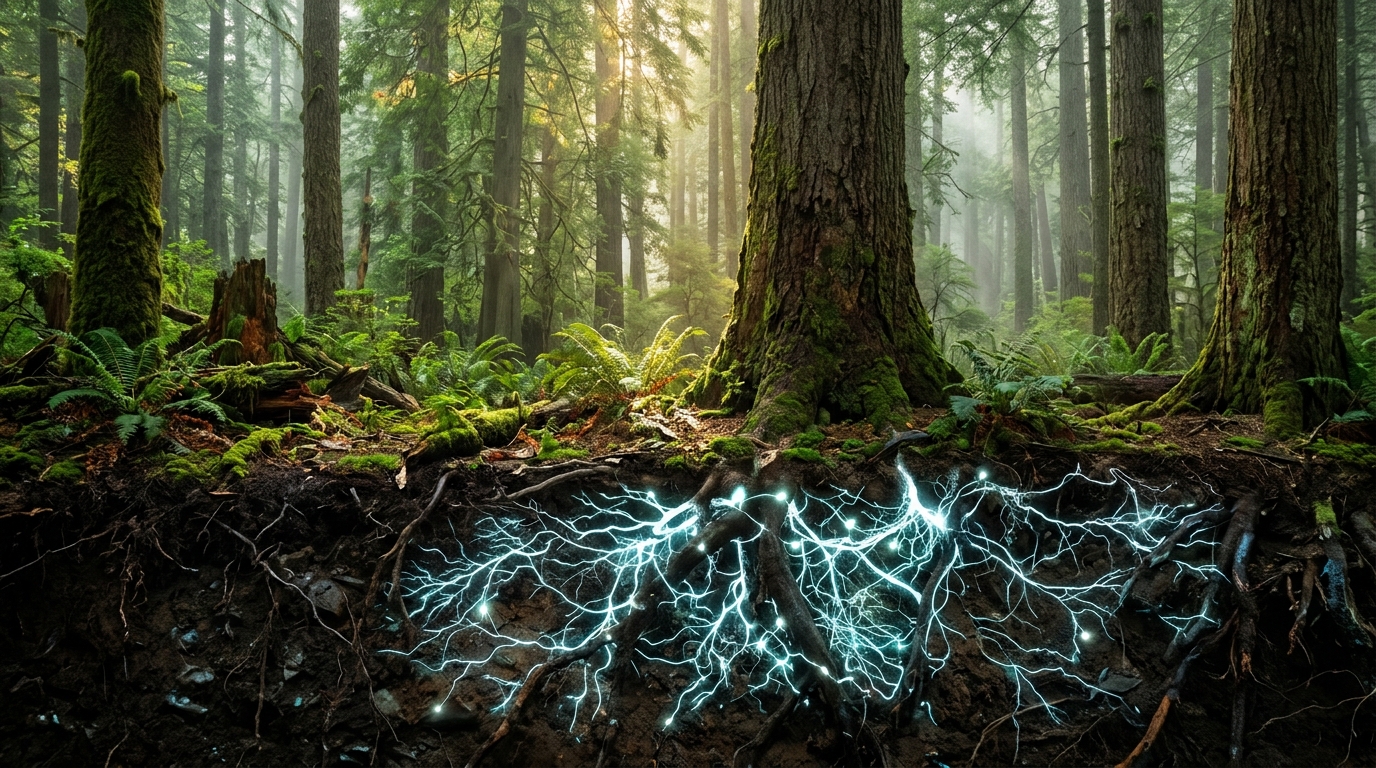
For centuries, classical forestry and Darwinian evolutionary biology viewed forests predominantly as ruthless battlegrounds where individual trees fiercely competed with one another for limited sunlight, water, and soil nutrients. However, revolutionary ecological research over the past three decades—pioneered by forest ecologist Dr. Suzanne Simard—has revealed that a forest operates not as a collection of selfish individuals, but as an intricately linked, cooperative super-organism connected by a subterranean biological internet nicknamed the 'Wood Wide Web'.
The Biological Infrastructure: Mycorrhizal Networks
The physical cables of this natural internet are composed of vast, thread-like fungal filaments called mycelium. The microscopic threads (hyphae) of specialized fungi physically fuse with the root tips of trees, establishing an ancient, 450-million-year-old symbiotic partnership known as mycorrhiza (from the Greek mykes meaning fungus, and rhiza meaning root):
- The Mutualistic Trade: Trees are photosynthesis powerhouses capable of capturing solar energy and fixing atmospheric carbon dioxide into sugars and carbohydrates. Fungi cannot photosynthesize, but their microscopic mycelial threads possess an immense surface area that mines soil minerals (particularly phosphorus, nitrogen, potassium, and micronutrients) and absorbs deep ground moisture.
- Resource Exchange: Trees donate up to 20% to 40% of their photosynthesized carbon sugars to the fungi. In exchange, the fungal network feeds life-giving nitrogen and phosphorus directly back into the tree's vascular system.
A single teaspoon of healthy forest soil can contain several miles of fungal mycelial threads, physically weaving hundreds of trees of diverse species into an interconnected collective web.
How Trees Talk and Share Resources
Because fungal mycelia connect multiple root systems simultaneously, the network serves as a dynamic biological distribution pipeline through which trees share physical resources and transmit chemical information:
- Source-to-Sink Nutrient Redistribution: Using radioactive Carbon-14 and Carbon-13 isotope tracing, scientists proved that mature, sunlit trees continuously pump carbon, water, and nutrients across the fungal network to nourish shadowed saplings growing beneath the dark forest canopy that would otherwise starve from lack of sunlight.
- Cross-Species Cooperation: Resource sharing occurs not only within the same species but across different plant families. For example, deciduous paper birch trees pump surplus carbon to evergreen Douglas firs during the spring and summer; in autumn, when birches drop their leaves, the evergreen firs return carbon through the fungal grid to help the dormant birches survive the winter.
- Early Warning Defense Signals: When a tree is attacked by pest insects (like aphids or caterpillars), it synthesizes defensive compounds (such as tannins and volatile organic chemicals). Crucially, the attacked tree sends electrochemical and biochemical alert signals through the fungal network to neighboring trees hours before the pests arrive. Forewarned neighbors immediately ramp up their chemical defenses, synthesizing anti-feedant enzymes to repel the incoming infestation.
The Crucial Role of 'Mother Trees'
At the center of these subterranean webs stand the oldest, largest trees in the forest, scientifically termed Hub Trees or 'Mother Trees'. DNA analysis reveals that a single majestic mother tree can be directly linked to hundreds of other trees across a forest stand.
Mother trees act as regional nerve centers, prioritizing nutrient allocation to their own kin seedlings while maintaining the overall health of the broader forest ecosystem. When a mother tree is severely injured or approaches natural death, it performs an extraordinary final act: it dumps its massive internal carbon and nutrient reserves through the fungal network to the next generation of saplings, passing down its biological legacy before dying.
Competitive Exam & GK Takeaways
🎯 High-Yield Ecology & Biology Facts for UPSC & State PSC
- Biological Term: Mycorrhiza (symbiotic association between a fungus and the roots of a vascular host plant).
- Major Types: Ectomycorrhizae (hyphae form an external mantle and Hartig net around root cells) and Endomycorrhizae/Arbuscular (hyphae penetrate plant root cell walls).
- Pioneering Scientist: Dr. Suzanne Simard (University of British Columbia), whose 1997 Nature paper popularized the term 'Wood Wide Web'.
- Ecological Importance: Forest clear-cutting destroys subterranean mycelial networks, severely degrading soil fertility and preventing natural forest regeneration.
Implications for Modern Forestry and Conservation
The discovery of the Wood Wide Web has dismantled traditional commercial logging practices. Clear-cutting large forest tracts obliterates fragile underground fungal infrastructure, leaving newly planted monoculture saplings isolated, vulnerable to disease, and unable to establish resilient root networks. Today, sustainable ecological forestry emphasizes preserving ancient mother trees to keep the vital fungal underground internet alive.


Comments & Reviews
Tap stars to rate this page: