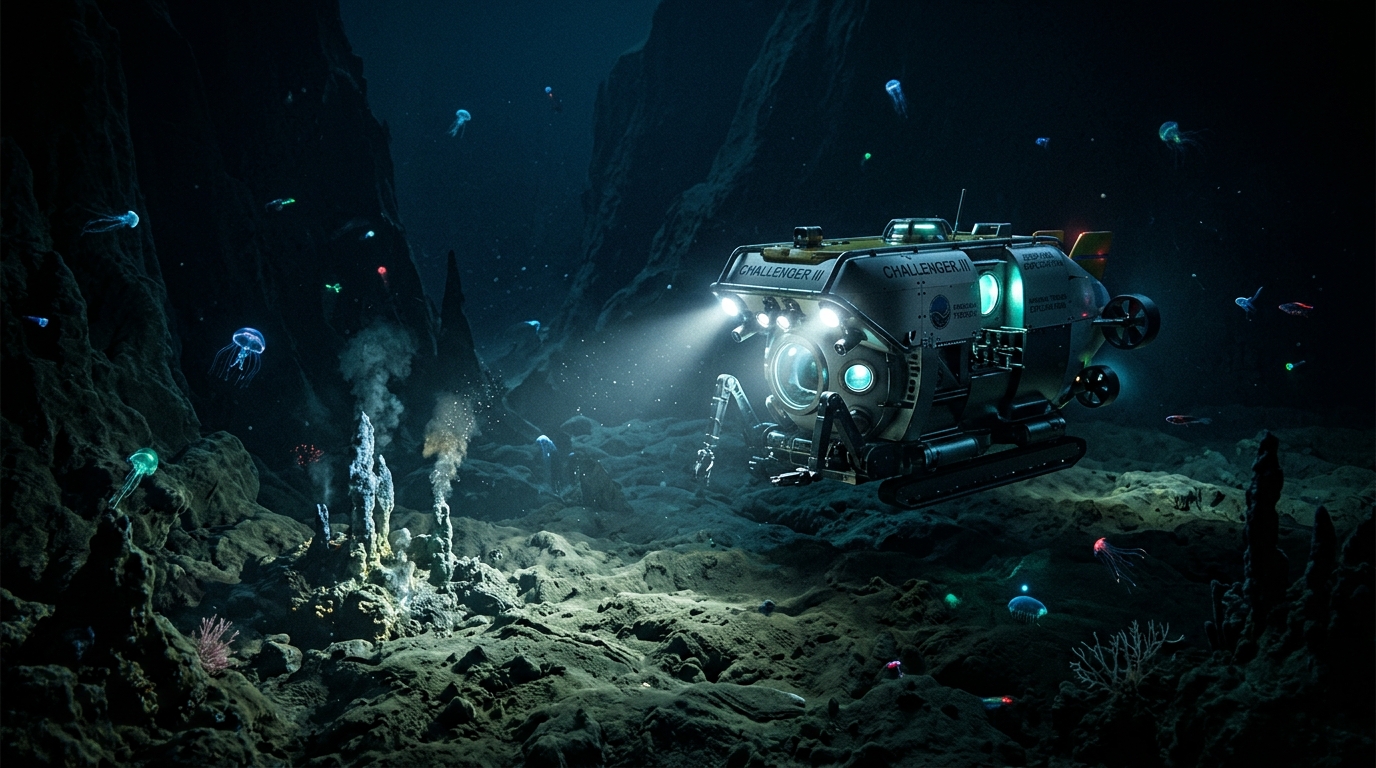
If Mount Everest, Earth's tallest peak standing at 8,848.86 meters, were inverted and dropped into the bottom of the Mariana Trench, its snowy summit would still be submerged under more than two kilometers of pitch-black, frigid ocean water. Situated in the western Pacific Ocean east of the Mariana Islands, the Mariana Trench plunges to a maximum measured depth of approximately 10,994 meters (36,070 feet / nearly 11 kilometers) at its deepest surveyed point: Challenger Deep.
Plate Tectonics: How Earth's Deepest Scar Formed
The Mariana Trench is a direct geological consequence of oceanic plate convergence. Along this active tectonic boundary:
- Subduction Zone Mechanics: The dense, ancient (approx. 180 million years old) Pacific Plate is sliding beneath the smaller, younger, and more buoyant Philippine Sea Plate at a rate of several centimeters per year.
- Deep Hadal Bending: As the rigid oceanic lithosphere plunges into the Earth's mantle, it flexes downward to form a crescent-shaped scar spanning over 2,550 kilometers in length and an average width of 69 kilometers.
- Serpentine Volcanism & Mud Volcanoes: Water dragged down with the subducting slab reacts with mantle peridotite rocks to form serpentinite, causing non-magmatic mud volcanoes that vent alkaline fluids and methane into the deep abyssal plains.
Life Under Unimaginable Physical Extremes
At the bottom of Challenger Deep, environmental conditions belong to the Hadal Zone (depths exceeding 6,000 meters), named after Hades, the ancient Greek god of the underworld. The physical environment features:
- Crushing Hydrostatic Pressure: Over 1,086 to 1,100 bars (more than 15,700 pounds per square inch)—equivalent to having the weight of an adult African elephant balanced on a single human thumb, or roughly 1,100 times standard atmospheric pressure at sea level.
- Total Darkness and Frigid Temperatures: Sunlight penetrates only to a depth of 200 meters (the photic zone). Below 1,000 meters, darkness is absolute. Water temperatures hover barely above freezing, between 1°C and 4°C.
- Extreme Bioluminescent Adaptations: Despite the lack of sunlight for photosynthesis, life flourishes around chemosynthetic microbial mats. Organisms produce specialized chemical compounds called piezolytes (such as trimethylamine N-oxide, or TMAO) that prevent cell membranes and vital proteins from being distorted and crushed by the immense pressure.
Extraordinary Creatures of the Trench
Scientific expeditions deploying deep-sea submersibles, landers, and ROVs (Remotely Operated Vehicles) have documented alien-like biodiversity:
- Mariana Snailfish (Pseudoliparis swirei): The deepest living vertebrate recorded, thriving at depths down to 8,000 meters. Transparent and lacking scales, their bones are composed of soft cartilage and their skull is partially open to equalize crushing internal and external pressure.
- Giant Xenophyophores: Single-celled giant amoebas measuring up to 10 centimeters across that absorb heavy metals (like mercury, lead, and uranium) without suffering toxicity.
- Supergiant Amphipods: Deep-sea crustaceans like Hirondellea gigas that use aluminum-reinforced exoskeletons extracted from seafloor clay to survive the bone-dissolving acidity of high-pressure carbonate-undersaturated waters.
Historic Descents into the Abyss
Because venturing into Challenger Deep requires engineering capable of withstanding pressures greater than those encountered on the surface of Venus, fewer humans have visited the deepest ocean floor than have walked on the Moon:
- 1960 (Bathyscaphe Trieste): Swiss oceanographer Jacques Piccard and US Navy Lieutenant Don Walsh completed the first historic manned descent to 10,916 meters.
- 2012 (Deepsea Challenger): Filmmaker and explorer James Cameron piloted a solo vertical submersible to 10,908 meters, capturing the first high-definition 3D footage of the barren, lunar-like seabed.
- 2019–2020 (Limiting Factor): American explorer Victor Vescovo completed repeated dives, mapping the Eastern, Central, and Western pools of Challenger Deep and setting a record depth of 10,928 meters.
Competitive Exam & GK Takeaways
🎯 High-Yield Geography Facts for UPSC, SSC & Railways
- Deepest Point on Earth: Challenger Deep in the Mariana Trench (~10,994 meters), located in the Western Pacific Ocean.
- Second Deepest Oceanic Trench: Puerto Rico Trench (Milwaukee Deep, ~8,376 m) in the Atlantic Ocean; Sunda (Java) Trench (~7,450 m) is the deepest in the Indian Ocean.
- Tectonic Boundary Type: Ocean-Ocean Destructive/Subduction Boundary (Pacific Plate subducting beneath the Philippine Sea Plate).
- Oceanic Depth Zone Classification: Epipelagic (0-200m) → Mesopelagic (200-1000m) → Bathypelagic (1000-4000m) → Abyssopelagic (4000-6000m) → Hadalpelagic (6000m+).
Environmental Warning: Anthropogenic Pollution in the Abyss
Recent deep-sea expeditions have delivered an alarming ecological discovery: even at the deepest, most remote bottom of Challenger Deep, synthetic microplastics, candy wrappers, and industrial chemical pollutants (like PCBs) were discovered inside the digestive tracts of hadal amphipods, underscoring the urgent need for global ocean conservation.
Comments & Reviews
Tap stars to rate this page: