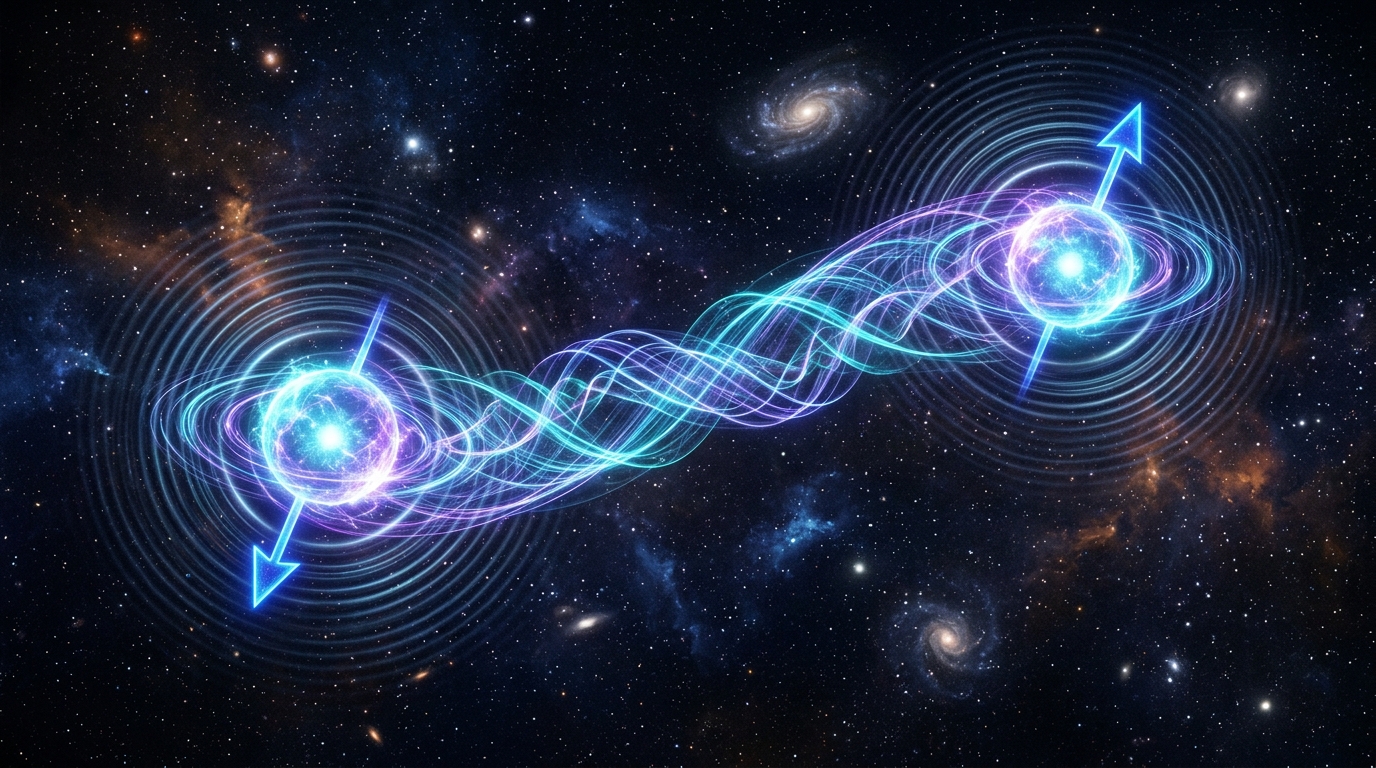
In 1935, Albert Einstein, Boris Podolsky, and Nathan Rosen published a groundbreaking physics paper arguing that quantum mechanics was incomplete. They pointed out an unsettling paradox: according to quantum theory, two subatomic particles could become linked in such a way that measuring the state of one would instantly determine the state of the other, even if they were separated by light-years. Disbelieving that information could propagate faster than light, Einstein famously dismissed the concept as "spooky action at a distance" (spukhafte Fernwirkung).
Today, this 'spooky' phenomenon—known as Quantum Entanglement—is no longer a theoretical debate. It has been experimentally verified across thousands of kilometers, earned the 2022 Nobel Prize in Physics, and is now the core engine driving the next global technological revolution: quantum computing and unbreakable quantum internet.
What is Quantum Entanglement?
In classical everyday physics, objects possess definite, measurable properties at all times. A coin sitting on a table is either heads up or tails up regardless of whether someone looks at it. In the quantum realm, however, elementary particles like electrons and photons exist in a cloud of probabilities called superposition—being in multiple states simultaneously until a physical measurement forces the wave function to collapse into a single definite outcome.
When two particles interact under specific conditions (such as splitting a high-energy laser photon through a non-linear crystal into two lower-energy photons), their quantum states become inextricably intertwined. If one photon is measured to have a vertical polarization, its entangled partner will instantaneously register a horizontal polarization—with zero time delay—even if one particle remains in an Indian laboratory and the other travels to the Andromeda galaxy.
Bell's Theorem and the Death of Local Realism
Einstein argued that the particles must carry 'hidden variables'—pre-programmed instructions established at the moment of their creation, much like placing a red ball in one sealed box and a blue ball in another. If you open one box and find a red ball, you instantly know the other box contains the blue ball without any magic transmission of signals.
In 1964, Northern Irish physicist John Stewart Bell devised a mathematical inequality known as Bell's Theorem to test whether Einstein's 'hidden variables' were real. Beginning with landmark experiments by Alain Aspect in 1982, and refined by John Clauser and Anton Zeilinger, physicists proved beyond doubt that Bell's inequality is violated in nature. Nature is fundamentally non-local: entangled particles do not possess predetermined values before measurement; their shared destiny is genuinely decided across space instantaneously.
The Quantum Revolution: Practical Applications
Far from being just philosophical, quantum entanglement is transforming 21st-century technology:
- Qubits and Quantum Supremacy: While classical computers use binary bits (0 or 1), quantum computers utilize qubits. Through entanglement and superposition, quantum processors can calculate exponentially vast permutations simultaneously, solving complex molecular drug designs and optimization problems in seconds that would take classical supercomputers millennia.
- Quantum Key Distribution (QKD): By transmitting cryptographic keys encoded in entangled photon pairs, eavesdropping becomes physically impossible. Any intercepting hacker disturbs the fragile quantum state, instantly alerting both sender and receiver and corrupting the key before data can be stolen.
- Satellite-Based Quantum Networks: In 2017, China's Micius satellite demonstrated quantum key distribution over a record distance of 1,200 kilometers between ground stations in Tibet and Xinjiang, laying the foundation for an unhackable global quantum internet.
Competitive Exam & GK Takeaways
🎯 High-Yield Facts for UPSC, SSC & Defense Exams
- EPR Paradox: Formulated in 1935 by Einstein, Podolsky, and Rosen questioning quantum completeness.
- 2022 Nobel Prize in Physics: Awarded jointly to Alain Aspect, John F. Clauser, and Anton Zeilinger for groundbreaking experiments with entangled photons and pioneering quantum information science.
- Faster-than-Light Communication Rule: Entanglement does not violate Einstein's Special Relativity because no classical, usable message or information can be transmitted faster than light (known as the No-Communication Theorem).
- India's National Quantum Mission (NQM): Approved by the Government of India in 2023 with a budget exceeding ₹6,000 Crore to develop indigenous quantum computers, quantum communication networks, and quantum sensors.
Conclusion
Quantum entanglement demonstrates that the universe at its most fundamental fabric is profoundly interconnected in ways classical human intuition struggles to grasp. What began as Einstein's philosophical discomfort has evolved into the bedrock of modern communication security and the quantum computing age.



Comments & Reviews
Tap stars to rate this page: