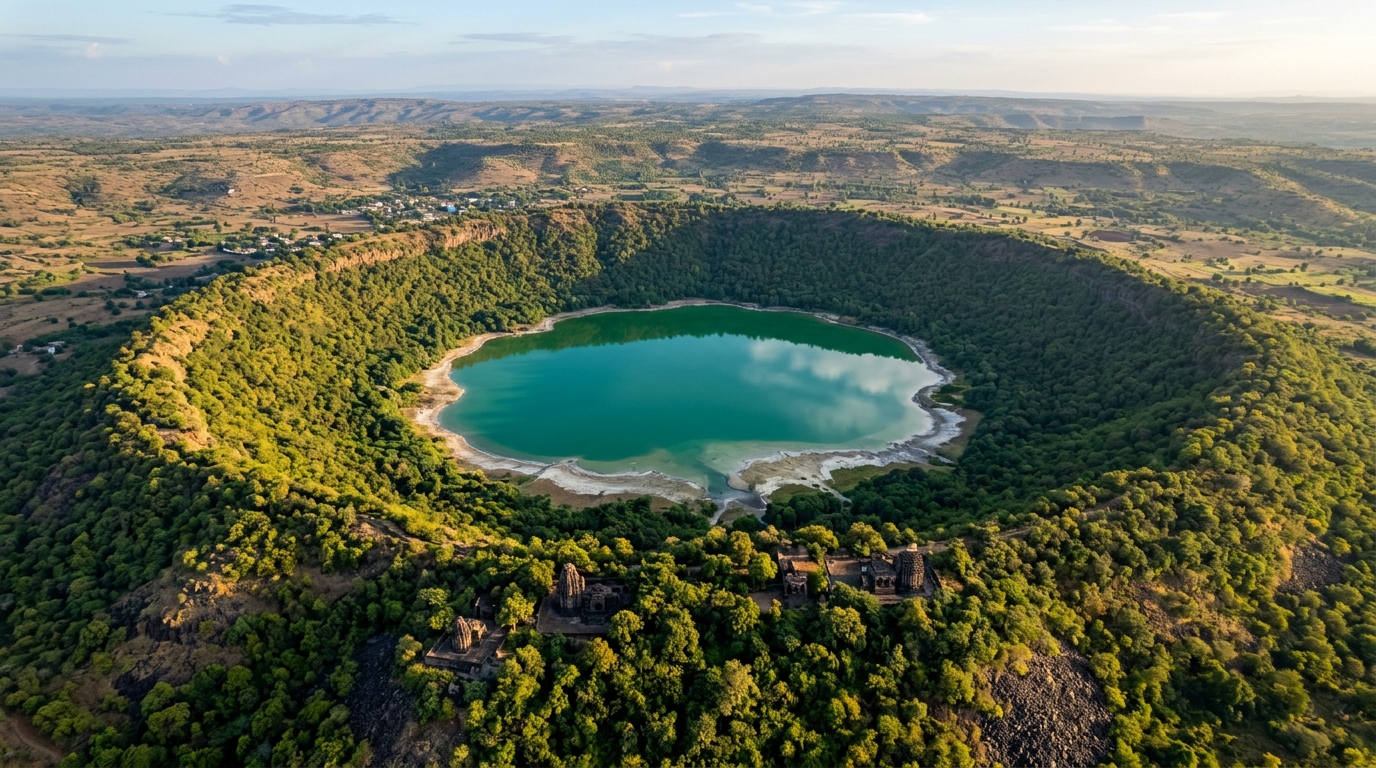
Nestled amid the ancient volcanic plains of the Deccan Plateau in Buldhana district, Maharashtra, lies one of Earth's rarest geological wonders: Lonar Crater Lake. For over a century after it was first documented in scientific literature in 1823, geologists assumed this nearly circular depression was an extinct volcanic caldera. Modern planetary geology, however, proved something far more dramatic—Lonar was carved roughly 50,000 years ago by a hyper-velocity meteorite slamming into solid Deccan basalt at cosmic speed.
Cosmic Origin in Volcanic Basalt
Unlike famous impact structures embedded in limestone or granite (such as Arizona's Meteor Crater), Lonar formed directly inside the flood basalts of the Deccan Traps—making it an invaluable Earth analog for craters on the Moon and Mars.
- Hyper-Velocity Impact: During the Pleistocene Epoch (roughly 35,000 to 52,000 years ago), an asteroid or comet fragment estimated at 50–60 metres across struck Earth at speeds exceeding 90,000 km/h, excavating an oval basin within fractions of a second.
- Diagnostic Shock Evidence: The decisive proof came from the discovery of maskelynite—a rare shock-metamorphosed glass formed when extreme impact pressure fuses plagioclase feldspar instantly without normal thermal melting—alongside shatter cones and impact breccia.
- Rarest of the Rare: Lonar is one of only four known hyper-velocity meteorite impact craters excavated in basaltic rock anywhere on Earth, and the largest well-preserved basaltic crater in India.
Dual Chemistry & The Mystery of the Pink Water
Because Lonar Lake occupies an endorheic (closed) basin with no natural outlet stream, water leaves only through evaporation, concentrating dissolved salts and carbonates leached from surrounding basaltic walls.
- Saline and Alkaline Water: The lake water exhibits an average pH around 10.5, making it both strongly alkaline and distinctly saline—a rare chemical combination capable of supporting specialized extremophiles.
- Two Distinct Ecological Zones: Scientists have noted two distinct zones inside the lake—an outer neutral zone (pH ~7) fed by freshwater springs like the perennial Dhar, and an inner alkaline core (pH ~10.5) that rarely mix thoroughly.
- 2020 Pink Lake Bloom: In June 2020, Lonar famously turned bright pink overnight due to a sudden surge in salt-loving Haloarchaea microbes and carotenoid pigments under intense summer evaporation and elevated salinity.
Geological & Scientific Specifications
📐 Geological & Scientific Specifications
- Location: Lonar, Buldhana District, Maharashtra (Deccan Traps Basalt Formation).
- Dimensions: Mean crater diameter of ~1.83 km (1,830 metres) with a depth of ~137–150 metres below the rim.
- Formation Age: Pleistocene Epoch (~50,000 years BP).
- Diagnostic Shock Mineral: Maskelynite (diaplectic plagioclase glass formed under shock waves above 30 GPa).
- Water pH & Hydrology: Highly alkaline (pH ~10.5) and saline endorheic lake fed by rainfall and freshwater rim springs.
Competitive Exam & GK Takeaways
🎯 Key Exam & Knowledge Points
- Lonar Lake was designated a Ramsar Wetland Site of International Importance in November 2020.
- Declared a National Geological Monument by the Geological Survey of India (GSI) in 1979.
- Earlier mistaken for a volcanic crater, its meteorite impact origin was confirmed through shock-metamorphic minerals like maskelynite and coesite.
- NASA and ISRO planetary geologists study Lonar as a terrestrial analog to understand Martian basaltic impact craters and potential extremophile biosignatures.
- Historic cultural heritage lines its rim, including medieval Chalukya-era Daitya Sudan and Gomukh stone temples.
A Living Laboratory for Planetary Science
Lonar Crater Lake bridges cosmic catastrophe, rare terrestrial geochemistry, and ancient Indian heritage within a single emerald bowl. Whether studied by astrobiologists decoding life in extreme Martian brines or travellers admiring medieval stone shrines perched on volcanic rock, Lonar remains one of India's most extraordinary natural archives.
Comments & Reviews
Tap stars to rate this page: