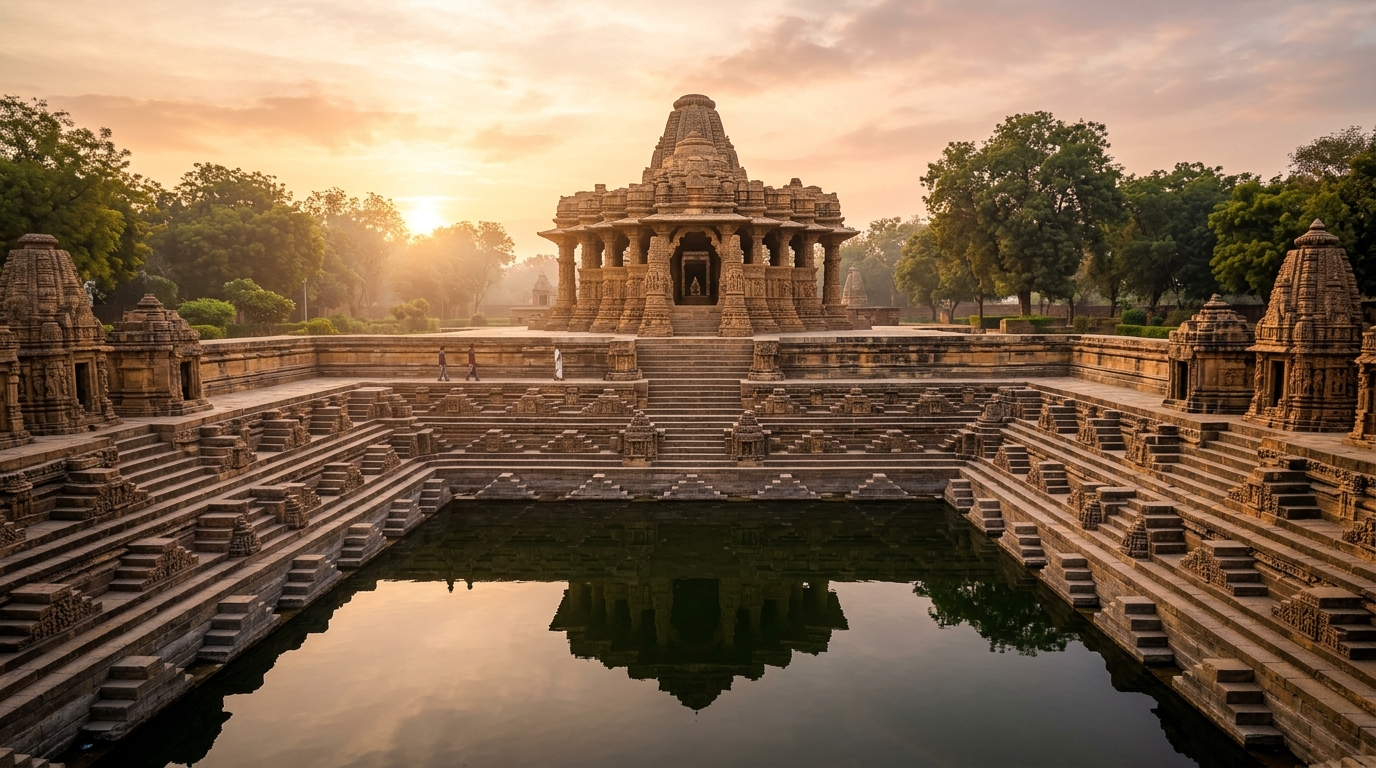
Perched gracefully on the banks of the ancient Pushpavati River in Mehsana district, Gujarat, the Sun Temple of Modhera stands as one of the pinnacle achievements of early medieval Indian temple architecture. Commissioned in 1026–1027 CE by King Bhimdev I of the Solanki (Chalukya) dynasty, the temple is dedicated to the solar deity, Surya. Beyond its visual magnificence, Modhera represents an extraordinary convergence of sacred geometry, hydrological engineering, and archaeoastronomical precision, designed such that the cosmic rhythms of the sun dictate its subterranean and structural axes.
The Tripartite Architectural Layout
Unlike standard temple complexes, the Modhera Sun Temple is designed in three axially aligned, distinct components, each serving a liturgical, cultural, or astronomical function:
- Surya Kund (Rama Kund): A colossal rectangular stepped water reservoir located on the eastern forefront. Measuring approximately 50 meters by 35 meters, the tank features a cascade of geometric pyramid-shaped staircases leading down to the water table. Embedded into its stepped terraces are 108 miniature shrines dedicated to various solar manifestations (Adityas), river deities, Ganesha, and Lord Shiva, symbolizing the sacred cosmological number 108.
- Sabha Mandapa (Grand Assembly Hall): An open, pillared hypostyle hall set on a high plinth (Jagati). Designed as a parallelogram on plan, it features 52 intricately carved pillars, representing the 52 weeks of the solar year. The columns are lavishly adorned with narrative bas-reliefs depicting episodes from the Ramayana, Mahabharata, and scenes of celestial dancers (apsaras).
- Guda Mandapa (Inner Sanctum & Assembly Hall): The enclosed sanctum sanctorum housing the Garbhagriha, surrounded by a circumambulatory pathway (Pradakshina Patha). Although the original golden idol of Surya was plundered during historical invasions, the sanctum's plinth rested on a deep underground inverted lotus cistern designed to absorb seismic vibrations.
Archaeoastronomy & Solar Equinox Alignment
The engineering brilliance of Modhera lies in its precise celestial orientation:
- Tropic of Cancer Coordinates: Modhera is positioned almost exactly on the Tropic of Cancer (latitude 23.58° N), maximizing solar exposure throughout the seasonal cycles.
- Equinoctial Phenomenon: The central longitudinal axis of the entire temple is oriented strictly along the true east-west cardinal line. On the days of the Vernal Equinox (March 21) and Autumnal Equinox (September 23), when day and night are of equal duration, the first rays of the rising dawn sun penetrate through the ornamental Torana gateway, traverse unobstructed through the open Sabha Mandapa, and illuminate the sanctum door to shine directly onto the crowned head of the central Surya idol.
- Twelve Solar Aspects (Dvadasha Adityas): The exterior walls of the Guda Mandapa feature twelve life-sized sculptures of Surya, depicting his twelve distinct cosmic forms across the twelve solar months of the Hindu calendar. Each deity is depicted standing upon a chariot driven by Aruna and drawn by seven horses, holding blossoming lotus flowers in both hands.
The Maru-Gurjara (Solanki) Architectural Style
The temple is a benchmark specimen of the Maru-Gurjara style (also known as the Solanki style), which flourished across Gujarat and Rajasthan between the 10th and 13th centuries CE:
- Dry-Stone Interlocking Joinery: Built entirely of golden sandstone without lime mortar, utilizing mortise-and-tenon joints and interlocking masonry blocks that grant remarkable resilience against seismic forces.
- Kirthimukha & Gajathara Bands: The basement plinths feature stratified horizontal bands of mythological figures, including the Gajathara (elephant processional band representing stability), Narathara (human activities and martial processions), and floral motifs.
- Cusped Torana Arches: Graceful, triangular flying arches (Makara Torana) span between the peripheral pillars of the Sabha Mandapa, creating an illusion of ethereal lightness despite the massive tonnage of the stone architraves.
Technical & Archaeological Specifications
📐 Archaeological & Architectural Specifications
- Patron & Dynasty: King Bhimdev I, Solanki (Chalukya) Dynasty of Gujarat
- Construction Date: 1026–1027 CE (Vikram Samvat 1083, verified by sanctum inscription)
- Architectural Classification: Maru-Gurjara (Solanki) Style of Northern Nagara Tradition
- Key Structural Dimensions: Surya Kund (53.6m x 36.6m); Sabha Mandapa (52 sculpted pillars)
- Geographical Location: Banks of River Pushpavati, Mehsana District, Gujarat (Tropic of Cancer)
Key Exam & Knowledge Takeaways
🎯 Important Examination Points for UPSC & State PSC
- Contemporary Heritage Context: Built in the same era as the Rani Ki Vav stepwell in Patan (built by Bhimdev I's queen, Udayamati) and the Sun Temple of Konark (13th century, Eastern Ganga dynasty).
- Inscription Evidence: An inverted stone inscription dated Vikram Samvat 1083 (1026 CE) on the back wall of the sanctum confirms the precise date of foundation.
- UNESCO Status: Placed on the UNESCO World Heritage Tentative List in 2022 along with Vadnagar and the Sun Temple complex.
- India's First 24x7 Solar-Powered Village: In 2022, Modhera village was officially declared India's first round-the-clock solar-powered village, integrating ancient solar heritage with contemporary green energy through a 6-megawatt ground-mounted solar power plant and battery storage system.
Legacy and Modern Cultural Significance
The Sun Temple of Modhera endures as an eternal testament to ancient India's scientific mastery of astronomy, civil masonry, and aesthetic refinement. Every year in January, the temple's Sabha Mandapa serves as the stage for the renowned Uttarardh Mahotsav (Modhera Dance Festival), celebrating classical dance forms against the backdrop of backlit 1,000-year-old sandstone pillars. Today, as India's first net-zero solar heritage site, Modhera continues to link ancient solar worship with modern sustainable energy leadership.


Comments & Reviews
Tap stars to rate this page: