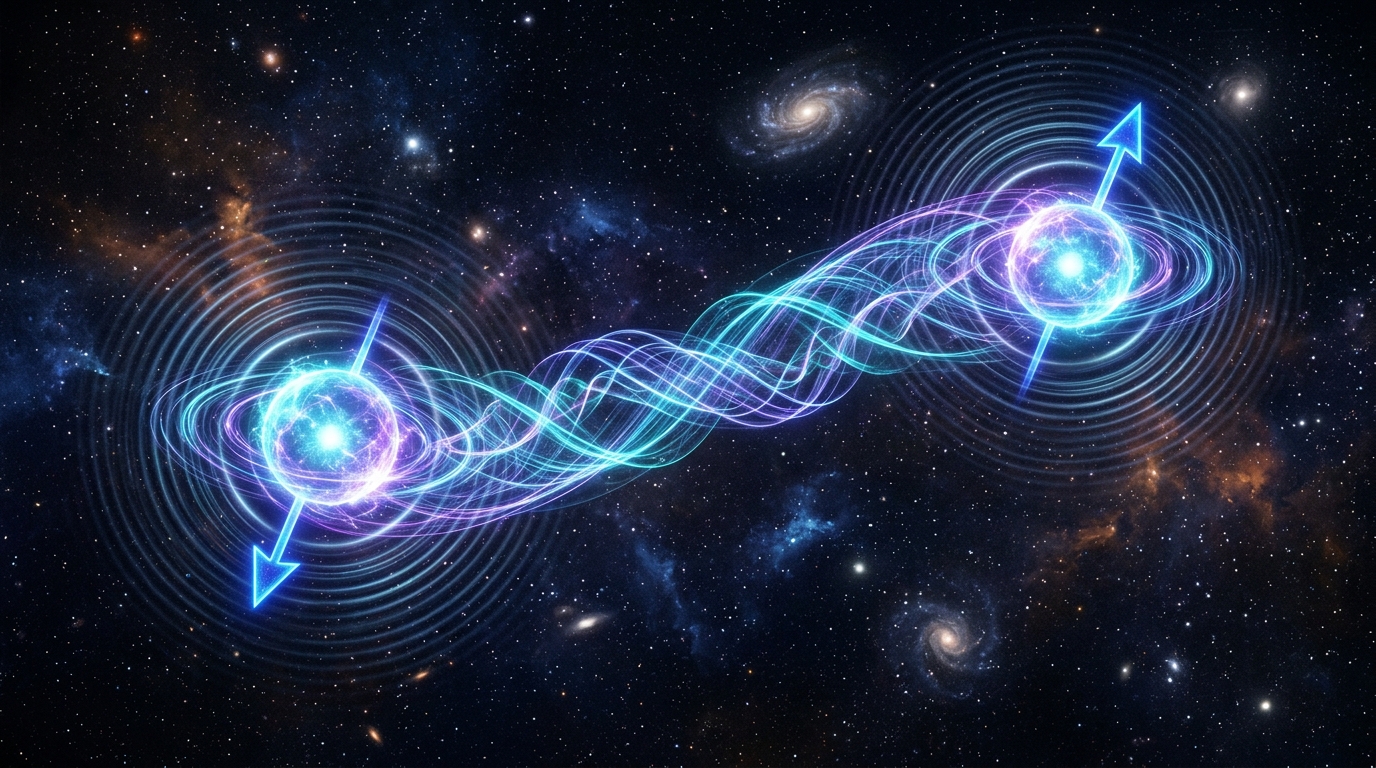
Long taught that matter exists in three fundamental states—solid, liquid, and gas (with plasma making a fourth)—modern physics has unlocked extraordinary realms of existence. Among these is the Bose-Einstein Condensate (BEC), often termed the fifth state of matter. Predicted in 1924 by visionary Indian physicist Satyendra Nath Bose and Albert Einstein, this macroscopic quantum phenomenon occurs when certain particles, known as bosons, are cooled to temperatures near absolute zero. In this bizarre regime, individual atoms lose their separate identities and merge into a single, collective 'super-atom,' behaving as a unified quantum wave.
The Theoretical Genesis and Quantum Statistics
The journey of the Bose-Einstein Condensate began not in a high-tech cryogenic laboratory, but through revolutionary mathematical statistics formulated to explain the behavior of light particles.
- Bose's Breakthrough: Satyendra Nath Bose derived Planck's quantum radiation law without referencing classical physics by treating light particles (photons) as indistinguishable entities, sending his manuscript to Einstein when British journals rejected it.
- Einstein's Expansion: Albert Einstein recognized that Bose's statistical method could be applied to massive material particles (atoms with integer spin, or bosons), predicting that at extremely low temperatures, they would drop into the lowest quantum state.
- Quantum Indistinguishability: Unlike classical particles that remain distinct, bosons in a BEC overlap spatially and temporally, erasing individual boundaries and forming a macroscopic manifestation of wave-particle duality.
Experimental Realization and Extreme Cryogenics
Proving the theories of Bose and Einstein required technological advancements in laser cooling and magnetic trapping that took seven decades to materialize.
- Absolute Zero Barrier: The condensate only forms at fractions of a Kelvin above absolute zero (-273.15°C), requiring ultra-sophisticated techniques to strip kinetic energy away from atoms.
- Laser and Magnetic Trapping: Eric Cornell, Carl Wieman, and Wolfgang Ketterle successfully created the first BEC in 1995 using rubidium atoms, employing laser cooling and magnetic traps to isolate the atoms.
- Macroscopic Wavefunction: In a BEC, scientists can directly observe quantum mechanics with the naked eye because trillions of atoms oscillate and flow together as a single coherent entity without internal friction.
Technical & Scientific Specifications
📐 Scientific Specifications
- Transition Temperature: Typically below 1 microkelvin (one-millionth of a degree above absolute zero)
- Constituent Particles: Bosons (particles with integer spin, e.g., Rubidium-87, Sodium-23, Lithium-7)
- Primary Cooling Method: Combined Laser Cooling (Doppler/Sisyphus) and Magnetic Evaporative Cooling
- Discovery Year: Theoretically predicted in 1924-1925; experimentally realized in 1995
Key Exam & Knowledge Takeaways
🎯 Important Examination Points
- Bose-Einstein Condensate is fundamentally recognized as the fifth state of matter governed by quantum mechanics.
- It was conceptualized through a collaboration between Satyendra Nath Bose and Albert Einstein in the mid-1920s.
- The state is achieved at ultra-low temperatures close to absolute zero where thermal motion is nearly eliminated.
- Atoms within a BEC lose their individuality and act collectively as a single macroscopic quantum wave.
- The 2001 Nobel Prize in Physics was awarded for the achievement of Bose-Einstein condensation in dilute gases of alkali atoms.
Legacy and Scientific Significance
The Bose-Einstein Condensate bridges the microscopic quantum realm with the macroscopic physical universe, opening unprecedented avenues in fundamental physics. From simulating complex cosmological phenomena like black hole event horizons to powering ultra-precise quantum sensors, atomic lasers, and navigation systems, the BEC remains a cornerstone of modern quantum technology.



Comments & Reviews
Tap stars to rate this page: