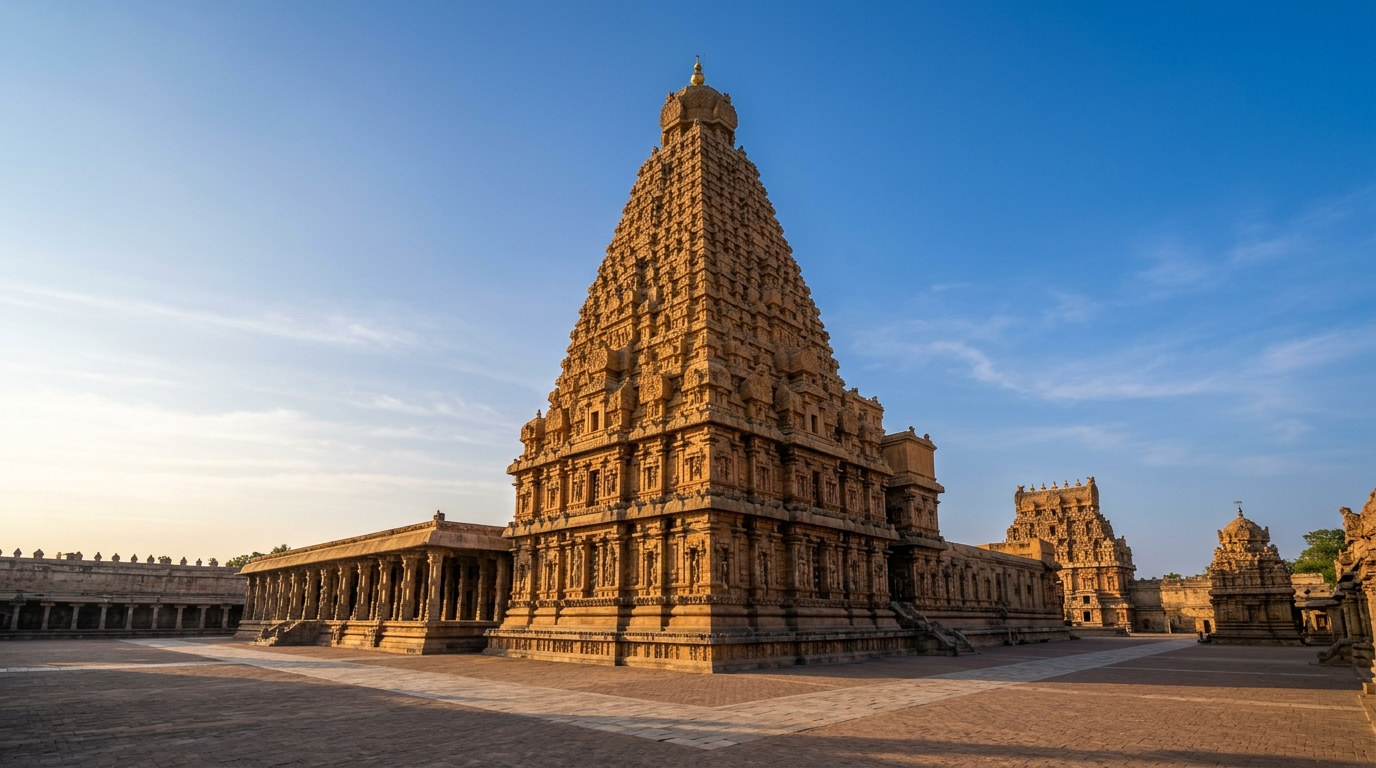
Standing tall on the fertile banks of the Cauvery delta in Tamil Nadu, the Brihadisvara Temple (also known as Rajarajesvaram or the Big Temple) in Thanjavur is one of humanity's greatest architectural and structural engineering triumphs. Consecrated in 1010 CE by the great Chola monarch Raja Raja Chola I, this monumental shrine is the world's first completely granite-built temple. What baffles modern civil engineers is not just its sheer scale, but how ancient Tamil builders transported and assembled over 130,000 tonnes of ultra-hard granite without modern cranes, cement, or binding mortar.
The Mystery of the 80-Tonne Monolithic Kumbam
The pinnacle of the temple's 216-foot (66-metre) central tower (Vimana) features a massive octagonal dome known as the Kumbam or Shikhara capstone.
- Single Granite Monolith: Unlike northern temple spires made of layered bricks or sandstone blocks, the apex capstone was carved from a single solid block of hard granite weighing an estimated 80 tonnes (80,000 kilograms).
- The 6-Kilometre Earthen Ramp: To lift an 80-tonne stone 66 metres into the sky without hydraulic cranes, Chola royal engineers constructed a gradual inclined earthen ramp starting over 6 kilometres away from a nearby village called Sarapallam (meaning 'scaffold hollow'). The massive stone was rolled up the ramp atop cylindrical wooden rollers pulled by thousands of war elephants and laborers.
- Gold-Plated Kalasam: Perched atop this monolithic capstone sits a 12-foot brass Stupi or Kalasam, originally coated in pure gold weighing over 4,000 kalanju (historical gold measure).
Zero-Mortar Interlocking Masonry & Seismic Resilience
Thanjavur sits in a flat river plain with no natural granite quarries within a 60-kilometre radius. Transporting raw granite required deep logistics using wooden rafts along the Kollidam and Cauvery rivers.
- Dry-Stone Puzzle Joinery: The entire 16-storey pyramid was constructed using dry-stone interlocking joints (mortise and tenon mechanics). The stones fit together with microscopic precision using gravitational friction and puzzle joints, without any lime mortar or adhesive.
- Centuries of Earthquake Survival: Because the stones are mechanically interlocked rather than rigidly bonded with brittle mortar, the temple absorbs ground tremors and seismic waves flexibly. It has survived major earthquakes, cyclone gusts, and six centuries of political turmoil without structural tilting.
- The Inverted Shadow Phenomenon: The base geometry of the tower is engineered so precisely that during midday at certain solstices, the shadow of the central Vimana falls entirely within its own stone plinth rather than extending onto the ground.
Architectural & Engineering Specifications
📐 Architectural & Engineering Specifications
- Builder & Consecration Year: Emperor Raja Raja Chola I (reign 985–1014 CE); completed in 1010 CE (275th day of his 25th regnal year).
- Total Granite Consumed: Approximately 130,000 tonnes (quarried from hills near Tiruchirappalli, ~60 km away).
- Vimana Height: 216 feet (66 metres) across 16 tiered storeys.
- Apex Capstone (Kumbam): Octagonal monolithic granite weighing ~80 tonnes.
- Monolithic Nandi: Second-largest monolithic Nandi statue in India, carved from a single 25-tonne granite boulder.
Competitive Exam & GK Takeaways
🎯 Key Exam & Knowledge Points
- Inscribed as a UNESCO World Heritage Site in 1987 as part of the Great Living Chola Temples (alongside Gangaikonda Cholapuram and Darasuram Airavatesvara).
- It represents the zenith of the Dravidian Temple Architecture style, characterized by the soaring Vimana dominating over the peripheral Gopurams (later Vijayanagara and Nayaka styles flipped this to giant Gopurams).
- The temple walls bear over 100 historical Tamil inscriptions documenting royal donations, military victories, administrative revenue, and temple dancer endowments.
- Famous for housing Chola-era fresco murals depicting Lord Shiva in Tripurantaka form and classical Bharatanatyam karanas.
An Enduring Symbol of Imperial Chola Ingenuity
A millennium after its dedication, the Brihadisvara Temple remains a living testament to the mathematical sophistication, stone-cutting mastery, and logistical prowess of ancient India. From heavy material transport along riverways to celestial alignments in stone, it stands as an enduring beacon of timeless civil engineering.

Comments & Reviews
Tap stars to rate this page: