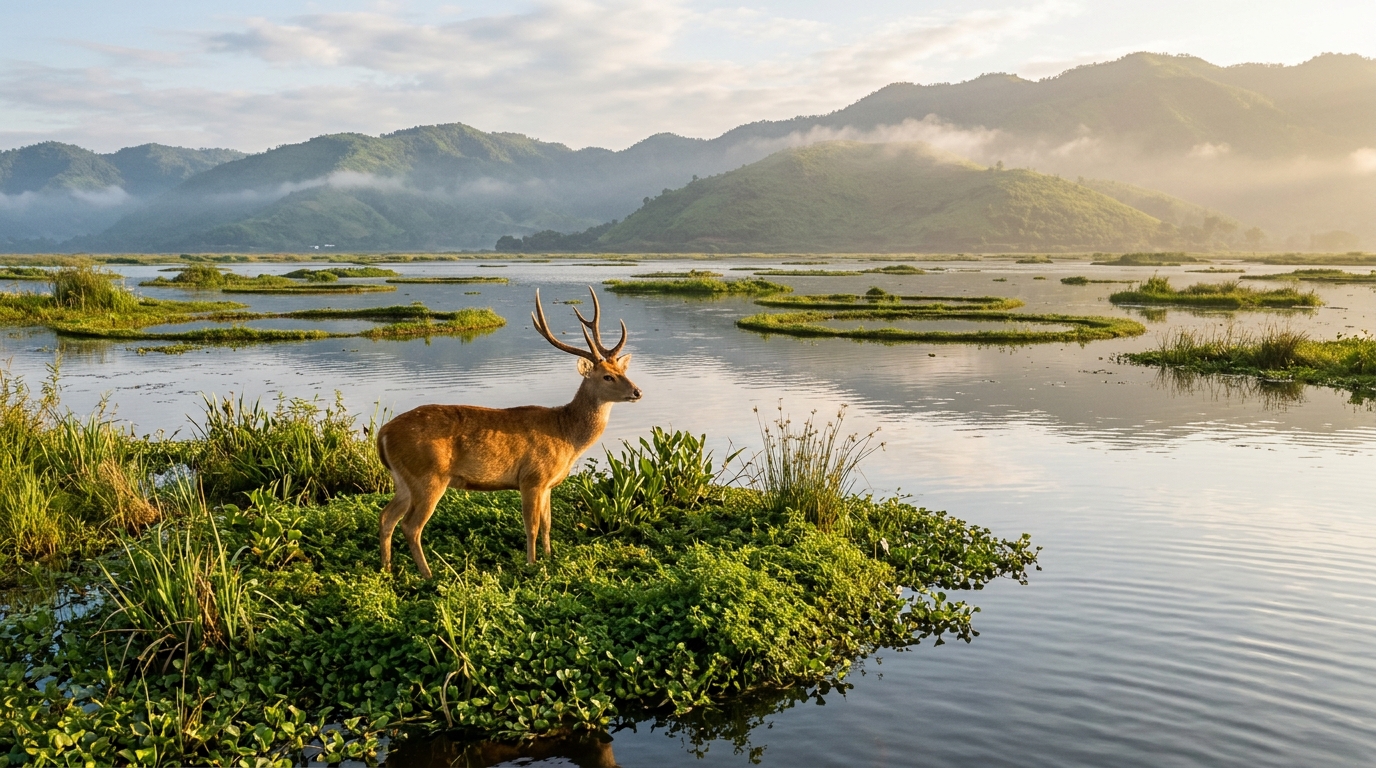
Nestled in the southeastern expanse of the iconic Loktak Lake in Bishnupur district, Manipur, lies an ecological wonder unparalleled anywhere on Earth: Keibul Lamjao National Park. Spanning approximately 40 square kilometers, it holds the singular global distinction of being the world's only floating national park. Rather than resting on bedrock or terra firma, the vast majority of the park consists of a floating, spongy carpet of decomposing plant matter and soil known in the indigenous Meitei language as Phumdis. This dynamic, floating wetland serves as the last natural stronghold for one of the rarest mammals on the planet: the critically endangered Sangai deer (Rucervus eldii eldii), famously celebrated as the "Dancing Deer of Manipur".
The Science Behind 'Phumdis': Nature's Floating Biomass Islands
The defining geographical and ecological feature of Keibul Lamjao is its intricate network of phumdis, which exhibit a remarkable seasonal hydrological cycle:
- Composition & Buoyancy: Phumdis are heterogeneous masses of soil, organic debris, and living wetland vegetation (primarily tall reeds, wild rice, and grasses like Zizania latifolia, Saccharum munja, and Echinochloa). Up to four-fifths of a mature phumdi's thickness remains submerged below the water level, buoyed by the gases trapped during anaerobic organic decomposition.
- Hydrological Float-and-Sink Cycle: Under natural seasonal dynamics, phumdis float freely during the monsoon season when lake water levels rise. In the dry winter months, as water recedes, the thickest phumdis sink to the lake bed. This contact is biologically critical: the roots of the vegetation penetrate the lake bottom sediment, drawing up vital mineral nutrients to sustain the biomass carpet for the following growing season.
- Human-Engineered Fish Traps (Athaphums): Local fishers also create artificial circular rings of phumdi known as Athaphums to aggregate and harvest fish, demonstrating the profound interdependence between local communities and wetland hydrology.
The Sangai: The Brow-Antlered 'Dancing Deer' of Manipur
The Sangai is not merely a wildlife species; it is the state animal of Manipur and an integral motif in Meitei folklore, literature, and indigenous identity:
- Evolutionary Adaptation & Pas de Deux: The Sangai possesses uniquely adapted, elongated hooves with expansive pasterns and flexible fetlock joints. These physical traits distribute the deer's body weight evenly across the spongy, quivering surface of the phumdi. When walking over the yielding biomass, the deer steps delicately with a rhythmic, springy gait, giving rise to its affectionate moniker: the "Dancing Deer".
- Distinctive Antler Morphology: Belonging to the brow-antlered deer species, the male Sangai boasts extraordinary crown-shaped antlers. The brow tine curves forward over the forehead in a continuous arc of over 100 degrees before sweeping upward and backward, resembling a regal royal tiara.
- Miraculous Rediscovery from Extinction: In 1951, the Sangai was officially declared extinct due to ruthless hunting and habitat reclamation. However, in 1953, renowned British naturalist Edward Pritchard Gee rediscovered a relict population of just 14 individuals surviving in the inaccessible floating phumdis of Keibul Lamjao. Prompt state action led to the declaration of the area as a Wildlife Sanctuary in 1966, followed by formal notification as a National Park in 1977. Through rigorous conservation, the population has revived to over 260 individuals today.
Loktak Lake & The Montreux Record Wetland Crisis
While celebrated as the largest natural freshwater lake in Northeast India, Loktak Lake represents a prime case study in anthropogenic ecological alteration:
- Ramsar Recognition: Loktak was designated a Ramsar Wetland of International Importance in March 1990 in recognition of its rich biodiversity, avifaunal migratory corridor, and socio-economic support for fishing communities.
- The Ithai Barrage Disruption: In 1983, the commissioning of the downstream Ithai Barrage for the Loktak Hydroelectric Project permanently elevated the lake water level to generate power year-round. This artificial impoundment severed the natural seasonal float-and-sink cycle of the phumdis. Unable to rest on the lake bed during the dry season, the phumdis are deprived of benthic nutrients, leading to progressive thinning, fragmentation, and vulnerability to uprooting during high winds.
- Inclusion in the Montreux Record: Because of these adverse ecological shifts, declining phumdi thickness, and severe siltation, Loktak Lake was placed on the Montreux Record in 1993 (a register of Ramsar wetland sites where ecological character has changed or is deteriorating due to technological developments, pollution, or human interference). Alongside Keoladeo National Park in Rajasthan, Loktak is one of only two Indian wetlands currently listed on the Montreux Record.
Technical & Ecological Specifications
🌿 Keibul Lamjao Conservation & Wetland Summary
- Location: Bishnupur District, Manipur, India (Southeastern lobe of Loktak Lake)
- Total Park Area: 40 sq km (Approx. 22 sq km composed of contiguous floating phumdi mats)
- Park Status: Wildlife Sanctuary (1966) • Upgraded to National Park (1977)
- Flagship Fauna: Sangai or Brow-Antlered Deer (Rucervus eldii eldii), Manipur's State Animal
- Sangai Protection Status: IUCN: Endangered (EN) • WPA 1972: Schedule I • CITES: Appendix I
- Wetland Designations: Ramsar Site (1990) • Montreux Record Enlistment (1993)

Comments & Reviews
Tap stars to rate this page: