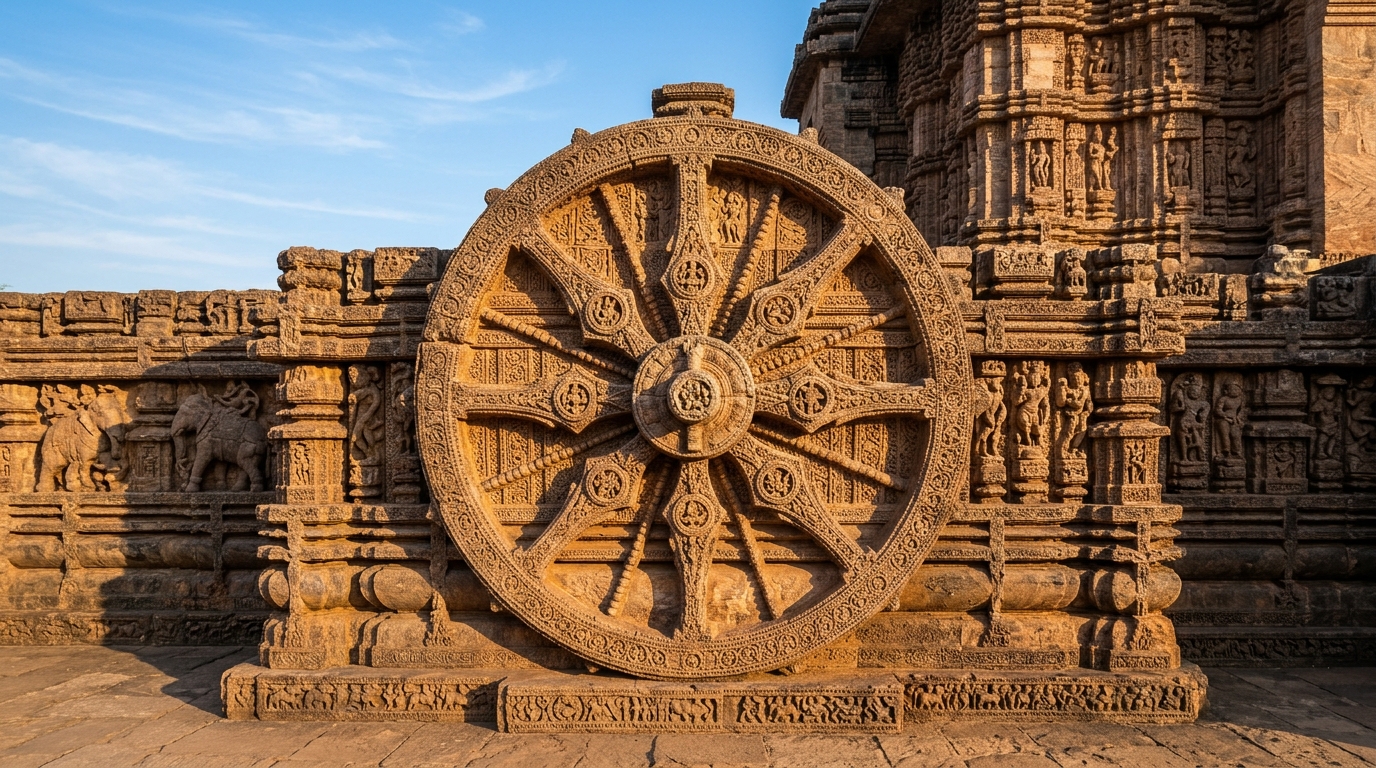
Standing on the Bay of Bengal coastline in Puri district of Odisha, the 13th-century Konark Sun Temple (derived from the Sanskrit words Kona meaning corner/angle and Arka meaning the Sun god Surya) represents the architectural and astronomical zenith of the Kalinga school of Nagara temple architecture. Built around 1250 CE by King Narasimhadeva I (r. 1238–1264 CE) of the Eastern Ganga Dynasty, the entire monumental complex is conceived as a colossal celestial chariot of Surya drawn by 7 galloping stone horses and supported on 12 pairs (24) of intricately carved stone wheels—each engineered as a precision astronomical sundial capable of calculating time down to 90 seconds.
1. The Mathematical Mechanics of the Konark Wheel Sundial
Far beyond ornamental temple relief work, the 24 carved Khondalite sandstone wheels—especially the two primary timekeeping wheels aligned along the true East–West solar meridian—subdivide the 24-hour diurnal cycle with geometric exactitude:
- 8 Major (Wide) Spokes: Each wheel measures 9 feet 9 inches (2.97 meters) in diameter and features 8 broad primary spokes adorned with circular medallions. Because a complete solar day equals 24 hours (or 8 traditional Indian Prahars), the angular span between any two adjacent major spokes represents exactly 3 hours (180 minutes).
- 8 Minor (Thin) Spokes: Placed strictly midway between every pair of major spokes is a thinner secondary spoke. This bisects each 3-hour sector into two equal intervals of 1.5 hours (90 minutes).
- 30 Rim Beads Between Adjacent Spokes: Along the inner edge of the outer rim, between any major spoke and its neighboring minor spoke (a 90-minute arc), Kalinga sculptors carved exactly 30 raised spherical beads. Each bead therefore equals 3 minutes of solar time (90 minutes ÷ 30 beads = 3 minutes), while reading the shadow at the center or edge of a bead allows time estimation to 1.5 minutes (90 seconds).
- Anti-Clockwise Shadow Progression: When a gnomon (horizontal rod or finger) is placed at the center of the wheel's axle hub, the Sun's east-to-west motion across the southern sky casts a sharp shadow onto the rim that rotates in an anti-clockwise direction from sunrise (6:00 AM at the horizontal spoke) to noon (12:00 PM at the bottom vertical spoke) and sunset (6:00 PM at the opposite horizontal spoke).
2. Kalinga Temple Architecture: Rekha Deul, Pidha Deul & Nata Mandira
In canonical Kalinga temple treatises (such as the Bhubana Pradipa and Silpa Prakasa), a complete temple complex aligns along an east–west axial plan so that the first rays of the rising sun over the Bay of Bengal illuminate the presiding deity inside the sanctum:
- Rekha Deul (Sanctum Sanctorum / Vimana): Originally rose to a height of approximately 229 feet (70 meters) with a curvilinear tower before its superstructure collapsed in the mid-19th century. Its three outer niches still retain towering green Chlorite stone sculptures of Surya at dawn (Aruna/Prabhat Surya), noon (Madhyahna Surya), and sunset (Astachala Surya).
- Pidha Deul (Jagamohana / Audience Hall): The surviving 128-foot structure topped by a tiered pyramidal roof of receding horizontal platforms (Pidhas) crowned by a massive fluted stone bell capital (Ghanta). To prevent structural collapse, British conservation engineer John Woodburn ordered the interior of the Jagamohana to be filled with sand and sealed in 1903.
- Nata Mandira (Hall of Dance): An open, detached pillared pavilion at the eastern entrance whose plinth and pillars are sculpted with hundreds of classical Odissi dance postures (Karanas) and ancient percussion, string, and wind instruments.
- Three Rock Types Used: Weathered Khondalite (feldspar-garnet-sillimanite gneiss) for the main walls and wheels, dense Chlorite for delicately carved doorframes and cult icons, and Laterite for the foundation core and invisible platform steps.
3. Metallurgical Engineering & the 'Black Pagoda' Maritime Landmark
Centuries before modern structural steel girders were invented in Europe, 13th-century Kalinga engineers forged colossal rust-resistant wrought-iron beams—some measuring up to 35 feet in length and weighing over 10 tonnes—by forge-welding smaller iron blooms together to reinforce the false ceiling and massive stone lintels of the Jagamohana. Due to the dark oxidized patina of its Khondalite tower visible from miles out at sea, early European mariners navigating the Bay of Bengal named Konark the "Black Pagoda", contrasting it with the white-plastered Jagannath Temple at Puri, which they called the "White Pagoda".
Technical & Architectural Specifications
📐 Scientific & Architectural Specifications
- Builder & Dynasty: King Narasimhadeva I (Eastern Ganga Dynasty, c. 1250 CE)
- Chariot Wheel Dimensions: 24 Stone Wheels (12 pairs); Diameter: 9 feet 9 inches (2.97 m)
- Sundial Time Resolution: 8 Major Spokes (3 hrs each) + 8 Minor Spokes (90 mins) + 30 Beads per arc (3 mins per bead / 90 sec half-bead)
- Building Stones & Metals: Khondalite, Chlorite, Laterite & Forge-Welded Wrought-Iron Girders
Key Exam & Knowledge Takeaways
🎯 Important Examination Points (UPSC / SSC / State PCS)
- UNESCO World Heritage Site: Inscribed on the UNESCO World Heritage List in 1984.
- Symbolism of 24 Wheels & 7 Horses: The 24 wheels symbolize the 24 hours of a solar day (or the 24 Pakshas/fortnights of a lunar-solar year), while the 7 horses represent the 7 days of the week and the 7 visible colors of sunlight.
- Indian Currency Motif: The Konark Sun Temple chariot wheel is depicted on the reverse of the ₹10 banknote in the Mahatma Gandhi New Series.
- Black Pagoda vs. White Pagoda: Konark Sun Temple is historically termed the Black Pagoda, whereas the Jagannath Temple at Puri is termed the White Pagoda.
Comments & Reviews
Tap stars to rate this page: