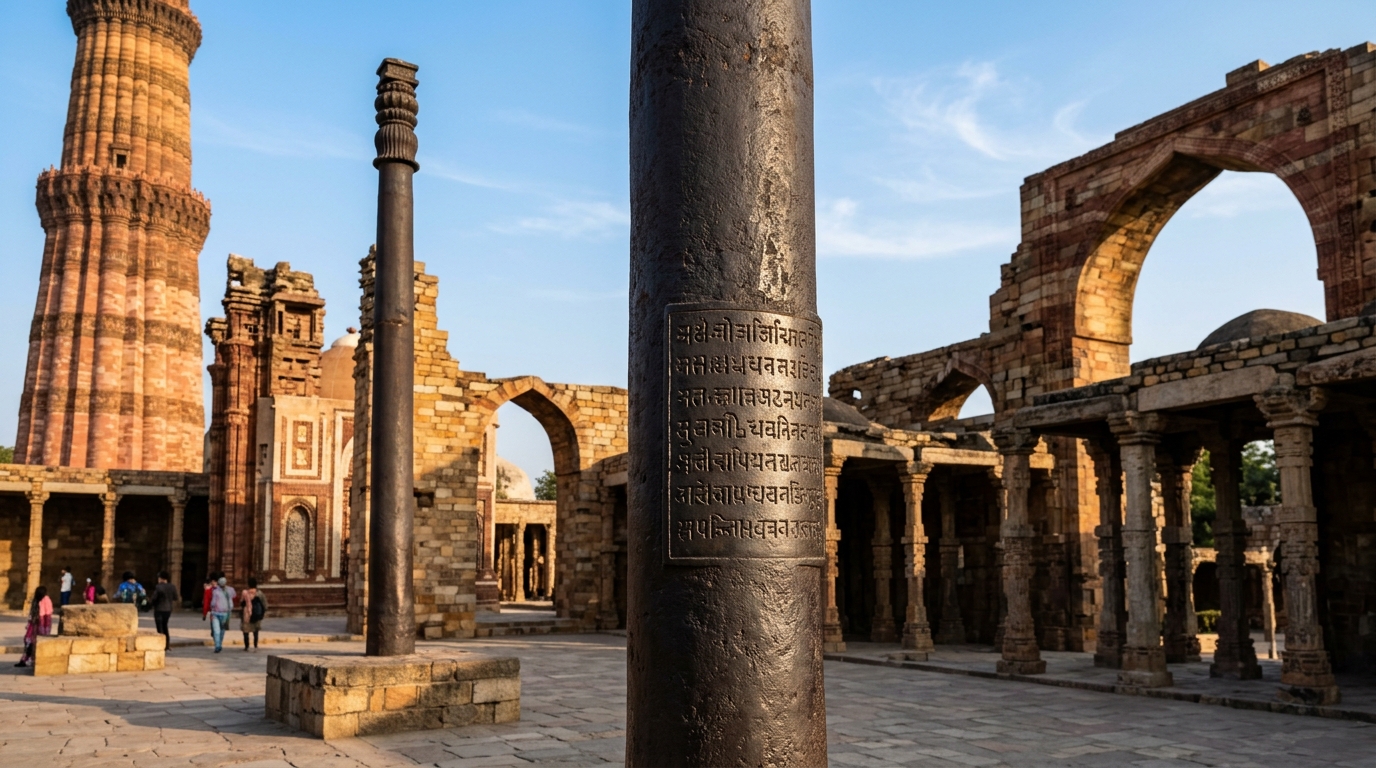
Standing 7.21 meters (23 feet 8 inches) tall and weighing over 6,500 kilograms (6.5 tonnes) in the courtyard of the Quwwat-ul-Islam Mosque inside the Qutb Complex at Mehrauli, New Delhi, the Iron Pillar of Delhi is one of the world's greatest masterpieces of ancient metallurgical engineering. Forged during the golden age of the Gupta Empire (late 4th to early 5th century CE) under Emperor Chandragupta II Vikramaditya, the exposed upper shaft of this wrought-iron monument has withstood over 1,600 monsoon cycles without disintegrating into rust.
1. Historical Origin: King 'Chandra' & the Vishnupadagiri Inscription
Engraved across the western face of the pillar is a celebrated six-line, three-stanza Sanskrit poem written in the eastern variety of the Gupta-period Brahmi script (dated paleographically to c. 375–415 CE). The epigraph eulogizes a valorous chakravartin monarch named "Chandra", whom historians, epigraphists, and numismatists unanimously identify with the Gupta Emperor Chandragupta II Vikramaditya (whose archer-type gold dinaras explicitly carry the short legend Chandra on the obverse):
- Military Campaigns Recorded in the Inscription: The Sanskrit verses state that King Chandra crushed a confederacy of enemies who had united against him in the Vanga (Bengal) region, and that he crossed the "seven mouths of the River Indus" (Sapta Mukhani Sindhos) to vanquish the Vahlikas (Bactria / Balkh region), establishing sole sovereignty over the earth.
- Original Site — Vishnupadagiri (Udayagiri): The final stanza explicitly records that the pillar was erected as a lofty Dhvaja-stambha (Garuda standard) in devotion to Lord Vishnu on a hill named Vishnupadagiri ("Hill of the Footprint of Vishnu"). Archaeometallurgical and astronomical studies by Prof. R. Balasubramaniam and historian Michael Willis have identified Vishnupadagiri with the Udayagiri Caves near Vidisha and Sanchi in Madhya Pradesh—a major Gupta center of iron smelting and Tropic-of-Cancer solstice astronomy.
- 11th-Century Relocation to Delhi: A later Nagari inscription dated Vikrama Samvat 1109 (1052 CE) records that the Tomara Rajput ruler Anangpal Tomar transported and re-installed the pillar at Lal Kot (Mehrauli, Delhi) as a trophy and royal standard.
2. The Metallurgical Secret: High Phosphorus & the 'Misawite' Passive Film
For over a century, hypotheses ranged from dry Delhi humidity to mystical alloys. Definitive X-ray diffraction, Mössbauer spectroscopy, and microstructural studies led by IIT Kanpur (Prof. R. Balasubramaniam) proved that the pillar's corrosion immunity stems from its high-phosphorus, low-carbon wrought-iron chemistry and a self-healing crystalline phosphate-oxyhydroxide passive film:
- Charcoal Smelting Without Limestone Flux: In modern blast furnaces, limestone (calcium carbonate) is added as a flux to strip phosphorus out of pig iron, leaving less than 0.05% phosphorus in commercial steel. Ancient Gupta metallurgists smelted iron ore in bloomery furnaces using wood charcoal without adding limestone. Consequently, a substantial fraction of phosphorus remained dissolved in the solid iron matrix—averaging 0.25% overall and up to 0.80% near the surface, alongside 99.72% pure iron, low carbon (~0.08%), negligible sulfur (0.006%), and zero manganese.
- Catalytic Formation of 'Misawite' (δ-FeOOH): When fresh iron is exposed to rain and air, ordinary porous rust (lepidocrocite and goethite) forms first. However, in the Mehrauli pillar, the enrichment of phosphorus at the metal-rust interface catalyzes the formation of a dense, amorphous oxyhydroxide phase known as Misawite (δ-FeOOH) together with alternate layers of magnetite (Fe3O4).
- Crystalline Iron Hydrogen Phosphate Hydrate Barrier: Over consecutive wetting and drying cycles (monsoon rain followed by intense Indian sun), this layer transforms into an insoluble crystalline film of Iron Hydrogen Phosphate Hydrate (FePO4·H3PO4·4H2O) measuring merely ~50 microns (0.05 mm) thick. This glassy layer seals the underlying metal from oxygen and moisture diffusion, dropping the corrosion rate to near zero!
- Horizontal Forge-Welding Manufacture: Rather than casting molten metal, Gupta smiths heated 20–30 kg iron lumps (pancakes) and hammered them together vertically and horizontally around a mandrel while the shaft lay horizontally on rollers. Microscopic entrapped slag particles further halt localized pitting corrosion.
Technical & Chemical Specifications
📐 Scientific & Chemical Specifications
- Dimensions & Mass: Height: 7.21 m (6.09 m above ground, 1.12 m below); Weight: ~6,511 kg (6.5 Tonnes)
- Chemical Composition: Wrought Iron (~99.72% Fe), High Phosphorus (0.25%–0.80% P), Low Carbon (0.08% C), Sulfur (0.006% S), Manganese (0.00% Mn)
- Protective Passive Film: Amorphous Misawite (δ-FeOOH) + Crystalline Iron Hydrogen Phosphate Hydrate (FePO4·H3PO4·4H2O, ~50 μm thick)
- Manufacturing Process: Solid-state Forge-Welding of 20–30 kg bloomery wrought-iron pancakes using wood charcoal without limestone flux
Key Exam & Knowledge Takeaways
🎯 Important Examination Points (UPSC / SSC / State PCS)
- Ruler & Script: King "Chandra" (Chandragupta II Vikramaditya, c. 375–415 CE); 6-line Sanskrit inscription in Gupta-period Brahmi script.
- Geographical Conquests Mentioned: Defeat of enemy confederacy in Vanga (Bengal) and conquest of the Vahlikas (Bactria) across the seven mouths of the Indus.
- Original Dedication & Relocation: Originally erected as a Vishnu Dhvaja-stambha on Vishnupadagiri (Udayagiri, Madhya Pradesh); relocated to Mehrauli (Delhi) in the 11th century by Tomara ruler Anangpal Tomar.
- Primary Cause of Rust Resistance: High phosphorus content (from charcoal smelting without lime) forming a protective passive film of Misawite (δ-FeOOH) and Iron Hydrogen Phosphate Hydrate.
Comments & Reviews
Tap stars to rate this page: