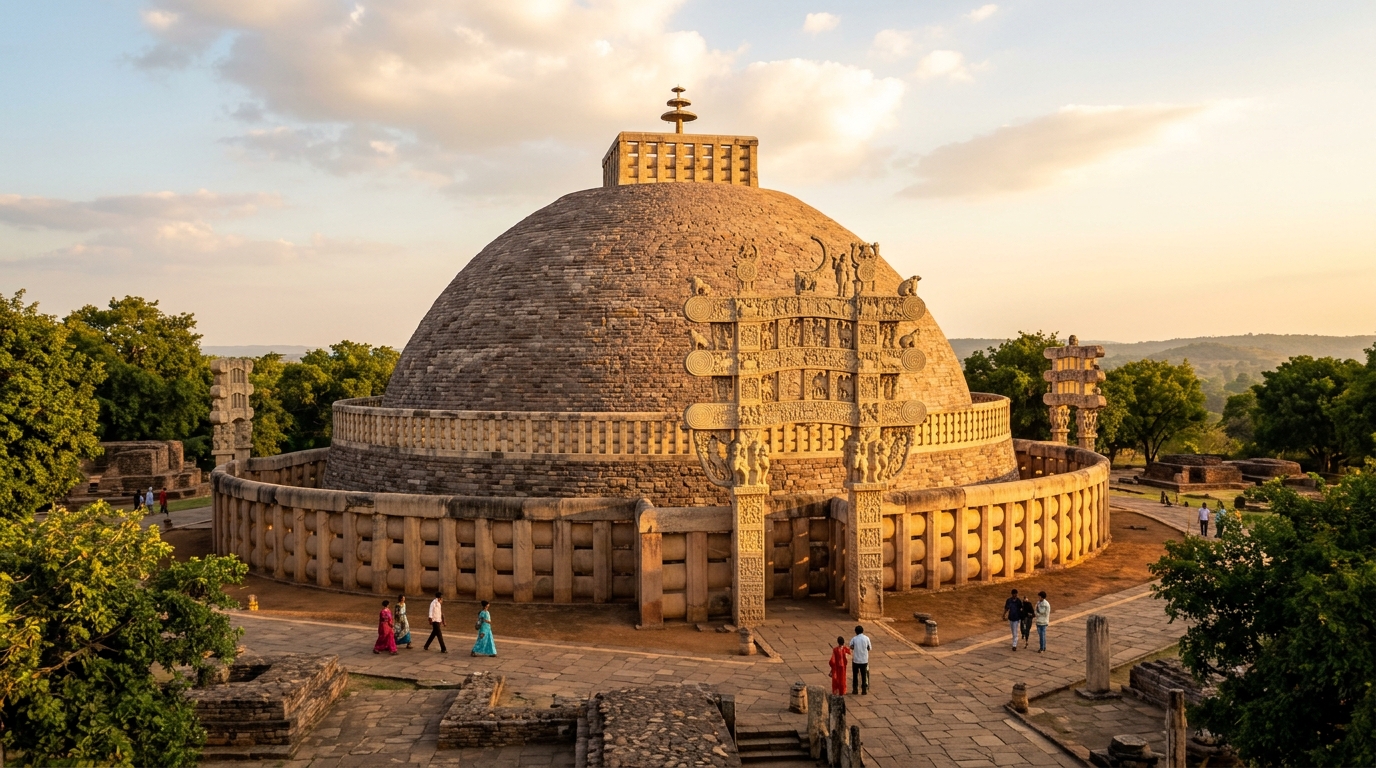
Crowning the sandstone hilltop of Sanchi (ancient Kakanava or Kakanadabota) in Raisen district of Madhya Pradesh, the Great Stupa (Stupa No. 1) is the oldest surviving stone structure in India and the supreme architectural archetype of early Buddhist hemispherical monuments. Originally commissioned by the Mauryan Emperor Ashoka the Great in the 3rd century BCE over the corporeal relics of Gautama Buddha, it stands near ancient Vidisha (Besnagar)—the hometown of Ashoka's queen Devi—at the strategic confluence of the Betwa and Bes rivers along the royal trade highway (Dakshinapatha).
1. Structural Anatomy & Cosmic Symbolism of the Stupa
Unlike later Southeast Asian pagodas, the classical Indian stupa was engineered as a three-dimensional cosmological mandala representing the enlightened mind and the universe. At its core lies the solid hemispherical dome known as the Anda ("Cosmic Egg", 36.6 meters in diameter and 16.46 meters high), symbolizing the dome of heaven enclosing the sacred relic chamber (Dhatugarbha).
Surmounting the flatten summit of the Anda is a square stone balustrade called the Harmika ("Abode of the Gods"), from the center of which rises a central axial mast—the Yashti (representing the Axis Mundi or cosmic world-axis)—crowned by three diminishing stone parasols known as the Chhatravali (Triple Chhatra) signifying the Triratna of Buddhism: Buddha (the Enlightened One), Dhamma (the Teaching), and Sangha (the Monastic Order). Pilgrims perform clockwise ritual circumambulation (Pradakshina) along two distinct pathways: a ground-level paved stone processional path enclosed by a massive interlocking sandstone railing (Vedika) and an elevated terrace (Medhi) accessed via a double flight of stairs (Sopana).
2. Multi-Dynastic Evolution: Mauryan Brick Core, Shunga Stone Casing & Satavahana Toranas
The Great Stupa showcases a remarkable four-century architectural continuity across three major Indian dynasties. Emperor Ashoka's original 3rd-century BCE monument was a modest brick hemisphere roughly half the present diameter, flanked by a polished monolithic Chunar sandstone Ashokan Pillar bearing an addorsed four-lion capital (closely mirroring the Sarnath Lion Capital) and a Schism Edict warning monks and nuns against dividing the Buddhist Sangha.
During the Shunga Period (2nd century BCE), the original brick stupa was encased in hammer-dressed local sandstone slabs, doubling its diameter to 36.6 meters, while the wooden railings were replaced with mortise-and-tenon stone balustrades (Vedika) funded through collective public donations (Dana) recorded in early Brahmi inscriptions. Subsequently, in the 1st century BCE under the Satavahana dynasty (recorded in an inscription by the royal artisans and ivory carvers of Vidisha on the Southern Gateway), four monumental free-standing ceremonial gateways—Toranas (each rising 10.36 meters)—were erected at the four cardinal directions.
3. Aniconic Narrative Sculpture & Jataka Reliefs on the Four Toranas
Each Torana consists of two square vertical pillars supporting three slightly arched horizontal architraves separated by square die-blocks, sculpted with narrative bas-reliefs of extraordinary delicacy by the ivory-carving guild of Vidisha. Crucially, the sculptures adhere strictly to the Early Buddhist (Hinayana / Theravada) Aniconic Tradition: Gautama Buddha is never depicted in human (anthropomorphic) form.
Instead, the Master's presence and key life milestones are communicated through sacred visual symbols: the Lotus and Bull (Birth), the Riderless Horse Kanthaka with a Parasol (the Great Renunciation / Mahabhinishkramana), the Bodhi Tree with Vajrasana (Enlightenment at Bodh Gaya), the Dharmachakra / Wheel of Law (First Sermon at Sarnath), and the Stupa itself or Footprints (Buddhapada) (Mahaparinirvana at Kushinagar). The architraves also vividly depict five great Jataka tales (including the Vessantara, Chhaddanta, Mahakapi, Sama, and Alambusa Jatakas), Ashoka's visit to the Ramagrama Stupa, and graceful Shalabhanjika Yakshi bracket figures symbolizing fertility and auspiciousness.
4. Rediscovery, Relics of Sariputta & Moggallana, and UNESCO World Heritage Status
After the decline of Buddhism in central India following the 12th century CE, Sanchi remained overgrown by forest until it was rediscovered in 1818 by General Henry Taylor. In 1851, Alexander Cunningham and F. C. Maisey excavated Stupa No. 2 (containing relics of ten Arhats and ten Ashokan-era Buddhist teachers from the Third Buddhist Council) and Stupa No. 3, where they discovered two steatite reliquary caskets inscribed in Brahmi with the initials of the Buddha's two chief disciples—Sariputta and Mahamoggallana.
Between 1912 and 1919, Sir John Marshall (Director-General of the Archaeological Survey of India) executed a scientific restoration of the entire complex. In 1989, the Buddhist Monuments at Sanchi were inscribed as a UNESCO World Heritage Site, and the motif of the Great Stupa is prominently featured on the reverse of India's ₹200 currency banknote.
Technical & Exam Summary (UPSC / SSC / PCS Pointers)
- Location & River Basin: Sanchi, Raisen District, Madhya Pradesh (near Vidisha at the confluence of the Betwa and Bes rivers)
- Dynastic Chronology: Founded by Emperor Ashoka (Maurya, 3rd century BCE); stone encasement & Vedika under Shungas (2nd century BCE); 4 carved Toranas added under Satavahanas (1st century BCE)
- Key Architectural Parts: Anda (hemispherical dome), Harmika (square summit railing), Yashti & Chhatravali (triple parasol), Medhi (elevated terrace), Vedika (stone railing), and Torana (4 cardinal gateways)
- Distinctive Sculpture Style: Strictly Aniconic (Buddha represented via symbols: Bodhi Tree, Wheel, Footprints, Empty Throne); carved by the ivory-carvers' guild of Vidisha; features Shalabhanjika Yakshi brackets
- Stupa No. 3 Relics: Contained casket relics of Buddha's chief disciples Sariputta and Mahamoggallana (Stupa No. 3 has only 1 Torana gateway)
- UNESCO & Currency Recognition: Inscribed as UNESCO World Heritage Site in 1989; depicted on the reverse of the ₹200 Indian banknote

Comments & Reviews
Tap stars to rate this page: