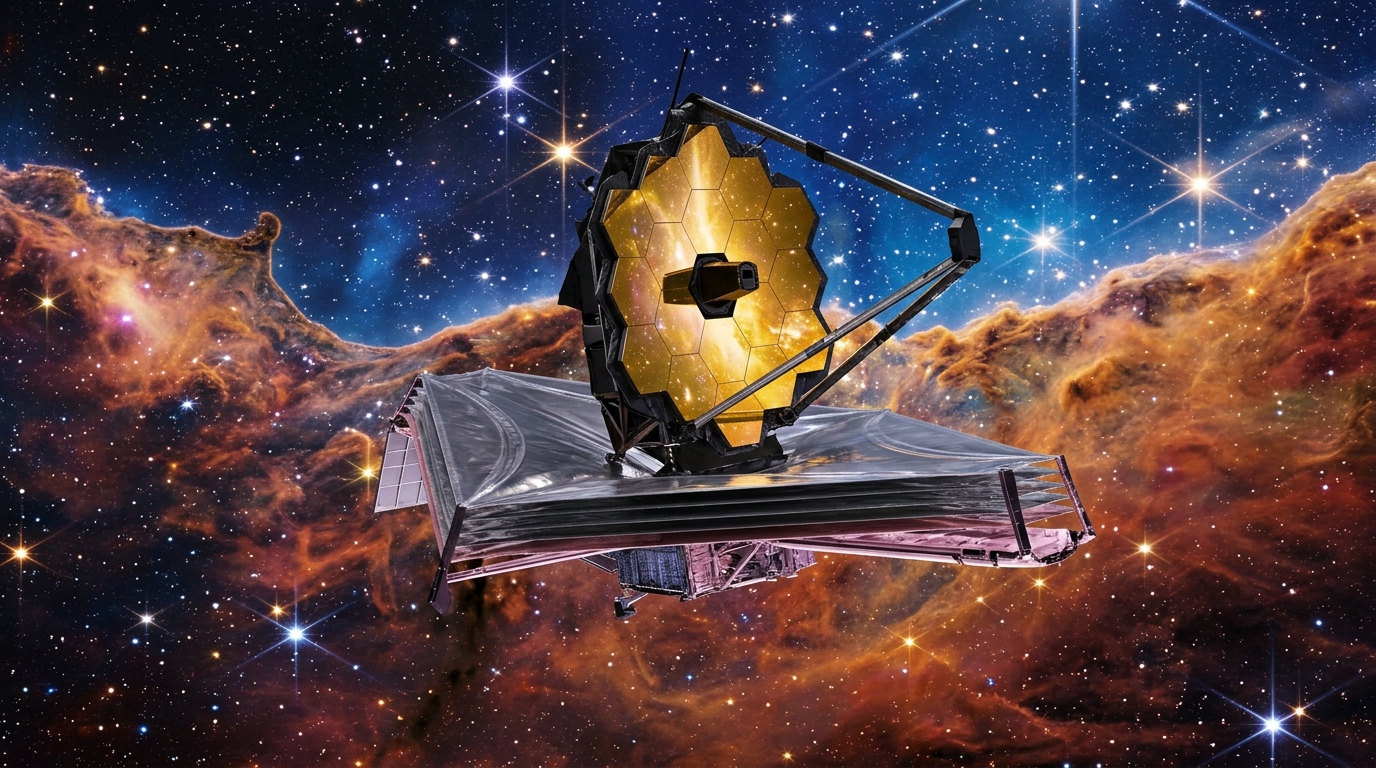
When the James Webb Space Telescope (JWST) was launched on Christmas Day in 2021 and reached its permanent vantage point at the Sun-Earth Lagrange Point 2 (L2), astronomers expected remarkable imagery. However, nobody anticipated that this flagship observatory would fundamentally challenge established theories of cosmic dawn and galaxy evolution.
The Technological Wonder: Peering Into Infrared Light
Unlike the Hubble Space Telescope, which primarily observes in visible and ultraviolet light, JWST is an infrared powerhouse. Because the universe has been expanding for 13.8 billion years, light emitted by the very first stars and galaxies has experienced an extreme cosmological phenomenon known as redshift. The wavelengths of ancient visible light have stretched outward into the near-infrared and mid-infrared spectrums.
To capture this faint, long-wavelength glow without thermal interference from its own instruments, JWST features:
- A 6.5-meter Beryllium Primary Mirror: Composed of 18 hexagonal segments coated with microscopic layers of pure gold, maximizing infrared reflectivity.
- A Five-Layer Sunshield: Sized like a tennis court, this Kapton sunshield keeps scientific payloads cooled to an astonishing -233°C (-388°F).
- MIRI (Mid-Infrared Instrument) Cryocooler: Actively cools sensors down to less than 7 Kelvin (-266°C), allowing detection of cold cosmic dust and organic molecules.
The Cosmic Surprise: 'Too Big, Too Early' Galaxies
Within its first two years of operations, Webb discovered multiple candidates for the oldest galaxies ever observed, such as JADES-GS-z14-0, seen just 290 million years after the Big Bang. Under the conventional Lambda-CDM cosmological model, early galaxies were predicted to be tiny, fragile clumps of stars that gradually merged over billions of years.
Instead, JWST revealed luminous, massive, and structurally mature galaxies already shining intensely when the cosmos was merely 2% of its current age. These ancient galaxies harbored hundreds of millions of solar masses and contained heavy elements like carbon and oxygen, suggesting that early star formation occurred at an unprecedented, hyper-accelerated rate.
Investigating Exoplanet Atmospheres for Signs of Life
Beyond cosmology, JWST has revolutionized the search for biosignatures outside our solar system. Using transit transmission spectroscopy, Webb analyzes starlight filtering through the gaseous envelopes of alien worlds. Landmark discoveries include:
- Detecting clear signatures of carbon dioxide, water vapor, and sulfur dioxide on hot gas giants like WASP-39b.
- Investigating the rocky planets of the TRAPPIST-1 system to determine whether red dwarf flare radiation strips away habitable atmospheres.
- Identifying potential carbon-bearing molecules like methane and carbon dioxide on sub-Neptune exoplanet K2-18b, located within its star's habitable zone.
Competitive Exam & GK Takeaways
🎯 High-Yield Facts for UPSC, SSC & Defense Exams
- Orbit Location: Sun-Earth Lagrange Point 2 (L2), approximately 1.5 million kilometers away from Earth.
- Joint Collaboration: Developed by NASA (USA), ESA (European Space Agency), and CSA (Canadian Space Agency).
- Primary Mirror Diameter: 6.5 meters (Hubble was 2.4 meters), offering over 6.25 times greater light-collecting area.
- Cosmic Distance Record: Observed galaxy JADES-GS-z14-0 at redshift z ≈ 14.32, existing merely ~290 million years post Big Bang.
Conclusion
The James Webb Space Telescope is more than a space telescope; it is a time machine that allows humanity to look back over 13.5 billion years into our origins. As JWST continues its nominal 20-year mission, it continues to provide groundbreaking data that forces astrophysicists to rewrite textbooks on how the modern universe came to be.
Comments & Reviews
Tap stars to rate this page: