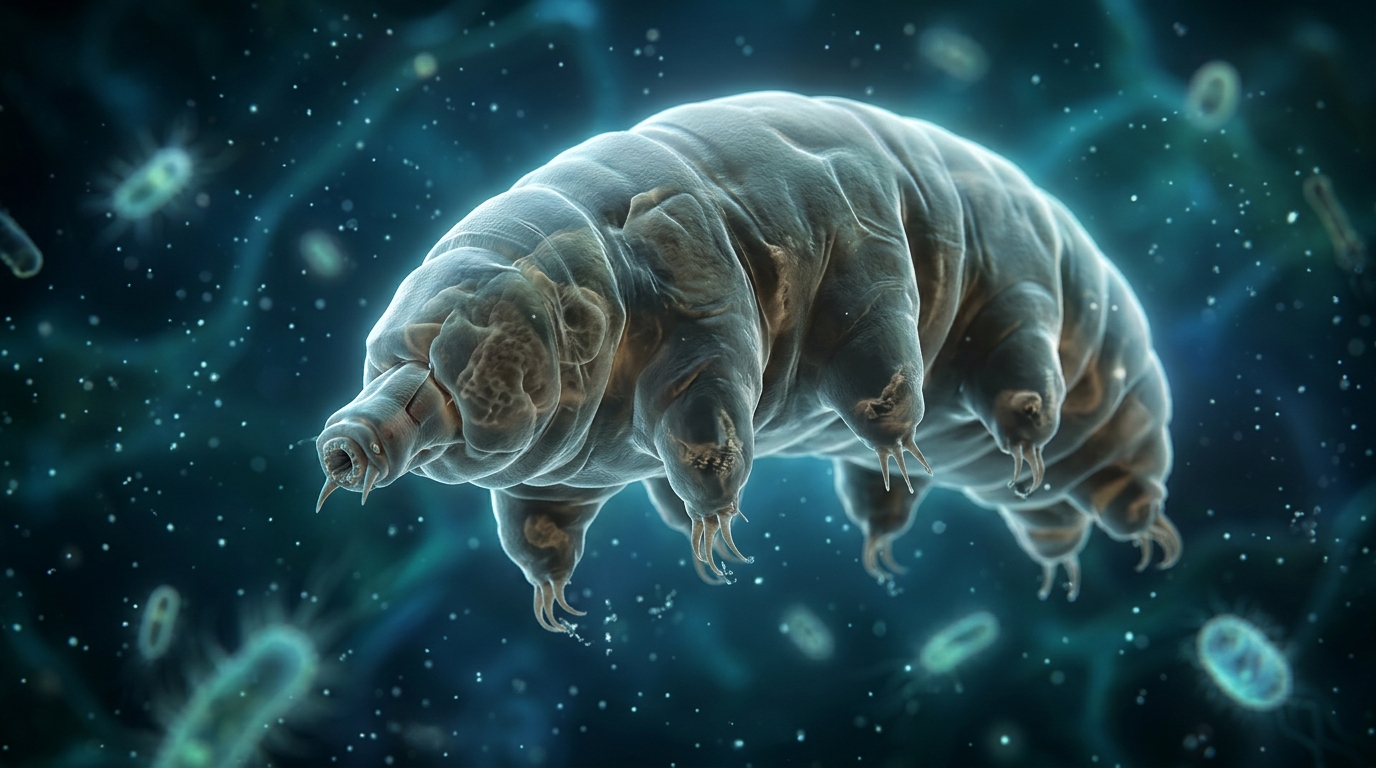
Measuring barely 0.5 to 1 millimeter in length, tardigrades—commonly referred to as 'water bears' or 'moss piglets'—are among the most ubiquitous yet extraordinary creatures on Earth. First described by German zoologist Johann August Ephraim Goeze in 1773, these eight-legged microscopic invertebrates inhabit nearly every ecological niche on our planet, from deep ocean trenches and frozen Antarctic glaciers to tropical rainforest mosses and volcanic mud.
The Secret of Immortality: Cryptobiosis
What makes tardigrades virtually indestructible is their evolutionary ability to enter a reversible state of suspended animation known as cryptobiosis. When environmental conditions become dangerously dry or hostile, tardigrades undergo a specific dehydration process called anhydrobiosis:
- They retract their eight legs, curl into a microscopic compact cylinder called a tun, and expel over 95% of the free water inside their bodies.
- Their metabolic activity drops to less than 0.01% of normal levels—virtually indistinguishable from death.
- Instead of cellular membranes collapsing into irreversible crystallization, tardigrades synthesize unique, disordered proteins known as TDPs (Tardigrade Disordered Proteins). These proteins vitrify, turning into a glass-like solid matrix that physically locks cells, DNA, and enzymes into suspended preservation.
In this 'tun' state, tardigrades can remain dormant without food, oxygen, or water for decades, only to awaken and reanimate within a couple of hours after a single drop of water touches them.
Withstanding Extremes That Would Vaporize Other Life
Laboratory and space experiments have subjected dormant tardigrades to environmental stresses far beyond any condition found on Earth's surface:
- Thermal Extremes: They survive temperatures as cold as -272°C (-458°F, less than one degree above absolute zero) and heat exceeding +150°C (+302°F), far above the boiling point of water.
- Hydrostatic Pressure: Tardigrades have survived crushing pressures up to 6,000 atmospheres (600 megapascals)—almost six times deeper than the pressure at the bottom of the Mariana Trench.
- Lethal Radiation: While a human body suffers fatal organ failure from a whole-body radiation dose of 5 Grays (Gy), tardigrades can withstand gamma radiation exceeding 5,000 to 6,000 Gy. They possess a unique protective protein named Dsup (Damage Suppressor) that physically binds to their chromatin and shields double-stranded DNA from oxidative and ionizing breakage.
Tardigrades in the Vacuum of Outer Space (FOTON-M3 Mission)
In September 2007, the European Space Agency (ESA) launched the TARDIS (Tardigrades in Space) project aboard the Russian FOTON-M3 satellite. Desiccated tardigrades (specifically Richtersius coronifer and Milnesium tardigradum) were directly exposed to the open vacuum of space, solar cosmic radiation, and intense ultraviolet rays in low Earth orbit for 10 consecutive days.
Upon returning to Earth and being rehydrated, a substantial percentage of the specimens revived, moved, fed, and successfully reproduced viable offspring. This marked the very first time an animal species had survived direct, unshielded exposure to the harsh vacuum and cosmic environment of outer space.
Competitive Exam & GK Takeaways
🎯 High-Yield Facts for UPSC, SSC & Defense Exams
- Phylum: Tardigrada (closely related to Arthropoda and Nematoda in the Ecdysozoa superphylum).
- Survival State: Cryptobiosis (anhydrobiosis, cryobiosis, and osmobiosis).
- Radiation Defense Molecule: Dsup (Damage Suppressor Protein), actively studied for protecting human cells during space travel and cancer radiotherapy.
- Space Mission: ESA's 2007 TARDIS experiment aboard the FOTON-M3 spacecraft proved animals can survive the open vacuum of space.
Medical and Technological Applications
Understanding tardigrade genetics holds enormous potential for human medicine. Scientists are currently researching tardigrade proteins to develop non-refrigerated vaccine stabilization technologies, protect agricultural crops from severe droughts, and design cellular radiation shields for long-duration human space exploration to Mars and beyond.

Comments & Reviews
Tap stars to rate this page: